

Scabies UK infections are rising sharply across England, with doctors warning that the highly contagious skin condition has reached worrying new levels and is now appearing in clinics on a near-daily basis. Health professionals say the outbreak is placing growing pressure on GP services, with many patients struggling to access timely treatment as case numbers continue to climb.
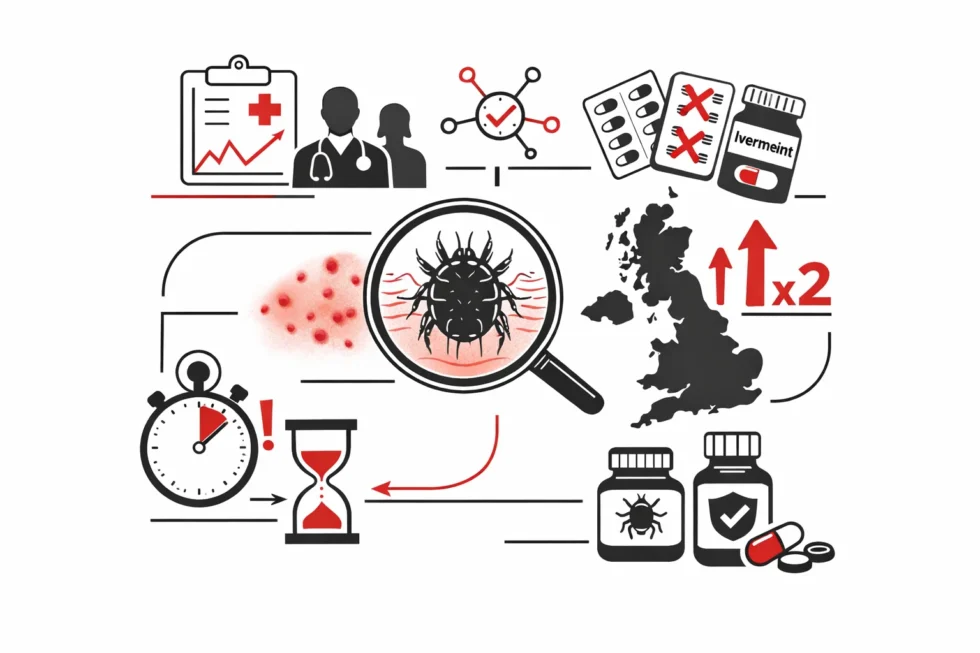
New figures from the Royal College of General Practitioners’ Research and Surveillance Centre confirm that consultations for scabies are currently running at double the five-year national average, a trend that has persisted for several months. The increase is particularly severe in northern England, where regional infection rates are significantly higher than elsewhere in the country. These findings, based on weekly GP surveillance data, were first highlighted in national reporting by The Guardian and analysed by medical correspondents across the UK press.
In just one recent week, doctors recorded close to 900 confirmed scabies cases nationwide – around 20 per cent more than during the same period last year. Medical experts warn that the true scale of the problem is likely to be considerably greater, as many sufferers seek over-the-counter remedies from pharmacies and never appear in official GP statistics.
The UK Health Security Agency (UKHSA) has also highlighted a sharp rise in diagnoses within sexual health services, reporting a 44 per cent jump in scabies cases between 2023 and 2024, with confirmed infections increasing from 3,393 to 4,872. Clinicians say this surge reflects wider community transmission rather than any change in sexual behaviour patterns. As The WP Times reports, citing The Guardian, doctors believe a combination of medication shortages, delayed NHS appointments and incomplete household treatment programmes has allowed the infection to spread more easily than in previous years.

Consultant physicians are now openly describing the situation as relentless. Dr Lewis Haddow, consultant in HIV and sexual health at Kingston Hospital NHS Foundation Trust, told The Guardian:
“I’m seeing scabies all the time.”
He added that the condition often falls between different parts of the healthcare system, making coordinated treatment more difficult: “Nobody really owns it.”
Frontline warnings from clinicians
Frontline clinicians say the current rise in scabies UK cases has become impossible to ignore, with hospitals and GP practices reporting a steady stream of new patients every week.
Scabies spreads primarily through prolonged skin-to-skin contact, meaning that entire families or households can quickly become infected together. The mites that cause the disease burrow into the outer layer of skin to reproduce, and without effective treatment the infestation can continue for months – or even years. Although scabies is not officially classified as a sexually transmitted infection, it is commonly passed between intimate partners. Outbreaks are also frequently reported in communal living environments such as university halls of residence, care homes, hostels and shared housing.
What is scabies and how does it spread
Scabies is caused by the microscopic mite Sarcoptes scabiei var hominis. The parasite burrows under human skin, lays eggs and triggers an intense allergic reaction that leads to severe itching and rashes.
Key medical facts about scabies:
- Mites can survive up to 36 hours outside the human body
- Symptoms usually appear three to six weeks after first infection
- People previously infected may develop symptoms within days
- Itching is typically worse at night
- Rash most often appears in skin folds – fingers, wrists, elbows, waist and genitals
Diagnosis can be difficult because early signs often resemble eczema, dermatitis or allergic reactions. As a result, many patients are initially misdiagnosed and only receive appropriate treatment weeks later.
Why are scabies UK cases rising
Public health specialists say there is no single cause behind the current surge. Instead, several overlapping factors appear to be driving the increase.

Experts point to:
- Shortages of key treatments such as permethrin and malathion during 2023–24
- Delays in NHS appointments, making rapid diagnosis harder
- Increased social mixing following the end of pandemic restrictions
- Outbreaks in crowded or shared living settings
- Incomplete treatment of household contacts, allowing reinfection
Professor Michael Marks from the London School of Hygiene & Tropical Medicine said the problem is not limited to Britain: “Similar trends are being seen across Europe.”
He added that outbreaks are likely linked to: “delays in people being able to access care, and inadequate tracing and treatment of their contacts.”
According to Marks, these delays mean that many patients remain infectious for longer than they should, unintentionally spreading the mites to family members, partners and colleagues before effective treatment begins.
Treatment failures and reinfection
Doctors warn that scabies is particularly difficult to eliminate because successful treatment requires careful coordination. Every person living in the same household must be treated at exactly the same time, even if they show no symptoms. If just one contact is missed, the mites can rapidly spread again, creating a cycle of reinfection that may last for months. Health professionals say this is one of the main reasons why many patients report repeated outbreaks despite following medical advice.
Pharmacists also report high demand for over-the-counter scabies creams, but incorrect or incomplete application can reduce their effectiveness.
Pressure on the NHS
Clinicians say the rise in scabies UK cases is adding further strain to already stretched GP services. Many surgeries are facing long waiting lists, while pharmacies are often left to manage large numbers of anxious patients seeking urgent help. Some doctors have warned that scabies is increasingly becoming a “hidden epidemic” because cases treated outside the NHS are not captured in official figures.
TABLE: Key Statistics – Scabies UK (latest available data)
| Indicator | Figure |
|---|---|
| GP consultations vs 5-year average | 2x higher |
| Weekly GP cases recorded | ≈900 |
| Year-on-year weekly increase | +20% |
| Rise in sexual health clinic diagnoses (2023–2024) | +44% |
| Diagnoses in clinics 2024 | 4,872 |
| Diagnoses in clinics 2023 | 3,393 |
| Highest affected age group | 20–24 years (41%) |
| Survival time of mites off body | Up to 36 hours |
How scabies is treated in the UK
The standard treatment for scabies UK infections has remained largely unchanged for decades. Most patients are prescribed permethrin 5% cream, a topical insecticide that must be applied carefully across the entire body, left on for 8 to 12 hours, and then repeated one week later to kill any newly hatched mites. Health professionals stress one crucial rule: everyone living in the same household must be treated at exactly the same time – even those showing no symptoms. Without this coordinated approach, reinfection is highly likely. Despite the availability of effective medicines, doctors say treatment frequently fails in real-life situations. Common reasons include:
- the cream not being applied thoroughly to every part of the body
- close contacts not being treated simultaneously
- bedding, towels and clothing not being washed correctly
- patients stopping treatment too early once itching eases
To reduce the risk of the mites surviving in the home, the NHS advises washing all bedding and clothing at 60°C or higher, tumble-drying items where possible, and sealing non-washable belongings in bags for at least three days.
Growing concerns over resistance
Alongside practical difficulties, clinicians are increasingly worried about the possibility that scabies mites are becoming less responsive to traditional medications. A 2024 review published in the Journal of Clinical Medicine warned: “Permethrin-resistant scabies is an escalating threat.”
While many experts believe that most treatment failures are still caused by incorrect application rather than true drug resistance, reports of persistent infections have prompted renewed interest in alternative therapies. In response, the NHS approved ivermectin, an oral anti-parasitic tablet, as a second-line option in 2023. The medication can be easier to administer than creams and may be recommended for severe or recurrent cases. However, specialists note that ivermectin is more expensive and not automatically more effective.
Where to get help – official contacts for scabies UK
If you suspect scabies, act quickly to stop the infection spreading. Help is available the same day through NHS services:
- NHS 111 (England): Call 111 or visit 111.nhs.uk for free 24/7 medical advice and urgent referrals.
- Your local GP: Request a same-day appointment for suspected scabies. Many surgeries offer online booking via the NHS App.
- Community pharmacies: Most UK pharmacies can provide scabies treatment without a prescription and advise on correct application and household hygiene.
- Sexual health clinics: Adults can seek rapid assessment at local clinics – find services at nhs.uk/service-search/sexual-health.
Return to work or school: People can usually resume normal activities once treatment has started, provided all close contacts are treated at the same time.
Seek urgent medical advice if:
- symptoms do not improve after two treatment cycles
- the rash becomes painful, swollen or infected
- itching is severe and prevents sleep
- a baby, elderly person or immunocompromised individual is affected
Early diagnosis and coordinated household treatment are the most effective ways to control the current scabies UK outbreak.
Read about the life of Westminster and Pimlico district, London and the world. 24/7 news with fresh and useful updates on culture, business, technology and city life: Why did the US suspend the Diversity Visa green card programme after the Brown University shooting
Sources: The Guardian, Royal College of General Practitioners Research and Surveillance Centre, UK Health Security Agency, NHS England, Journal of Clinical Medicine, Kingston Hospital NHS Foundation Trust, London School of Hygiene & Tropical Medicine