
Self assessment tax return is now one of the most financially dangerous obligations in the UK calendar, affecting more than 12 million taxpayers and over 4.3 million self-employed people ahead of the 31 January 2026 deadline. Each year HMRC issues hundreds of thousands of late-filing penalties, with automated systems generating £100 fines within seconds of midnight for anyone who misses the cut-off. The deadline is not just a date — it is the moment when HMRC legally converts estimated tax into enforceable debt, activating interest, penalties and recovery powers. This risk now extends far beyond freelancers to London landlords, Airbnb hosts, professionals with side income, crypto investors and families hit by the High Income Child Benefit Charge, many of whom do not realise they must file until a penalty arrives. As The WP Times reports, citing the UK Government tax portal, HMRC’s fully digital compliance engine now cross-checks bank data, platforms and income streams to detect missing returns, mismatched earnings and undeclared income without human review.
Who actually falls inside the self assessment net
Most people still think self assessment means “running a business”. That belief is now one of the most expensive mistakes in the UK tax system. HMRC does not care whether you see yourself as a business owner. The legal test is far simpler and far broader: did any money reach you that was not taxed through PAYE? If the answer is yes, a self assessment tax return is required — even if the amount was small, irregular or came from something you see as a hobby.
HMRC treats every non-PAYE pound as potentially taxable income until you prove otherwise. That includes one-off sales, online platforms, digital assets and family benefits. This is why people who think “it was just a bit extra” are now receiving compliance letters.
You fall inside the self assessment net if you had:
- Rental income, even from a single room, Airbnb or short-term let
- Online sales, including clothes, electronics or handmade items sold on platforms such as Vinted, eBay, Etsy or Amazon
- Crypto activity, including selling, swapping, staking rewards or converting crypto into pounds
- Dividends or investment income, even from small shareholdings
- Foreign income, whether salary, rent or interest from abroad
- Child Benefit where either partner earns more than £50,000 and the High Income Child Benefit Charge applies
What catches many people out is that HMRC now receives data directly from these platforms. Airbnb reports hosts. Marketplaces report sellers. Crypto exchanges report transactions. The tax authority does not wait for you to volunteer the information.
In London and the South East this creates a powerful compliance trap. Two professionals on £60,000 salaries who claim Child Benefit, rent out a spare room for part of the year, and sell a few items online already meet the legal definition of a self assessment household. They may feel like ordinary PAYE employees, but HMRC classifies them as multi-income taxpayers — and that classification brings filing obligations, penalties and audit risk if ignored. This is why self assessment has quietly become a middle-class tax system, not just a freelancer’s one.
What the 31 January 2026 deadline really does
Before 31 January 2026, your tax position exists in HMRC’s system as a calculation. After midnight, it becomes a debt that HMRC can legally enforce. This distinction is critical. Up to the deadline, HMRC is waiting for information. After the deadline, it is allowed to collect money.
That single moment switches on three separate financial mechanisms:
- Statutory late-filing penalties, starting automatically at £100
- Daily interest charges on any unpaid tax
- HMRC’s debt-collection powers, including letters, enforcement action and in extreme cases the use of debt collectors or court orders
What most taxpayers do not realise is that HMRC does not need to “review” your case before this happens. The system is designed to apply these measures automatically, based purely on the clock and the data on your account.
This is why the deadline matters more than any other date in the UK tax year. Crossing 31 January moves you from being a taxpayer who has not finished their paperwork into a debtor in HMRC’s legal systems. From that point on, every week of delay increases the cost of compliance, even if the underlying tax bill does not change.
How HMRC penalties destroy your cash flow
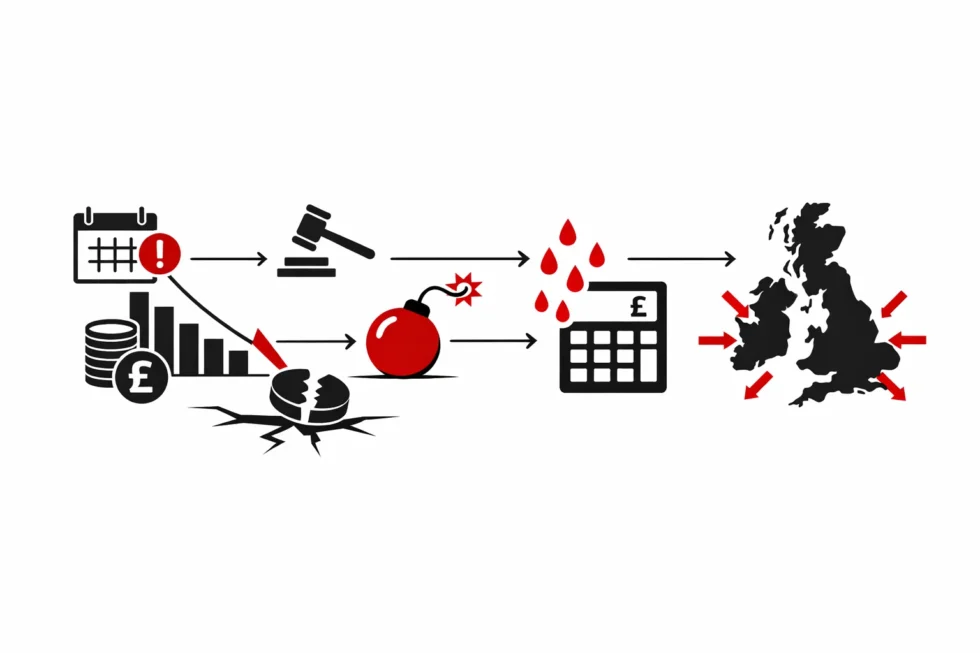
HMRC’s penalty framework is engineered to escalate exposure, not merely to signal non-compliance. Once the filing deadline passes, your tax position is reclassified as overdue debt, and a sequence of statutory charges is triggered automatically.
| Delay after 31 January | Statutory charge |
|---|---|
| 1 day | £100 fixed penalty |
| After 3 months | £10 per day, capped at £900 |
| After 6 months | 5% of tax outstanding or £300 (whichever is higher) |
| After 12 months | A further 5% or £300 |
These charges accumulate. They are applied on top of each other, not in place of one another. For a taxpayer owing £10,000, a twelve-month delay produces a minimum of £1,000 in statutory penalties, before interest is added. HMRC then applies interest to both the principal and the penalties, meaning the liability increases even in the absence of further non-compliance.
From a financial perspective, late filing converts a tax obligation into a compounding liability with characteristics similar to high-cost credit. This is why taxpayers who defer action frequently find themselves in persistent tax-debt positions rather than temporary arrears.
Why HMRC now knows what you earned
HMRC no longer relies on voluntary disclosure. The UK tax authority now operates one of the most comprehensive financial data-matching systems in Europe. It receives structured, automated feeds from:
- UK banks and building societies (interest, balances, transaction summaries)
- Short-term rental platforms such as Airbnb and Booking.com
- Online marketplaces including eBay, Etsy, Amazon and resale apps
- Payment processors and digital wallets
- Crypto exchanges and custodians
- Employers, pension providers and investment platforms
This data is processed through HMRC’s Connect analytics platform, which compares declared income against third-party records. When your self assessment tax return does not align with what these institutions have reported, the discrepancy is flagged automatically.
There is no human judgement at this stage. The system scores risk, identifies undeclared income and prioritises cases for compliance action. From HMRC’s perspective, missing or inconsistent figures are not treated as errors — they are treated as indicators of tax loss.
This is why failing to declare “small” streams of income is now one of the most common triggers for penalties and investigations. The data already exists. The return is simply where HMRC checks whether you told the same story.
What happens if you get it wrong
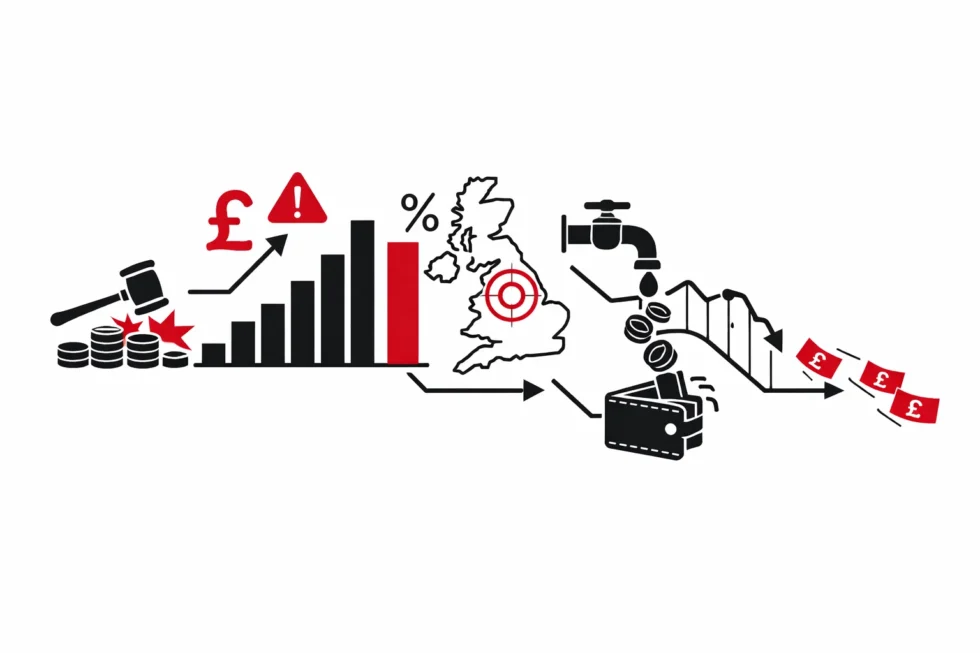
HMRC distinguishes between voluntary correction and detected non-compliance — and the financial difference is substantial. If you discover an error in your self assessment tax return and amend it within 12 months of the 31 January deadline, HMRC recalculates the tax and issues either a refund or an additional bill, but no penalty is charged for an honest mistake.
If, however, HMRC’s data systems identify the error first, the situation changes. At that point, HMRC assumes that the inaccuracy represents undeclared tax and applies penalties of up to 30% of the extra tax owed, in addition to interest. The same figures can therefore produce very different outcomes depending on who finds the mistake first.
In practical terms, checking and correcting your return protects you from turning a tax bill into a compliance penalty.
Why January scams explode
The tax deadline creates a perfect environment for fraud. In January, millions of people are waiting for HMRC messages about refunds, penalties or account status. Criminals exploit this by sending emails and texts that copy GOV.UK branding and HMRC language.
These scams typically claim:
- you are due a tax refund
- your account is under review
- immediate action is required
HMRC does not send clickable links asking for bank details, passwords or card numbers. Any message that does so is fraudulent. Clicking once can compromise your Government Gateway account and allow criminals to redirect refunds or file returns in your name.
Why London families are now the biggest losers
London has the highest concentration in the UK of people with multiple income streams. This includes contractors with PAYE jobs, households renting out spare rooms, professionals with side businesses, and parents affected by the High Income Child Benefit Charge.
These households are far more likely to cross HMRC’s filing threshold than single-income families elsewhere in the UK. Yet many of them still believe they are “just employees”. That mismatch between reality and perception makes London the UK’s largest self-assessment risk zone.
The most important rule in UK tax compliance is simple: filing and paying are two different obligations. Submitting your self assessment tax return before 31 January protects you from late-filing penalties, even if you cannot afford to pay the full amount. Once the return is filed, HMRC allows payment plans, time-to-pay arrangements and staged settlements. Missing the filing deadline removes those options and converts your tax into escalating debt. From a financial standpoint, filing on time is the single most effective way to limit your exposure — even in a difficult year.
Read about the life of Westminster and Pimlico district, London and the world. 24/7 news with fresh and useful updates on culture, business, technology and city life: Why US inflation data, Micron’s outlook and the Bank of England are reshaping global markets