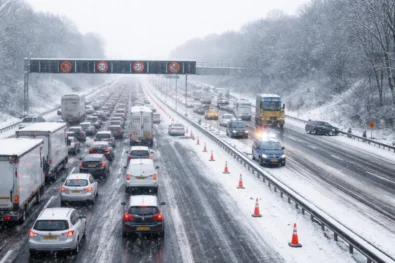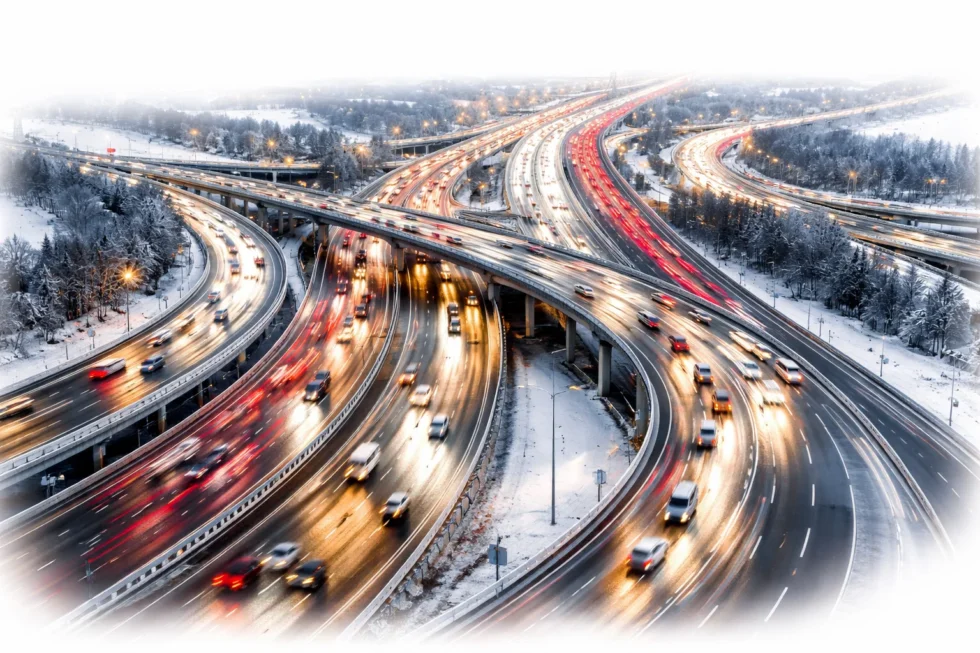
Severe winter conditions continued to disrupt travel across the United Kingdom on Tuesday, 6 January 2026, as sub-zero temperatures, snow showers and widespread black ice left large parts of the road network struggling to cope with peak-hour demand. Scotland’s Central Belt — including the M8, M80, M74, M77 and the A720 Edinburgh City Bypass — emerged as the main pressure point, while major English corridors such as the M62, A1(M) and M1 also saw slower traffic, reduced grip and growing delays. The WP Times reports this, citing police travel advisories, Met Office winter warnings and live data from national highways agencies.
Although heavier snowfall eased in some areas, overnight refreezing rendered previously treated carriageways dangerously slick, triggering a second consecutive day of disruption for commuters, logistics operators and long-distance motorists across Britain.
Scotland: Central Belt motorways under sustained pressure
Scotland’s transport heartland remained at the centre of the winter disruption on 6 January, with the country’s busiest motorway corridors between Glasgow and Edinburgh struggling to cope with icy conditions and heavy traffic volumes. The combination of high commuter flows, freight traffic and freezing road surfaces left key routes across the Central Belt operating well below normal capacity throughout the day.
M8 (Glasgow – Edinburgh)
Scotland’s busiest motorway saw extended stretches of stop-start traffic between Kingston Bridge (J19), Baillieston (J8) and Livingston (J3). Ice formed quickly on bridges, flyovers and open carriageways, leaving vehicles struggling for grip on slip roads and forcing speeds well below normal.
M80 (Glasgow – Stirling)
Between Stepps (J2) and Denny (J6), icy surfaces and exposed overpasses caused repeated slowdowns. Heavy goods vehicles were particularly affected when climbing gradients, creating rolling queues behind them.
M74 and M73 (south of Glasgow)
Congestion built around Maryville (M74 J4) and the M73 interchange, where compacted snow and black ice made braking distances unpredictable and acceleration difficult.
M77 (Glasgow – Ayrshire)
Elevated sections between J2 and J5 remained treacherous, with surface ice reducing speeds on routes towards Kilmarnock and the Ayrshire coast.
M9 and A720 (Edinburgh)
The M9 at Newbridge (J1) and the A720 Edinburgh City Bypass experienced heavy congestion near Lasswade, Gilmerton and Lothianburn, as untreated feeder roads funnelled traffic onto already slippery main lanes.
Beyond the Central Belt, Highland, Aberdeenshire and Angus continued to face drifting snow and fresh accumulation on higher ground, leaving rural A-roads difficult and vulnerable to temporary closures if conditions deteriorated further.
England: ice slows key strategic routes
M62 (Pennines)
Cross-Pennine journeys between Lancashire and West Yorkshire were slow and unreliable, particularly over higher ground, where sleet and frost quickly turned into black ice.
A1(M) (North Yorkshire and County Durham)
Icy stretches forced drivers to reduce speed, especially early in the morning and after dusk, when longer braking distances became essential.
M1 (Midlands and North)
On exposed sections and gradients, HGVs were forced to slow, creating rolling congestion through Derbyshire and South Yorkshire.
Wales and the South: frost and localised disruption
In Wales, upland routes including the A470 and A40 remained prone to frost, while the M4 corridor stayed open but slick, producing longer journey times. In London and the South East, light snow showers and overnight frost disrupted the A2, A4 and A40, particularly on bridges, flyovers and open sections that freeze first.
Diversions and alternative routes
With road conditions varying sharply by altitude and treatment priority, drivers were advised to remain on main gritted routes wherever possible and only divert when live updates confirmed safe alternatives.
Scotland
- M8 delays: the A8 can provide a local alternative between Glasgow and Edinburgh if confirmed treated.
- M80 problems: A803 and A9 via Kilsyth and Denny may offer relief, though they are more exposed to ice.
- M77 disruption: A726 or A737 towards Ayrshire can be used, but secondary roads may be untreated.
Northern England
- M62 unreliable: longer-distance traffic may find more consistent conditions via the M1 and A1(M), which receive priority winter treatment.
Wales and the South
- M4 slow: some local journeys can divert via A48 or A449, though these too can ice over in freezing weather.
Why these routes were already vulnerable before the snow
Many of the roads hit hardest on 6 January were already operating close to their limits even before winter weather arrived. The M8 between Glasgow and Livingston, the M74 south of Glasgow around Maryville, and the M80 corridor from Stepps towards Stirling are some of the busiest commuter and freight routes in Scotland, carrying tens of thousands of vehicles a day between the Central Belt, the Midlands of Scotland and the North of England.
These sections also include major junctions, slip roads and long-running maintenance areas, where traffic is routinely funnelled into fewer lanes. Under normal conditions this already causes regular queues at peak hours. When black ice forms on bridges, flyovers and uphill slip roads, even a single stranded car or lorry can block a lane and trigger long tailbacks in both directions.
The same pattern applies on the M77 towards Ayrshire and on the A720 Edinburgh City Bypass, where heavy commuter flows meet tight junction spacing and elevated carriageways. Once grip levels drop, traffic cannot clear quickly enough, which is why these routes repeatedly become the first to fail when temperatures fall below zero.
What drivers were told on 6 January
Authorities across the UK repeated three clear messages:
- Avoid non-essential travel while snow and ice warnings remain in force.
- Allow significantly longer journey times and reduce speed, even on main roads.
- Check live traffic and weather updates before setting out, as conditions can change rapidly, particularly after dusk when refreezing accelerates.
With temperatures forecast to remain low, further refreezing and disruption were expected into the evening and overnight. Read about the life of Westminster and Pimlico district, London and the world. 24/7 news with fresh and useful updates on culture, business, technology and city life: 6 January 2026: London City Airport ends free drop-offs as £8 kerbside charge begins