
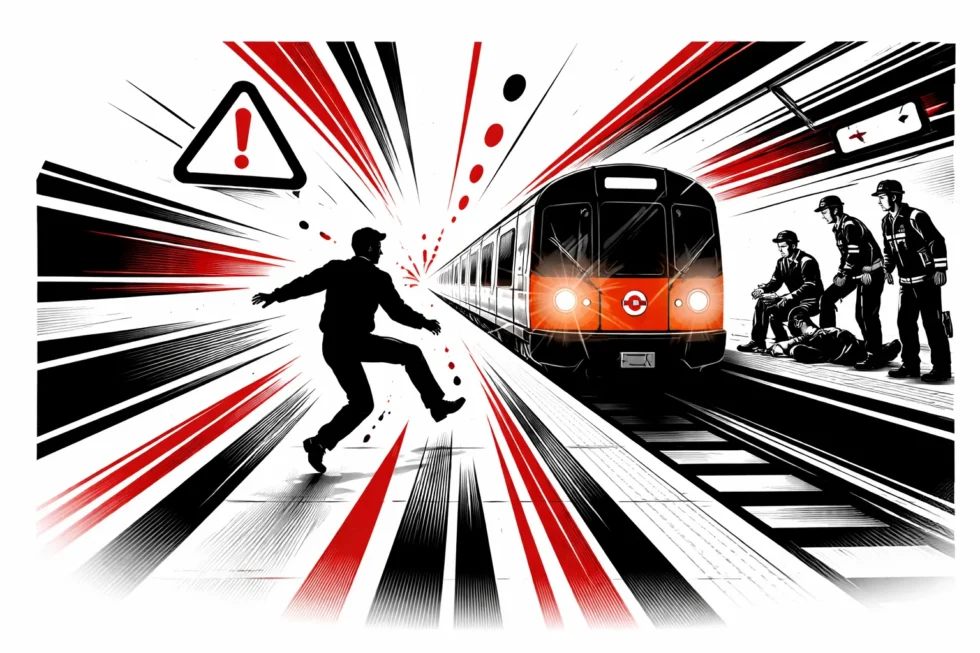
Stratford station safety, London Underground platform safety and Jubilee line operations are under intense scrutiny after a coroner’s inquest revealed how a 72-year-old passenger was struck seven times by four separate trains before services were finally stopped at one of London’s busiest Underground interchanges.
Brian Mitchell, 72, died on 26 December 2023 after falling onto the tracks at Stratford station, a major east London terminus on the Jubilee line. The jury ruled that his death was accidental. However, evidence heard in court exposed a sequence of operational, structural and systemic failures that allowed a life-threatening situation to escalate over an extended period, raising broader questions about emergency response, automation and platform design across the London Underground network. This is reported by The WP Times editorial desk, citing the coroner’s inquest findings.
Platform 13: a failure measured in minutes, not seconds
CCTV footage and witness testimony showed that Mr Mitchell had been on platform 13 for almost an hour before the incident. Shortly before 14:45, he stood, stumbled forward and fell from the platform edge onto the track. Once there, he was unable to climb back up or reach a place of safety.
Stratford operates as a terminus station, where trains regularly arrive, stop, and then depart back along the same line. Over the next half hour, this operational pattern meant repeated train movements across the same section of track. During that time, four Jubilee line trains entered and exited the platform, striking Mr Mitchell seven times before an emergency stop was fully implemented.
Why trains were not stopped earlier
The inquest and the findings of the Rail Accident Investigation Branch made clear that the failure was not the result of a single error. Instead, several factors aligned:
- Automatic train operation reduced the level of continuous manual engagement required from drivers, increasing the risk of “operator underload” in rare emergencies.
- Limited sightlines on the curved platform restricted clear visibility of the track area.
- One operator mistook what was seen on the track for an inanimate object.
- A later operator recognised a body but was described as being in shock and did not immediately activate the emergency brake.
At the same time, platform staff did not have a direct, instantaneous mechanism to halt all approaching trains once the danger became apparent. Medical evidence confirmed that Mr Mitchell died from blunt-force trauma to the head and chest.
Coroner’s warning: risk remains
Graeme Irvine, Senior Coroner for East London, told the court that he will issue a formal prevention of future deaths report to Transport for London, citing continuing safety concerns at Stratford station. He said that “not a huge amount has changed” on platform 13 since the incident, and warned that without targeted and demonstrable action, the conditions that led to the fatality could allow a similar tragedy to occur again.
The coroner’s intervention marks a deliberate shift away from examining individual decisions towards a broader assessment of system resilience and design. It questions whether existing safety layers on the London Underground are sufficiently robust for high-frequency terminus platforms, where automation, constrained sightlines and repeated train movements reduce tolerance for delayed detection and operational hesitation.
What the case reveals about London Underground safety
Stratford is not a marginal station. It is a critical interchange linking Underground, Overground, DLR and national rail services, used daily by tens of thousands of passengers. The fact that a person could remain on the track long enough to be struck repeatedly has unsettled transport safety experts.
The case highlights broader concerns about:
- reliance on human visual detection in rare emergencies
- gaps between automated operation and human override
- the absence of technology capable of detecting a person on the track and triggering an immediate response
The RAIB has already recommended that London Underground consider detection systems that can identify a person in a dangerous position and intervene before a train enters the platform.
Why this matters beyond Stratford
While incidents of this nature remain rare, the Stratford inquest has emerged as a reference point in the wider debate over whether London’s ageing transport infrastructure is adequately aligned with modern operating models, automation and sustained passenger density. The case illustrates how, in complex high-frequency systems, safety depends not on a single safeguard but on multiple layers activating immediately and in sequence.
Safety specialists warn that when those layers fail to engage without delay — whether due to design limitations, human factors or operational assumptions — risk can escalate rapidly, leaving little opportunity for corrective action. For passengers, the evidence heard in court has directly challenged the long-held assumption that visibility and intervention will always come in time, exposing the limits of reliance on informal human detection within automated networks.
Read about the life of Westminster and Pimlico district, London and the world. 24/7 news with fresh and useful updates on culture, business, technology and city life: Where can you experience a real tea ceremony in London’s Westminster & Pimlico