

Television licence rules in the UK are facing renewed political scrutiny after a growing public petition called on the Government to restore free TV licences for all state pensioners regardless of income. More than 13,000 people have already backed the proposal, which would remove the current Pension Credit requirement and automatically grant a free television licence to everyone who has reached state pension age. Supporters argue that the measure would help older households cope with continuing cost-of-living pressures, while critics warn that expanding eligibility could cost taxpayers hundreds of millions of pounds annually. The WP Times reports that the campaign is gaining momentum as debate over support for pensioners returns to the political agenda.
The proposal comes at a time when many pensioners continue to face higher household costs despite inflation easing from recent peaks. Television remains a key source of news, entertainment and social connection for millions of older Britons, particularly those who spend significant amounts of time at home. Campaigners argue that the annual television licence fee represents an increasing burden for retirees living on fixed incomes. They believe the current system excludes many pensioners who are not wealthy but fail to qualify for means-tested support. If the petition reaches 100,000 signatures, Parliament's Petitions Committee could consider the issue for debate.
Why campaigners want free television licences for all pensioners
Supporters of the petition argue that retirement itself should be enough to qualify for a free television licence. Under their proposal, every person who reaches state pension age would automatically receive a licence funded by the Government rather than paying the annual fee.
Campaigners say the existing system creates an unfair divide between pensioners who qualify for Pension Credit and those who sit just above eligibility thresholds. Many older people receive only slightly more income than the qualifying limit but still face rising costs for food, energy, housing and healthcare. According to supporters, television often serves as an essential service rather than a luxury for elderly households, providing access to news, public information and companionship.
The campaign highlights several objectives:
- Free television licences for all state pensioners
- Removal of Pension Credit eligibility requirements
- Automatic age-based entitlement
- Reduced administrative complexity
- Additional support during retirement
- Greater financial certainty for older households
Advocates also argue that many pensioners contributed taxes and National Insurance payments throughout their working lives and should receive broader support during retirement.
Who currently qualifies for a free television licence
Despite common assumptions, reaching retirement age does not automatically exempt someone from paying the television licence fee. The current system is based on both age and financial circumstances.
Under existing rules, a person must be aged 75 or older and receive Pension Credit before becoming eligible for a free television licence. Millions of pensioners therefore continue paying the standard annual charge even after retirement.
| Requirement | Current Rule |
|---|---|
| Minimum age | 75 years |
| Pension Credit required | Yes |
| Free licence cost | £0 |
| Standard licence fee | £180 annually |
| Black-and-white licence | £60.50 annually |
This means that someone aged 80 or even 90 may still have to pay the full licence fee if they do not receive Pension Credit. Critics argue that this creates a gap between retirement status and eligibility for support.
How the UK reached the current system
The debate surrounding free television licences is not new. For many years, households containing someone aged 75 or over automatically qualified for a free licence. That universal system became one of the most recognisable pensioner benefits in Britain. However, major changes followed when responsibility for funding the concession shifted away from direct government support. In 2020, the universal scheme ended and a means-tested model was introduced. Since then, only households containing a person aged 75 or over who claims Pension Credit have been entitled to a free licence.
The change generated significant political controversy at the time and remains one of the most debated pensioner policy decisions of recent years. Supporters of the old scheme argue that its removal disproportionately affected older people on modest incomes. Opponents argued that continuing universal eligibility would have imposed substantial financial costs.
The latest petition effectively seeks a return to an age-based system rather than the current means-tested approach.
Why Pension Credit has become so important
Pension Credit is now the main route to obtaining a free television licence. The benefit is designed to support pensioners on lower incomes and can significantly increase weekly household income for eligible claimants. Current guidance indicates guaranteed weekly income levels of approximately:
| Household Type | Weekly Income Level |
| Single pensioner | £238 |
| Pensioner couple | £363.25 |
| Additional support | Depends on circumstances |
Pension Credit can also unlock:
- Free television licence for eligible over-75s
- Council Tax support
- Housing-related assistance
- Help with energy costs
- Cold Weather Payments where applicable
- Additional pensioner benefits
Government figures have repeatedly suggested that large numbers of eligible households do not claim Pension Credit despite qualifying for it. As a result, some pensioners may be paying the full television licence fee unnecessarily.
Which pensioners remain excluded
One of the central criticisms of the current system is that many retired people remain outside the exemption despite living on relatively modest incomes.
The following groups generally continue paying the full television licence fee:
| Pensioner Type | Free Licence Available? |
| Age 66–74 | No |
| Age 75+ without Pension Credit | No |
| Age 75+ receiving Pension Credit | Yes |
| Working-age households | No |
| Mixed-age households | Depends on circumstances |
Campaigners argue that pensioners who narrowly miss Pension Credit thresholds often experience many of the same financial pressures as those who qualify. They believe the current approach creates unnecessary complexity and leaves vulnerable households without support.
What could happen if the petition succeeds
The immediate future of the proposal depends on public support. The petition must reach 100,000 signatures before Parliament's Petitions Committee can consider it for debate. Reaching that threshold does not automatically change the law, but it would force the issue onto the parliamentary agenda. Possible outcomes include:
| Scenario | Outcome |
| Petition remains below threshold | No parliamentary debate |
| 100,000 signatures reached | Debate may be considered |
| Government review | Policy assessment possible |
| No policy change | Current rules remain |
| Future reform | Eligibility expanded |
Even if MPs debate the issue, there is no guarantee that ministers would introduce a new scheme. Any expansion would require significant public funding and would likely become part of a broader discussion about pensioner support and BBC funding.
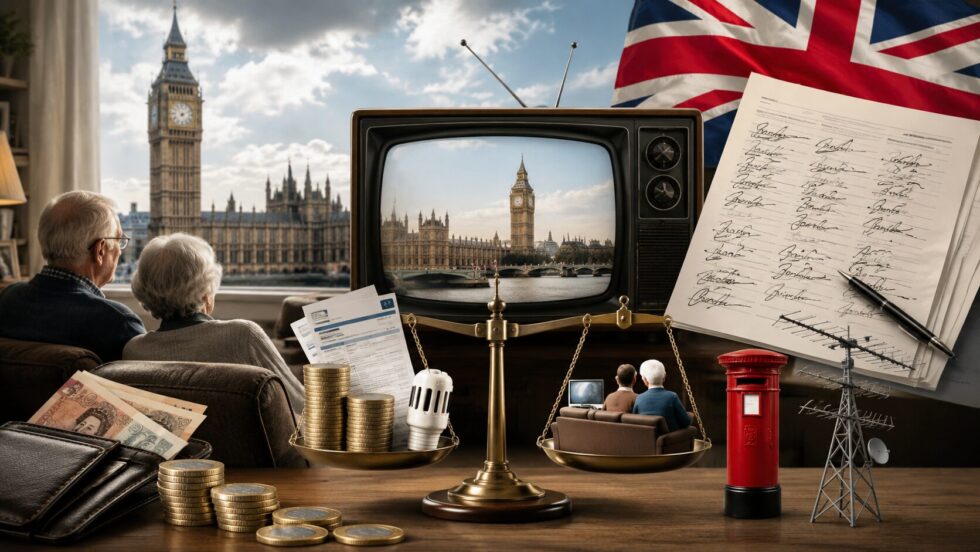
How much could a universal scheme cost
One of the biggest obstacles facing campaigners is cost. A universal age-based system would dramatically increase the number of eligible households. Millions of additional pensioners could become entitled to a free licence. Depending on final eligibility rules and future licence fee levels, the annual cost could run into hundreds of millions of pounds. Any government considering such a reform would need to determine whether the funding should come directly from taxpayers, from central government budgets, or through changes to broadcasting funding arrangements.
Supporters argue that the social benefits would justify the expense. Critics counter that limited public finances should be directed towards the poorest households rather than all retirees regardless of income.
For now, television licence rules remain unchanged. Pensioners aged 75 or over who receive Pension Credit can continue claiming a free licence, while all other households remain subject to standard licensing requirements.
Anyone who believes they may qualify for Pension Credit should check their eligibility as soon as possible. Beyond the television licence concession, the benefit can unlock thousands of pounds in additional support each year through related schemes and financial assistance programmes. The wider debate is likely to continue as campaigners seek additional signatures and politicians face growing pressure over support for older households. Whether free television licences eventually return for all pensioners remains uncertain, but the question of who should pay for television in retirement has once again become one of the most politically sensitive issues in British public policy.
Read about the life of Westminster and Pimlico district, London and the world. 24/7 news with fresh and useful updates on culture, business, technology and city life: UK Visa Changes 2026: What Foreign Workers Need To Know About New Salary Rules, English Tests And Settlement Delays