
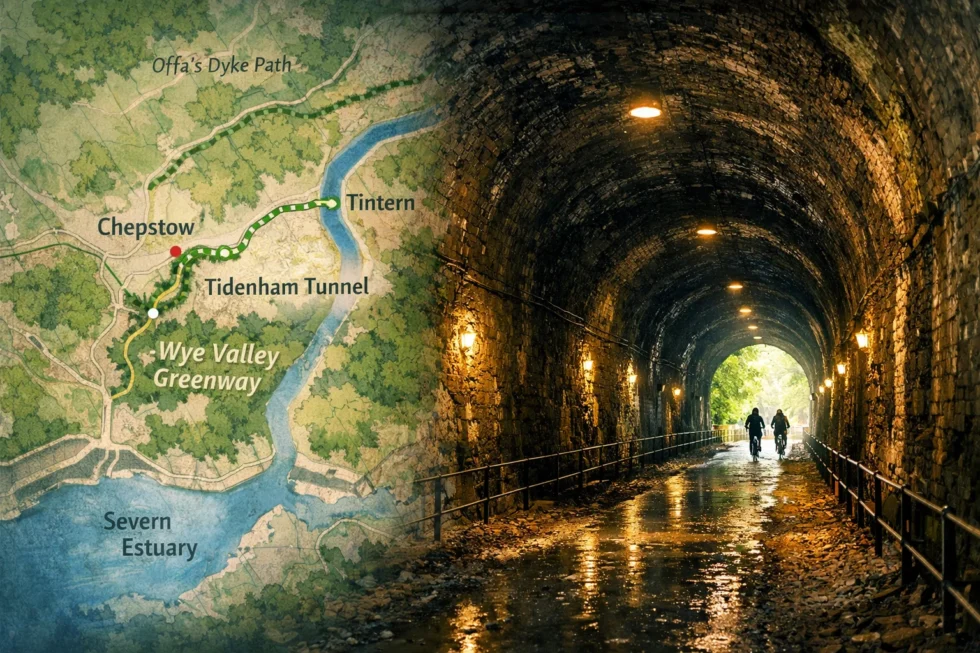
Tidenham Tunnel near Chepstow, approximately 140 miles (225 km) west of London, has reopened for the 2026 summer season, giving public access to one of the longest restored railway tunnels on the Wye Valley Greenway. The 1,080-metre structure, linking Tintern and Sedbury, is open daily until 20:00 and will remain accessible through to 1 October 2026, with free entry for walkers and cyclists using the route as a traffic-free corridor through the Wye Valley landscape, reported by The WP Times. .
The tunnel operates under strict seasonal conditions due to its status as a protected habitat for lesser horseshoe bats, with full closure during winter months when ecological sensitivity is highest. Access in 2026 is aligned with conservation regulations agreed with Natural England, limiting lighting, visitor behaviour and daily operating hours to prevent disturbance to wildlife. Despite its scale and accessibility, the site remains non-commercial, with no ticketing or infrastructure inside, functioning instead as a controlled passage within a wider greenway system. This dual role—heritage structure and protected ecological zone—defines both its growing public interest and its operational limits.
What is Tidenham Tunnel and why it matters in 2026 visitor planning
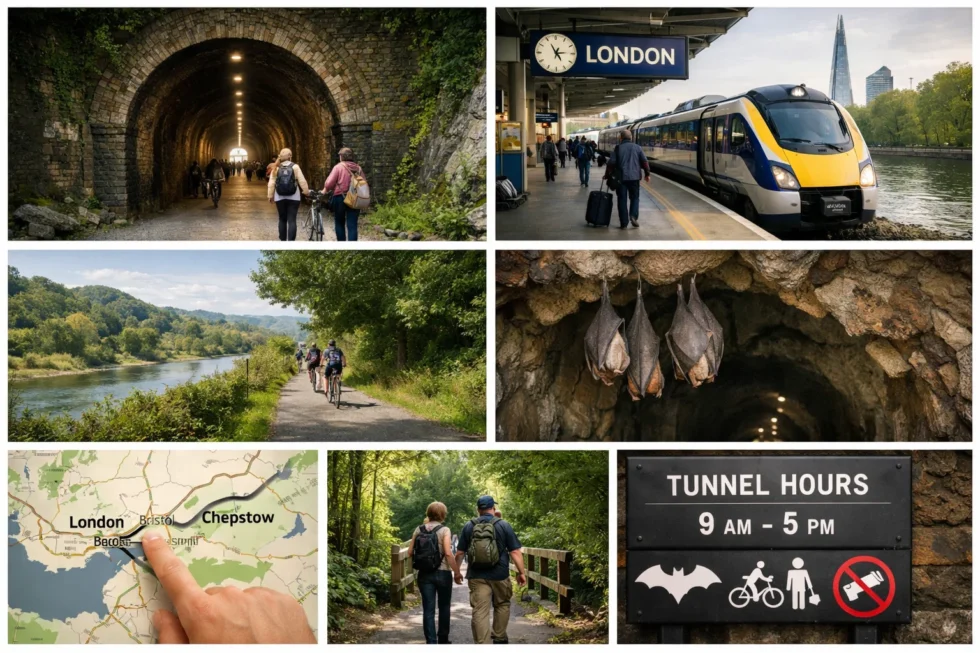
Tidenham Tunnel forms a core section of a five-mile traffic-free corridor along the Wye Valley Greenway, created from a disused railway line that originally opened in 1876 and was later abandoned in stages throughout the late 20th century. Its length of 1,080 metres places it among the longest publicly accessible tunnels of its kind in the UK, with a continuous enclosed passage that creates a distinct environmental transition for visitors. The tunnel is not simply a transport feature but a regulated conservation site, with approximately 26% of the UK’s lesser horseshoe bat population located in the surrounding region. This concentration gives the site national ecological significance and directly determines how public access is structured, timed and controlled. The restoration of the tunnel and wider greenway, completed in phases and reopened in 2021, reflects a broader shift in the UK towards repurposing industrial infrastructure for sustainable mobility and recreation. In 2026, the tunnel is positioned as a hybrid asset: part heritage corridor, part ecological zone, and part regional tourism route.
Key structural and ecological facts:
- Length: 1,080 metres continuous tunnel
- Location: between Tintern and Sedbury near Chepstow
- Route type: traffic-free walking and cycling path
- Ecological status: protected bat roost (lesser horseshoe bats)
- Railway origin: Wye Valley Railway, opened 1876
The tunnel’s importance is therefore defined not only by its physical scale but by its dual function, requiring ongoing coordination between conservation policy and public access management.
Opening times, access rules and operational limits for visitors in 2026
The tunnel reopened at the beginning of April 2026 and will remain accessible until 1 October 2026, aligning with the hibernation cycle of the bat population that inhabits the structure. Daily access is permitted until 20:00, after which entry is restricted to prevent disturbance during evening wildlife activity and to ensure visitor safety in low-visibility conditions. Entry remains free, but usage is limited strictly to pedestrians and cyclists, with no motorised vehicles allowed under any circumstances. Lighting conditions inside the tunnel are intentionally minimal and regulated to the maximum permitted threshold defined by Natural England, ensuring compliance with environmental protection requirements. The operational model is therefore not flexible; it is fixed around ecological constraints rather than visitor demand. This approach reflects a wider trend in UK heritage management where environmental considerations take precedence over commercial access.
Access rules and restrictions:
- No flash photography or artificial lighting devices
- No torches permitted inside the tunnel
- Visitors must keep to the left (shared-use path)
- No stopping or gathering in bat roost areas
- No attempts to locate or disturb wildlife
“Tidenham tunnel is an important local bat roost, so the tunnel lighting is the maximum permitted by Natural England in order not to disturb the bat population” (Wye Valley Greenway, official statement, 2026).
Following the rules is not optional; disturbance of bats or their habitat constitutes a criminal offence under UK law, reinforcing the controlled nature of the visitor experience.
How to get to Tidenham Tunnel from London: routes, timing and access points
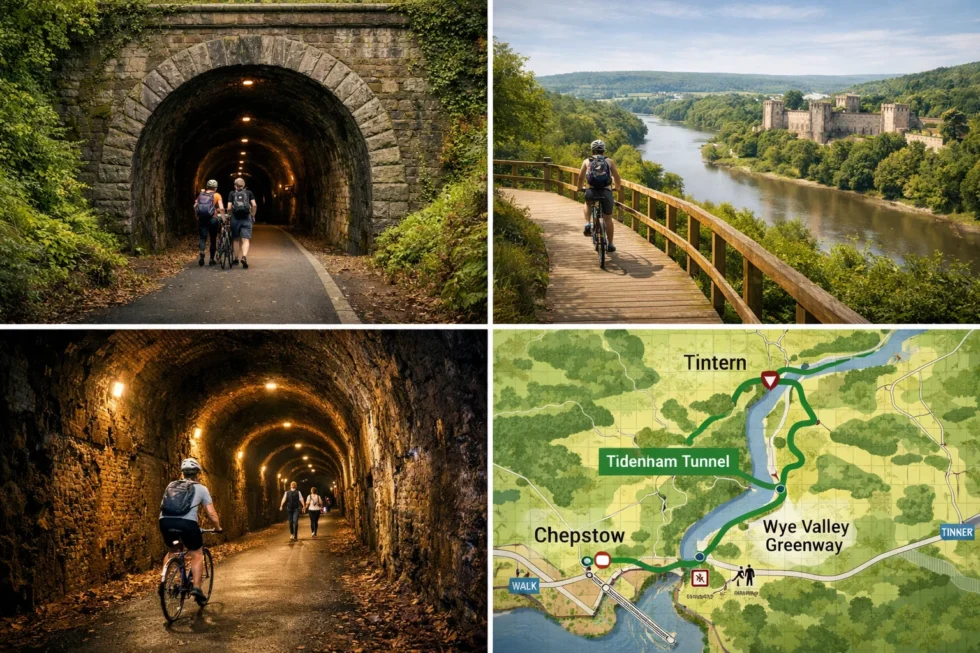
The tunnel is accessed via Chepstow, which functions as the nearest rail-connected hub and the primary entry point for visitors travelling from London. Journeys typically depart from London Paddington Station and require a change at Newport, with total journey times averaging around two hours and thirty minutes depending on service frequency. Alternative routes via Bristol Parkway provide additional scheduling flexibility, though they may extend travel time slightly. From Chepstow, the Greenway can be reached within 15 to 25 minutes on foot or by bicycle, with clearly marked access points leading towards Sedbury or Tintern. The final approach is entirely traffic-free, removing the need for complex navigation or additional transport connections. The route is also notably flat, which reduces physical barriers for casual visitors and aligns with its positioning as an accessible outdoor corridor.
Travel from London to Tidenham Tunnel
| Route | Method | Duration | Practical note |
|---|---|---|---|
| London → Chepstow | Train via Newport | ~2h 30m | Primary route |
| London → Bristol Parkway → Chepstow | Train + connection | ~2h 45m | Alternative |
| London → Chepstow | Car (M4) | ~2.5–3h | Traffic dependent |
| Chepstow → Tunnel | Walk/Cycle | 15–25 min | Flat Greenway path |
The integration of rail access and short-distance active travel makes the tunnel a viable day trip from London without requiring complex logistics or overnight planning.
What to expect inside Tidenham Tunnel: visibility, safety and movement conditions
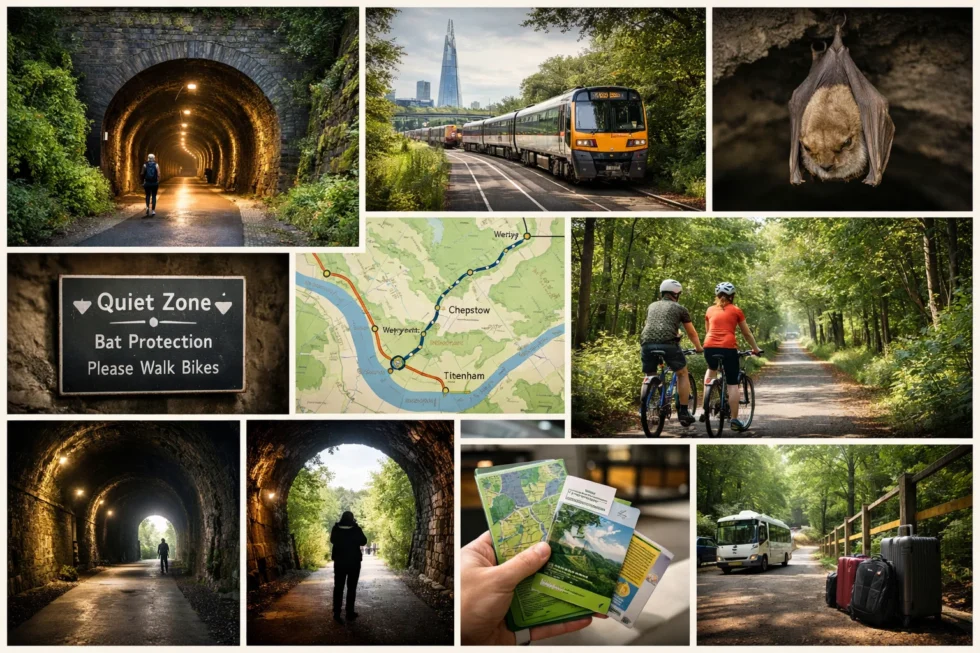
The internal environment of the tunnel is defined by controlled low lighting, stable cool temperatures and a continuous enclosed passage that creates a distinct sensory shift compared to open-air sections of the Greenway. Visibility is limited, particularly during initial entry, as eyes adjust from daylight conditions to the subdued interior lighting. The surface may be damp in sections, reflecting the natural conditions of the structure, which requires careful footing for pedestrians and controlled speed for cyclists. The tunnel’s length creates a sustained period of reduced visibility, meaning visitors should not expect quick passage unless moving at a consistent pace. Acoustic conditions are also notable, with sound carrying along the curved structure and amplifying movement within the space. These combined factors position the tunnel as a transit experience rather than a stopping point, with flow and movement prioritised over static observation.
Visitor expectations inside the tunnel:
- Low light throughout entire 1,080m length
- Gradual visual adaptation required
- Shared use with cyclists and pedestrians
- Damp or uneven surfaces possible
- Continuous movement recommended
“Take them off upon entry and you’ll see so much more” (Wye Valley Greenway guidance, 2026).
The experience is therefore functional, controlled and defined by environmental constraints rather than designed visitor comfort.
History of Tidenham Tunnel: railway origins, closure and restoration
The tunnel was constructed in 1876 as part of the Wye Valley Railway, a regional transport route linking rural and industrial areas along the River Wye during a period of rapid infrastructure expansion in the UK. It remained operational for several decades before declining usage and restructuring of the rail network led to phased closures between 1959 and 1992. Following its closure, the tunnel remained disused for an extended period, with limited maintenance and no public access. Restoration efforts began in 2019, driven by volunteer groups and supported by local authorities aiming to repurpose the corridor for public use. The reopening in 2021 marked the transition from industrial infrastructure to recreational and sustainable transport asset. This transformation aligns with broader UK initiatives to convert former railways into greenways, balancing heritage preservation with modern usage.
Historical development timeline
| Year | Event |
|---|---|
| 1876 | Tunnel constructed and railway opened |
| 1959–1992 | Railway closures implemented |
| 2019 | Restoration begins |
| 2021 | Public reopening |
| 2026 | Continued seasonal operation |
The tunnel’s current function is therefore the result of long-term structural preservation combined with modern environmental and tourism strategies.
Wildlife protection and seasonal closure: why the tunnel shuts in winter
The presence of lesser horseshoe bats is the defining factor governing access to the tunnel, with the structure serving as a protected roost under UK wildlife legislation. Approximately 50 bats are known to reside within the tunnel itself, while the wider region supports a significant proportion of the national population. These bats require stable environmental conditions, particularly during active and breeding periods, making disturbance a critical risk factor. Seasonal closure during winter ensures that periods of higher biological sensitivity are protected, while reopening during hibernation allows controlled human access. Legal protections mean that any disturbance, including noise, light or physical interference, can result in enforcement action. This regulatory framework defines the operational limits of the tunnel and explains the strict rules imposed on visitors.
Key wildlife protection facts:
- Species: lesser horseshoe bats
- Legal status: protected under UK law
- Estimated tunnel population: ~50 individuals
- Regional concentration: ~26% of UK population
- Disturbance: criminal offence
The balance between access and protection is therefore not optional but legally enforced and central to the site’s operation.
Practical visitor strategy: timing, preparation and nearby routes
Planning a visit requires consideration of both environmental conditions and operational constraints, particularly given the tunnel’s limited opening hours and low-visibility environment. Early morning visits typically offer lower congestion and more stable light transition conditions, while late afternoon periods may coincide with increased visitor numbers. Equipment should be minimal but functional, focusing on safety rather than enhancement, as artificial lighting is restricted.
The surrounding Wye Valley area offers extended walking and cycling routes, allowing the tunnel to be integrated into a broader itinerary rather than treated as a standalone destination. Nearby sites such as Tintern Abbey and viewpoints along the River Wye provide additional context and value to the visit. The route’s flat profile also makes it accessible for a wide range of visitors without requiring advanced physical preparation.
Before you visit:
- Wear stable footwear suitable for damp surfaces
- Avoid peak hours if sensitive to low visibility
- Follow all posted safety and conservation rules
- Plan entry and exit within opening hours
- Use natural light adaptation rather than artificial sources
The tunnel is best approached as part of a structured day trip rather than a spontaneous stop, given its operational limitations.
Why Tidenham Tunnel is drawing attention in 2026: location, access details and practical visitor value
The reopening of Tidenham Tunnel reflects a measurable shift in UK travel behaviour towards low-cost, accessible outdoor routes that combine heritage infrastructure with regulated environmental use. Located between Tintern and Sedbury on the Wye Valley Greenway near Chepstow, the tunnel sits at approximately 51.6403° N, 2.6755° W, positioning it within the Wye Valley Area of Outstanding Natural Beauty. The site operates without commercialisation, meaning no ticketing system, retail infrastructure or paid entry model is imposed on visitors. Instead, access is governed entirely by ecological constraints linked to protected lesser horseshoe bats, which directly shapes its opening calendar and usage rules. In practical terms, this creates a rare case in the UK where a high-value heritage asset remains free, publicly accessible and strictly regulated at the same time. The absence of commercial overlay increases its appeal for visitors seeking authentic, non-curated environments rather than managed attractions. In 2026, this positioning aligns with increased demand for slow, nature-based tourism across the UK.
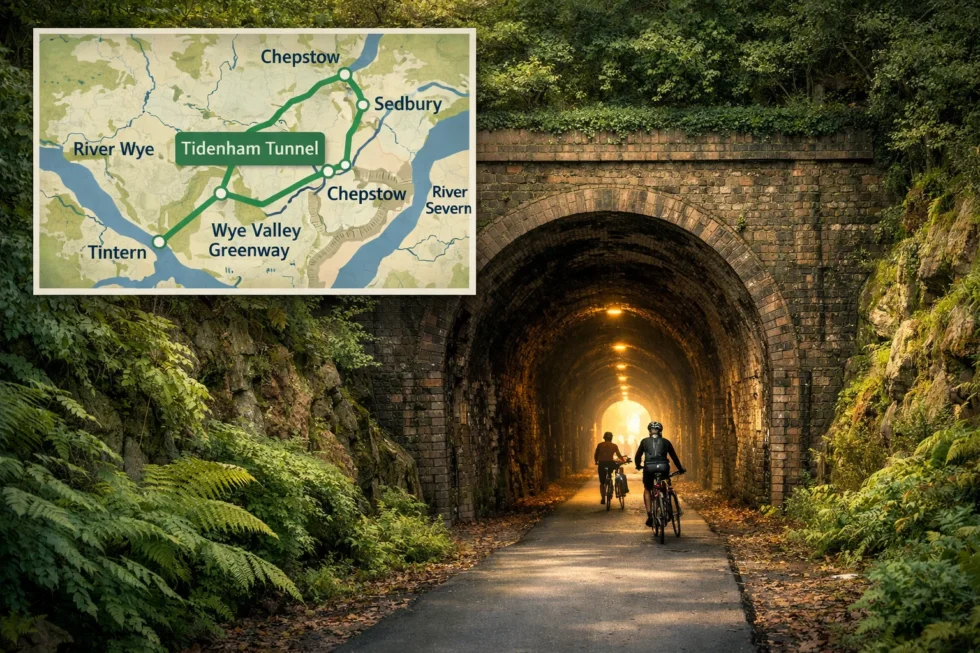
Location and visitor access details:
- Location: Tidenham, near Chepstow, Wales (Wye Valley)
- Coordinates: 51.6403° N, 2.6755° W
- Route: Tintern ↔ Sedbury via Wye Valley Greenway
- Nearest rail station: Chepstow
- Distance from London: ~140 miles (225 km)
- Access type: walking and cycling only
Opening times and conditions (2026):
- Season: early April → 1 October 2026
- Daily hours: until 20:00 (8pm)
- Entry: free of charge
- Lighting: low-level, conservation-regulated
- Winter: closed due to bat protection requirements
Official information and contact:
- Website: Wye Valley Greenway (official information and updates)
- Regional support: Monmouthshire tourism services (Chepstow area)
- On-site facilities: none (no ticket office, no staff base inside tunnel)
The tunnel’s growing attention in 2026 is driven by a combination of accessibility from London, zero entry cost, and a physically unique experience defined by its 1,080-metre enclosed passage. At the same time, its limitations remain fixed: no extended hours, no artificial lighting expansion, and strict seasonal closure aligned with wildlife protection law. This creates a controlled visitor model where demand does not change access conditions. The result is a rare balance in the UK travel market—an open site that remains non-commercial, regulated and environmentally constrained.
Read about the life of Westminster and Pimlico district, London and the world. 24/7 news with fresh and useful updates on culture, business, technology and city life: Castle Combe named one of the most beautiful villages in the world: why this untouched Cotswolds gem still has no new homes after 400 years