
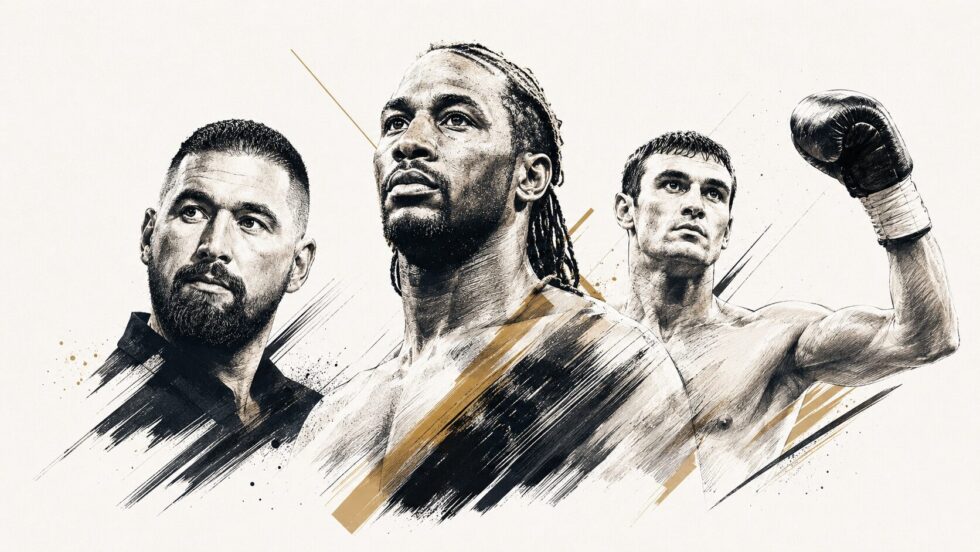
Tony Bellew, the 43-year-old former WBC cruiserweight champion from Liverpool, has named Lennox Lewis and Joe Calzaghe as the only British boxers he considers genuinely elite. Speaking on the Fight Your Corner podcast, Bellew drew a clear distinction between fighters who reached world level and the far smaller group whose records, longevity and tactical adaptability place them among the sport’s historic greats, The WP Times editorial team reports.
“There are world-class fighters and then there are elite-level fighters. There are very few elite-level fighters,” Bellew said. “I think this country has produced two in Calzaghe and Lennox Lewis.”
His verdict leaves out several of Britain’s most decorated and recognisable champions, including Carl Froch, Ricky Hatton, Chris Eubank, Nigel Benn and Naseem Hamed. Bellew’s argument, however, is not that those fighters fell short of world-class standard. He is applying a more demanding test in which belts, popularity and individual victories are not enough on their own. Under Bellew’s definition, an elite fighter must dominate at the highest level over a sustained period, defeat leading opponents and remain effective when a contest moves away from familiar conditions. That means showing the ability to adjust tactics, absorb pressure and find solutions when speed, power or an established game plan is no longer sufficient.
Lewis satisfies that standard through his reign as undisputed heavyweight champion, victories over leading names from different eras and his success in avenging both professional defeats. Calzaghe’s claim rests on an unbeaten 46-fight career, 21 world-title defences at super-middleweight and major wins over opponents including Chris Eubank, Jeff Lacy, Mikkel Kessler and Bernard Hopkins. Bellew’s judgement is therefore less a dismissal of other British champions than an attempt to protect the meaning of the word elite. In his view, world-class fighters can win titles and produce memorable nights, but elite fighters build complete careers defined by sustained dominance, adaptability and victories that continue to carry weight long after retirement.
Why Bellew Separates Elite Fighters From Champions
Bellew retired in 2018 with 30 wins, three defeats and one draw after competing at light-heavyweight, cruiserweight and heavyweight. He won the vacant WBC cruiserweight title by stopping Ilunga Makabu in the third round at Goodison Park (Liverpool, 29 May 2016), then recorded two heavyweight victories over David Haye before losing his final bout to undisputed cruiserweight champion Oleksandr Usyk (Manchester Arena, 10 November 2018).
That career explains the distinction behind his elite boxer ranking. Bellew experienced championship success, major stadium fights and defeats against opponents operating above ordinary world level. In his assessment, holding a recognised belt is evidence of quality, but not automatic entry into boxing’s highest historical tier. An elite record requires several connected achievements:
- defeating champions in their strongest divisions;
- maintaining success over several years;
- adjusting tactics during competitive fights;
- recovering from defeats, knockdowns or difficult rounds;
- leaving a record that remains credible after retirement.
World titles establish status in a particular period; elite victories retain their value across generations.
Bellew has used Terence Crawford, Oleksandr Usyk and Saul “Canelo” Alvarez as modern examples of that higher category. Each became an undisputed champion and succeeded against opponents with different dimensions, rhythms and tactical demands.
Lennox Lewis Beat Every Man He Faced
Lennox Lewis was born in West Ham, London (2 September 1965) and retired at 38 with 41 wins, two defeats and one draw. He recorded 32 knockouts, became undisputed heavyweight champion and avenged both losses before leaving the sport.
Lewis represented Canada at two Olympic Games and won super-heavyweight gold in Seoul (2 October 1988), stopping future heavyweight champion Riddick Bowe in the final. He turned professional the following year and became WBC heavyweight champion after Riddick Bowe declined to defend the belt against him.
His defining undisputed-title victory came against Evander Holyfield at the Thomas & Mack Center (Las Vegas, 13 November 1999). Their first fight at Madison Square Garden (New York, 13 March 1999) had ended in a widely disputed draw. Lewis controlled the rematch with his jab, reach and right hand, winning a unanimous decision to combine the WBC, WBA and IBF championships.
Lewis did not build his reputation around one famous opponent. He defeated Olympic medallists, former champions, dangerous punchers and leading contenders across three different heavyweight eras.
His strongest victories included:
- Evander Holyfield, by unanimous decision in their rematch;
- Vitali Klitschko, by sixth-round stoppage because of cuts;
- Mike Tyson, by eighth-round knockout;
- David Tua, by unanimous decision;
- Donovan Ruddock, by second-round knockout;
- Andrew Golota, by first-round knockout;
- Ray Mercer, by majority decision;
- Frank Bruno, by seventh-round stoppage.
Lewis lost to Oliver McCall at Wembley Arena (London, 24 September 1994), when the referee stopped the contest in round two. He regained the WBC belt by stopping McCall in their rematch at the Las Vegas Hilton (7 February 1997).
Hasim Rahman produced the second upset at Carnival City (Brakpan, South Africa, 22 April 2001), knocking Lewis out in the fifth round. Seven months later, Lewis arrived for the rematch lighter, sharper and better prepared, then knocked Rahman out with a right-left combination at Mandalay Bay (Las Vegas, 17 November 2001).
Lewis retired having defeated every professional opponent who had shared a ring with him.
| Career measure | Lennox Lewis |
|---|---|
| Professional record | 41 wins, 2 defeats, 1 draw |
| Knockout victories | 32 |
| Olympic achievement | Gold medal, Seoul 1988 |
| Undisputed title won | 1999 |
| Defeats avenged | Oliver McCall and Hasim Rahman |
| Final fight | Victory over Vitali Klitschko |
| Hall of Fame induction | 2009 |
The International Boxing Hall of Fame lists Lewis as a three-time heavyweight champion and records his induction in 2009.
Joe Calzaghe Retired 46–0 After a Decade as Champion
Joe Calzaghe was born in Hammersmith, London (23 March 1972), grew up in Newbridge, Wales, and completed a 46-fight professional career without a defeat. He won 32 contests inside the distance and held the WBO super-middleweight title for more than ten years.
Calzaghe claimed the vacant championship by beating former two-weight title-holder Chris Eubank at Sheffield Arena (11 October 1997). A first-round knockdown gave Calzaghe an immediate advantage, but Eubank remained competitive for 12 rounds. The Welshman won a unanimous decision and began a run of 21 successful WBO title defences.
His breakthrough in the United States came through a fight held in Britain. Jeff Lacy arrived at Manchester Arena (4 March 2006) as an unbeaten IBF champion with 17 knockouts in 21 wins. Calzaghe dismantled him over 12 rounds, using rapid combinations, changes of angle and sustained output to win by scores of 119–105, 119–107 and 119–107.
Calzaghe’s advantage was not simply speed. He could recognise a tactical pattern within rounds, alter his distance and maintain a pace that opponents could not match.
Mikkel Kessler represented a stronger technical test at the Millennium Stadium (Cardiff, 3 November 2007). The unbeaten Dane brought the WBA and WBC belts, a disciplined jab and a powerful straight right. Calzaghe adjusted after the opening rounds, disrupted Kessler’s preferred range and won a unanimous decision in front of more than 50,000 spectators.
He then moved to light-heavyweight and faced Bernard Hopkins at the Thomas & Mack Center (Las Vegas, 19 April 2008). Hopkins dropped him with a counter right in the first round and repeatedly slowed the action with clinches. Calzaghe increased his punch volume, forced Hopkins to work at an uncomfortable pace and won a split decision.
His final appearance came against Roy Jones Jr at Madison Square Garden (New York, 8 November 2008). Calzaghe recovered from another first-round knockdown and won every remaining round on all three scorecards.
The value of Calzaghe’s 46–0 record lies in its combination of longevity, unification victories and late-career success outside Britain.
| Career measure | Joe Calzaghe |
|---|---|
| Professional record | 46 wins, 0 defeats |
| Knockout victories | 32 |
| WBO title defences | 21 |
| Championship reign | More than ten years |
| Major unification win | Mikkel Kessler |
| Final opponent | Roy Jones Jr |
| Hall of Fame induction | 2014 |
The International Boxing Hall of Fame confirms Calzaghe’s 46–0 record, 32 knockouts and 2014 induction.
Why Naseem Hamed Misses Bellew’s Top Tier
Bellew identified Naseem Hamed’s boxing career as the closest alternative. Hamed was born in Sheffield (12 February 1974), became WBO featherweight champion at 21 and retired with 36 victories, one defeat and 31 knockouts.
His power was exceptional for a 126-pound fighter. Hamed stopped Steve Robinson to win the WBO title at Cardiff Arms Park (30 September 1995), defeated IBF champion Tom Johnson at London Arena (8 February 1997) and survived three knockdowns before stopping Kevin Kelley at Madison Square Garden (19 December 1997).
The decisive weakness in Bellew’s argument is Hamed’s response to Marco Antonio Barrera. The Mexican controlled their fight at the MGM Grand Garden Arena (Las Vegas, 7 April 2001) with disciplined positioning, compact counters and a refusal to chase Hamed’s exaggerated movements. Hamed lost a unanimous decision and fought only once more, beating Manuel Calvo in London (18 May 2002).
Unlike Lewis, he did not avenge his defeat. Unlike Calzaghe, he did not retire unbeaten after defeating the strongest available rival. Hamed still entered the International Boxing Hall of Fame in 2015, and his 36–1 record remains among the strongest in modern British boxing.
Bellew’s Standard Leaves Little Room for Reputation
The case for Britain’s greatest boxers becomes clearer when the records are placed side by side. Lewis defeated every opponent he faced, unified the heavyweight division and corrected both defeats. Calzaghe remained unbeaten through 46 contests, made 21 title defences and solved major tactical problems against Lacy, Kessler and Hopkins.
| Boxer | Record | Central elite-level argument |
|---|---|---|
| Lennox Lewis | 41–2–1 | Undisputed heavyweight champion who avenged every defeat |
| Joe Calzaghe | 46–0 | Ten-year champion with 21 defences and no professional losses |
| Naseem Hamed | 36–1 | Exceptional power and influence, but no rematch after his defining defeat |
Bellew’s verdict is severe because it treats world-class status and historical greatness as different achievements. British boxing has produced dozens of champions, but his elite category demands a complete record: high-level opposition, long-term control, tactical adaptability and decisive answers to adversity. Lewis and Calzaghe satisfy every part of that test.
Read about the life of Westminster and Pimlico district, London and the world. 24/7 news with fresh and useful updates on culture, business, technology and city life: Will Elon Musk’s Tesla Tiny House Really Reach the UK – or Is It Just Another Vision