
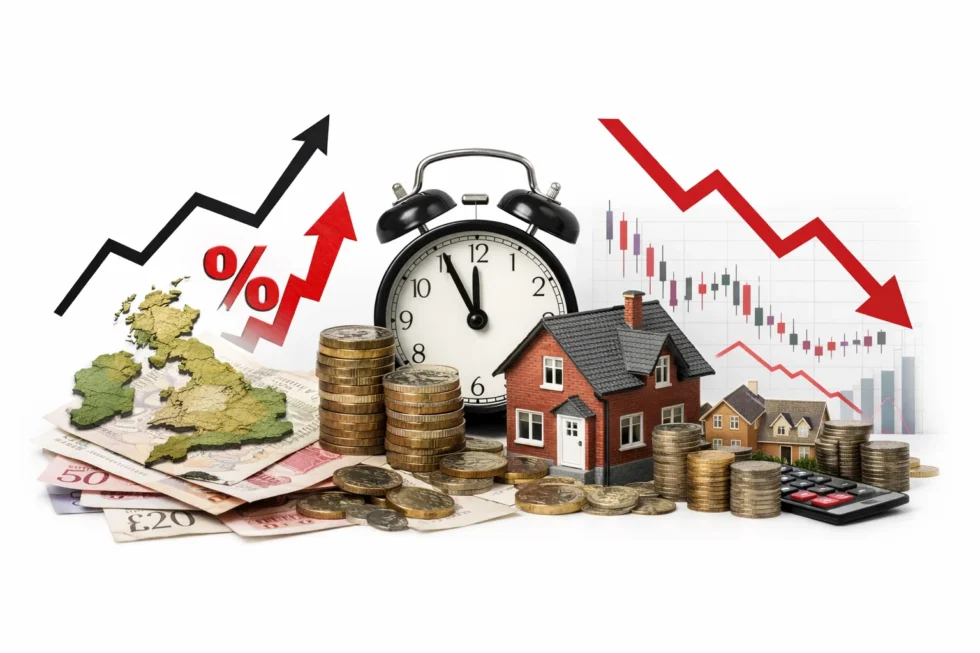
In 2026, the UK credit market is operating under a new financial reality: money is cheaper for banks, but not for households. That shift was set in motion in 2025, when the Bank of England began to reverse three years of aggressively high interest rates used to suppress inflation as price pressures cooled and economic momentum weakened.
By December 2025 the Bank Rate had been cut to 3.75% from 5.25%, reducing banks’ funding costs, restoring liquidity in wholesale money markets and easing stress on lenders’ balance sheets — a turning point that now defines how credit is priced across Britain in 2026, as reported by The WP Times editorial team.
However, for households — especially in London — credit has not become meaningfully cheaper. Despite the fall in base rates, the effective cost of consumer borrowing remains structurally high. Lenders continue to price in elevated default risk, rising unsecured debt and the financial strain created by high rents, energy bills and everyday living costs. As a result, many borrowers still face double-digit APRs on credit cards, overdrafts and personal loans, even as headline interest rates fall.
This has produced a sharply segmented market in which two people on similar incomes can receive radically different offers. Borrowers with low rent, strong savings and minimal existing debt are rewarded with far lower rates, while those paying high housing costs or carrying revolving credit are treated as high-risk, regardless of salary — a divide that is now one of the defining features of the London credit economy.
Base rate, inflation and credit conditions
The relationship between the Bank of England’s base rate and what households actually pay for borrowing is not direct. While changes in the Bank Rate shape the cost of money for banks, consumer credit pricing is driven just as much by inflation, household finances and perceived default risk — a gap that became especially visible in 2025.
Bank of England Bank Rate in 2025
| Date | Bank Rate |
|---|---|
| January 2025 | 5.25% |
| July 2025 | 4.50% |
| December 2025 | 3.75% |
The reduction in the Bank Rate through 2025 reflects the cooling of inflation and a visible slowdown in economic momentum. But consumer credit pricing has not followed the base rate down in parallel. Banks do not lend at the Bank Rate; they lend at the Bank Rate plus a risk premium, and that premium has widened as lenders become more cautious about household balance sheets.
In London, where rent, utilities and transport absorb a far larger share of disposable income than in most of the UK, that risk premium is especially high. For lenders, a London borrower may earn more on paper — but often has less room to absorb financial shocks, making credit riskier and therefore more expensive.
Household borrowing in the UK
UK households continued to increase their use of credit through late 2025 despite falling base rates. Bank of England data show that net new consumer credit in October 2025 stood at around £1.1 billion, confirming that borrowing is still expanding rather than contracting. At the same time, average unsecured personal debt per household has continued to rise:
| Year | Average unsecured debt |
|---|---|
| 2023 | £5,300 |
| 2024 | £5,545 |
| 2025 | £5,711 |
This trend reflects a structural shift in how credit is used. Borrowing is no longer primarily funding discretionary spending such as travel or home upgrades. Instead, a growing share of loans and credit-card balances is being used to cover rent, energy bills, food and everyday essentials — turning consumer credit into a tool of household survival rather than consumption smoothing.
Why London pays more for credit
London borrowers face systematically higher pricing because of three structural pressures that directly affect lender risk models.
Housing costs
In large parts of the capital, rent absorbs 40–55 % of net income, sharply reducing the cash available to service debt and leaving little margin for financial shocks.
Expense volatility
Transport, childcare, council tax and utilities are more expensive and less predictable than in most regional cities, making household budgets more fragile.
Layered borrowing
Londoners are far more likely to hold overdrafts, credit cards and Buy Now Pay Later (BNPL) balances simultaneously, increasing the likelihood that a small income disruption triggers missed payments.
Even when salaries are higher, these factors lead lenders to classify London households as riskier than regional borrowers on the same income, pushing rates up.
What borrowers actually pay
Typical personal-loan APR ranges in 2025–26
| Borrower profile | Risk level | Practical APR |
|---|---|---|
| Stable income, low debt | Low | 5–7% |
| High rent, moderate debt | Medium | 8–13% |
| Stretched or unstable finances | High | 14–25%+ |
Example: £10,000 loan over five years
- 6% APR → about £193 per month → £11,580 repaid
- 12% APR → about £223 per month → £13,380 repaid
The £1,800+ difference is the direct price of perceived risk rather than the cost of money itself.
How banks decide your rate
UK lenders use detailed affordability and risk models that go far beyond income alone. They typically assess:
- Income stability and employment history
- Debt-to-income ratio
- Rent or mortgage share of earnings
- Credit-card and overdraft utilisation
- Length and depth of credit history
- Missed payments, defaults or CCJs
They also apply stress tests, often assuming lower income and higher living costs. If repayments remain affordable under those assumptions, pricing improves. If not, APRs rise sharply.
Fees that raise the true cost
Beyond headline interest rates, borrowers must also factor in charges that materially increase what they repay:
- Early-repayment fees, often 1–2% of the outstanding balance
- Late-payment charges, typically £12–£30 plus extra interest
- Payment holidays, which capitalise interest and extend the debt
- Add-ons and insurance, which increase the loan size
For borrowers, the most important figure is always the total amount repayable, not the advertised APR.
Where lenders stand in 2026
| Lender type | Typical pricing | Strength |
|---|---|---|
| Major banks (HSBC, Barclays, NatWest, Santander) | 7–14% | Competitive for strong profiles |
| Building societies (e.g. Nationwide) | 7–11% | Often good for mid-sized loans |
| Fintech and challenger lenders | 8–20%+ | Fast but more expensive |
Representative APRs apply to only 51% of approved borrowers. Many Londoners are priced above them.
What borrowers should do in 2026
The biggest mistake borrowers make is assuming that falling base rates automatically mean cheaper credit. In 2026, pricing is driven far more by personal risk profiles than by the Bank of England. Before applying for any loan, households should review their credit files with Experian, Equifax and TransUnion, correct any errors and make sure credit-card and overdraft balances are kept well below their limits. High utilisation is one of the fastest ways to push a borrower into a higher-risk pricing tier.
Soft-search eligibility tools should be used wherever possible. These allow borrowers to see realistic offers without damaging their credit score, which itself affects pricing. When comparing loans, the focus should always be on the total amount repayable, not the headline APR, and on how flexible the lender is if circumstances change.

For households already carrying expensive debt, personal loans can be an effective way to replace high-interest overdrafts and credit cards. What they should not be used for is funding everyday living costs such as rent or groceries. Once credit starts paying for survival rather than smoothing cash flow, the debt spiral accelerates.
Outlook for 2026
Further base-rate cuts are likely as inflation continues to normalise, but that will not automatically make consumer credit cheap. Lenders price risk, not just money. Borrowers with stable incomes, low rent burdens and clean credit histories will see the best conditions since 2022. Households under pressure — especially in London — will continue to pay a premium.
What this means for Londoners
Credit in London is widely available, but it is priced for fragility. The Bank Rate no longer determines what households pay; financial resilience does. In 2026, actively managing credit utilisation, comparing offers and planning repayments is the dividing line between affordable borrowing and long-term expensive debt.
Read about the life of Westminster and Pimlico district, London and the world. 24/7 news with fresh and useful updates on culture, business, technology and city life: Why has UK inflation fallen to 3.2% and is the Bank of England now forced to cut rates