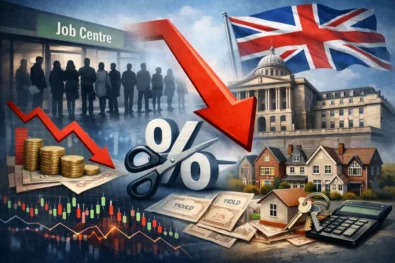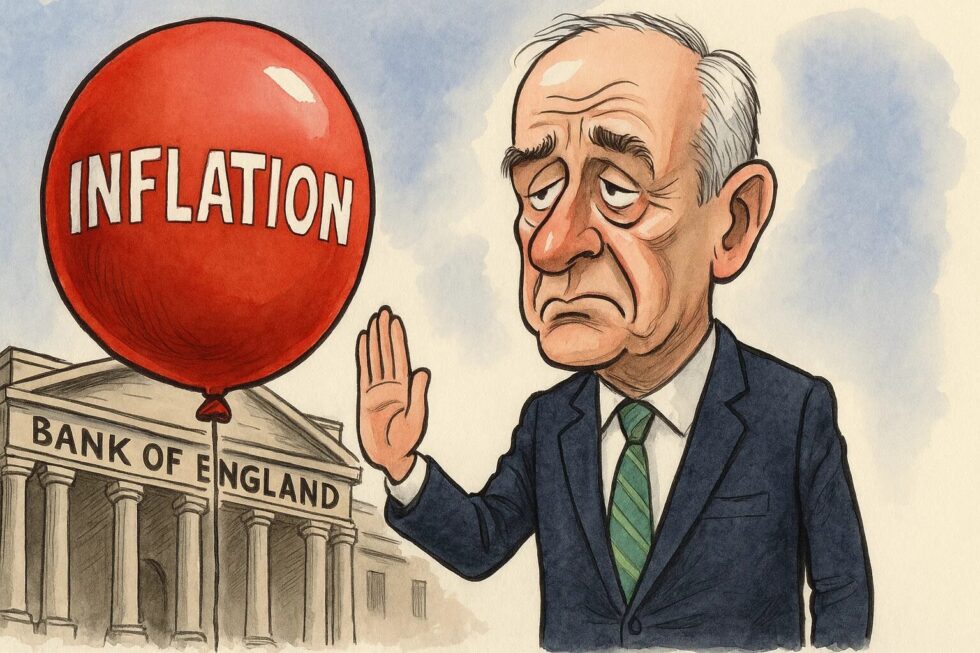
The Bank of England's Monetary Policy Committee has decided to hold its key interest rate steady at 4%, though the decision was narrowly split among policymakers. Alongside the vote, the central bank announced a significant shift in its economic outlook, stating definitively that the recent surge in UK consumer price index (CPI) inflation has reached its maximum point and begun to subside, reports The WP Times with reference to the Guardian.
The decision to maintain borrowing costs was carried by a 5-4 vote, with Governor Andrew Bailey casting his vote with the majority. The central bank's latest Monetary Policy Report confirms its belief that CPI inflation, which stood at 3.8% in July, August, and September, has peaked, despite the BoE previously forecasting a maximum of 4% in September. The report expresses confidence that the process of disinflation is ongoing, predicting that price growth will likely drop to nearly 3% early next year before gradually easing toward the 2% target over the subsequent year. This disinflationary progress is attributed to the current restrictive monetary policy stance, which is fostering an easing of pay growth and services price inflation, underpinned by subdued economic growth and increasing slack in the labor market.
Governor Andrew Bailey, effectively the swing voter in the committee’s narrow split, explained his reasoning for holding rates steady. He told reporters he requires more concrete evidence that inflation has truly passed its high point before he would vote to reduce rates. Supporting this cautious stance, Deputy Governor Dave Ramsden pointed out that inflation remains at 3.8%, which is still considerably higher than the 2% target. Conversely, Dhingra and Taylor were among the four dissenting members, expressing concern that current interest rates are already "significantly" too high.
Addressing questions about fiscal policy, Deputy Governor Clare Lombardelli estimated that approximately 0.4% of the current 3.8% inflation rate is due to administered and regulated prices. Governor Bailey stated that the Bank will not pass judgment on the Chancellor Rachel Reeves' recent pre-budget speech but will wait for the actual Budget announcement on November 26 to analyze its influence on the economy and the inflation outlook. Bailey further noted that the central bank is observing signs of economic weakening, pointing specifically to subdued household consumption growth with only a limited recovery expected in the near term. In a separate commentary on financial markets, Bailey also addressed the potential for an artificial intelligence bubble, acknowledging the danger while simultaneously suggesting that the eventual benefits of AI for productivity could be substantial.
Read about the life of Westminster and Pimlico district, London and the world. 24/7 news with fresh and useful updates on culture, business, technology and city life: Zohran Mamdani Secures Historic Win in NYC Mayoral Race, Defeats Andrew Cuomo.