
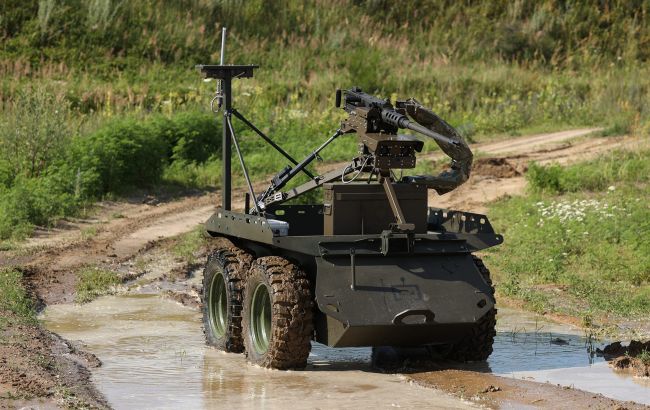
Ukraine has formally authorised the Zmiy Droid 12.7, a heavily armed unmanned ground combat vehicle, for frontline deployment, marking a decisive shift in Kyiv’s military doctrine towards robot-led warfare as the conflict with Russia enters its most technologically intense phase.
The clearance, issued on Wednesday by Ukraine’s Ministry of Defence, gives battlefield commanders legal authority to deploy the domestically built system across eastern and southern Ukraine, including some of the most heavily contested sectors of the war, The WP Times reports, citing the Ministry.
The move reflects the brutal realities of a battlefield now dominated by drone surveillance, precision artillery and dense minefields, where even brief exposure of infantry units can trigger catastrophic losses — forcing Ukraine to increasingly replace soldiers at the point of first contact with armoured robotic systems capable of advancing, scouting and delivering heavy fire without risking human life.
What is the Zmiy Droid 12.7
The Zmiy Droid 12.7 is a tracked, armoured unmanned ground combat vehicle (UGV) developed by the Ukrainian defence companies DevDroid and Rovertech to operate in the most hostile sections of the battlefield. It is designed as a mobile robotic weapons platform capable of moving alongside infantry, advancing into enemy-controlled zones and delivering continuous suppressive fire in conditions where human crews would be exposed to extreme risk. Built on a low-profile tracked chassis, the Zmiy is engineered for shell-cratered terrain, collapsed buildings, trenches and forest belts — the defining geography of Ukraine’s front line.
Firepower
At the core of the system is a 12.7-millimetre heavy machine gun, the same calibre used by NATO’s .50 BMG weapons mounted on armoured vehicles and helicopters. This gives the Zmiy the ability to:
- penetrate light armoured vehicles
- destroy fortified firing points and bunkers
- dominate trench networks
- engage low-flying reconnaissance drones
- suppress infantry behind concrete and earth cover
The weapon is mounted in a stabilised remote-controlled turret, allowing accurate fire while the vehicle is moving, even over rough ground.
Sensors, targeting and electronic warfare
The Zmiy is equipped with a multi-layer battlefield sensor suite designed for modern, drone-saturated warfare:
- high-definition optical cameras
- thermal imaging for night, smoke and camouflage
- digital zoom with target tracking
- encrypted data links designed to resist jamming
Live video and telemetry are transmitted back to operators several kilometres away, allowing the system to act both as a forward scout and a direct-fire weapons platform.
Unlike wheeled robotic vehicles, the Zmiy uses a tracked drive system, which is essential on Ukraine’s front lines where terrain is shaped by:
- deep mud from shelling and irrigation
- snow and ice
- cratered farmland
- shattered roads
- collapsed urban structures
Tracks allow the vehicle to climb rubble, cross trenches and keep moving in conditions that immobilise most vehicles. The Ministry of Defence says the Zmiy has passed tests in sand, snow and shallow water, making it deployable throughout the year.
Ukraine has not released an official procurement price, but defence procurement specialists estimate that robotic combat vehicles in this class typically cost between $150,000 and $300,000 per unit, depending on sensors and weapons. That makes the Zmiy far cheaper than a tank or infantry fighting vehicle, and dramatically cheaper than the cost of training, equipping and replacing a human crew.
How it compares internationally
The Zmiy belongs to the same technological class as NATO robotic ground systems such as:
| System | Country |
|---|---|
| THeMIS | Estonia |
| Mission Master | Germany |
| Ripsaw M5 | United States |
| Titan UGV | United Kingdom |
However, Ukraine is currently the only country deploying armed robotic ground vehicles at scale in a full-intensity war, giving it a unique operational and technological edge.
Where it will be used
Ukrainian commanders say the Zmiy will be deployed in:
- Donetsk
- Luhansk
- Zaporizhzhia
- Kherson
These regions are dominated by trench systems, urban ruins and drone-guided artillery — the deadliest environments for conventional infantry. The first units are expected to enter frontline service in early 2026.
A defence industry reshaped by war
Ukraine’s arms industry has undergone one of the fastest wartime expansions seen in modern Europe, driven by the need to replace imported weapons and keep pace with the demands of a high-intensity conflict. According to Defence Minister Denys Shmyhal, 76% of all weapons now purchased centrally by the Ukrainian state are produced by domestic manufacturers, reflecting a deliberate shift away from foreign supply chains.
Prime Minister Yuliia Svyrydenko has said that more than half of all weapons currently in use by Ukraine’s armed forces are now made inside the country, a figure that was negligible before Russia’s full-scale invasion.
Since 2022, Ukraine’s military production has increased more than thirty-five times, according to government data — a surge that has allowed Kyiv to field new drones, artillery systems and robotic vehicles at a speed unmatched in most NATO states. The deployment of the Zmiy Droid 12.7 reflects how Ukraine’s expanding defence industry is being translated into operational capabilities on the battlefield.
Armed unmanned ground vehicles provide Ukrainian units with the ability to conduct reconnaissance, deliver suppressive fire and probe enemy positions in environments dominated by mines, drones and artillery, where conventional infantry movement carries high risk.
Read about the life of Westminster and Pimlico district, London and the world. 24/7 news with fresh and useful updates on culture, business, technology and city life: BBC inside a secret missile factory: what is known about Ukraine’s “Flamingo” cruise missile
Photo: The Zmiy Droid 12.7 unmanned ground combat vehicle cleared for service with Ukraine’s Defence Forces (DevDroid / Rovertech)