
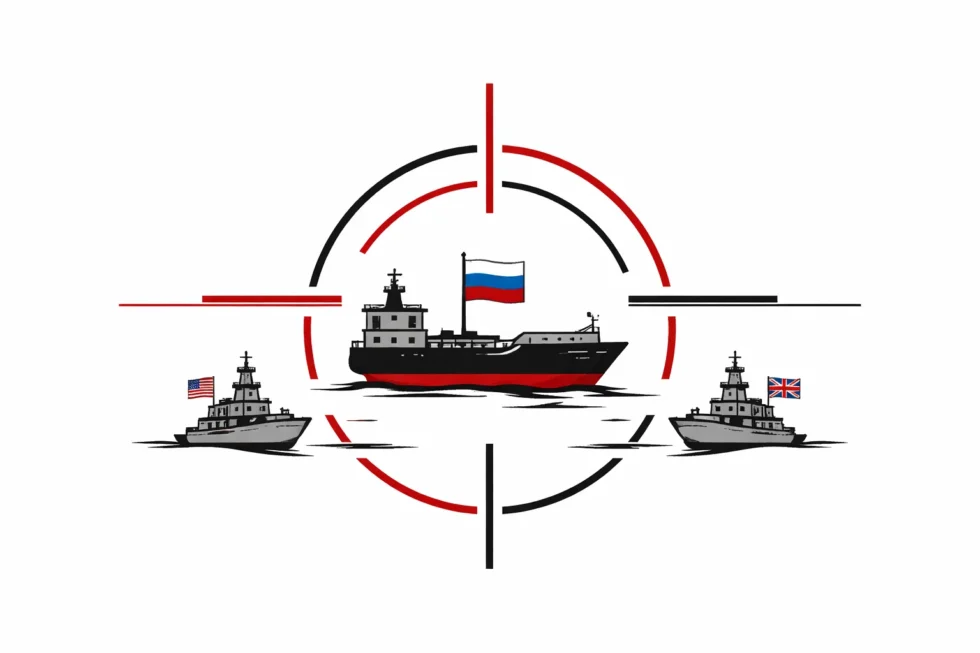
A Russian-flagged oil tanker at the centre of a US-tracked sanctions-evasion network moving Venezuelan and Iranian crude was seized by American special forces with British military support in the North Atlantic on 7 January, in what US officials described as the first operational use of physical force to enforce Western energy sanctions, The WP Times reports citing CNN and the US Coast Guard.
The vessel, originally registered as Bella 1 before being re-flagged by Russia as Marinera, was intercepted during a multi-week surveillance operation involving maritime tracking, aerial monitoring and allied naval coordination.
Where the tanker was seized
MarineTraffic satellite and AIS data reviewed by Renewz show the Russian-flagged tanker was intercepted at 07:00 Eastern Time on 7 January, approximately 190 miles (305 km) south of Iceland, inside one of the North Atlantic’s most closely monitored NATO shipping corridors, a route routinely covered by US, British and Norwegian maritime patrol aircraft because of its use by sanctioned oil carriers.
Russia’s Transport Ministry confirmed the loss of operational control later the same day, stating that “contact with the vessel was lost after US forces boarded it” in a statement carried by the state news agency TASS (7 January 2026), an unusually direct acknowledgment that the ship was no longer under Russian command.
The US Coast Guard subsequently released real-time pursuit footage showing one of its offshore cutters shadowing the tanker in open seas shortly before the boarding, visually confirming that the interception occurred outside territorial waters but within a NATO-secured maritime surveillance zone used to track sanction-linked shipping.
How the operation was executed
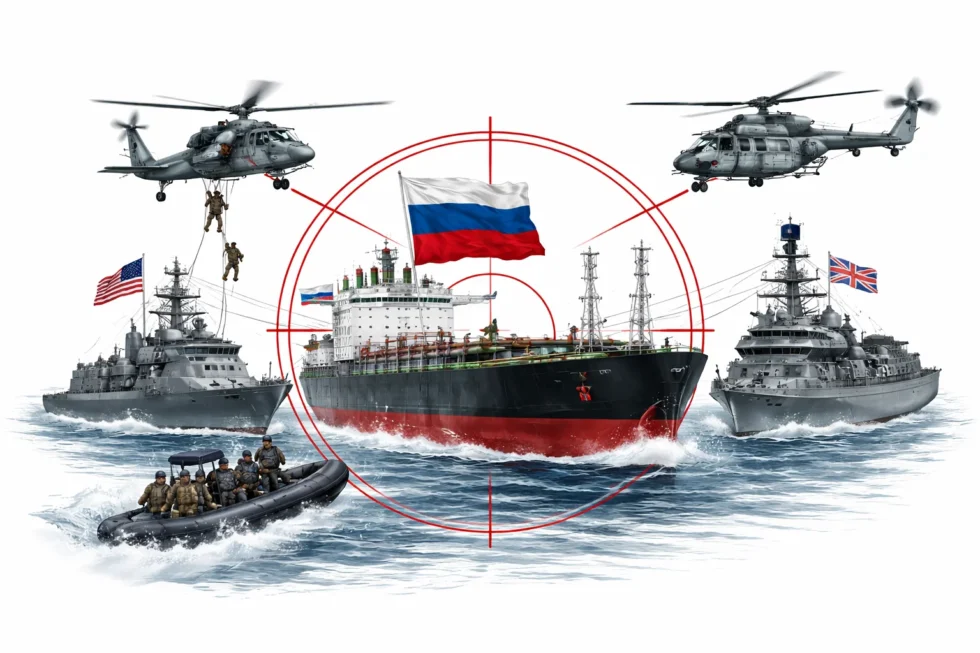
According to CNN, the seizure was preceded by the forward deployment of US special-operations aviation assets to the United Kingdom, including V-22 Osprey tilt-rotor aircraft capable of long-range maritime insertion and AC-130 gunships designed to provide armed overwatch during hostile boarding operations — a configuration normally reserved for counter-terrorism and high-risk interdictions at sea.
The tanker was boarded by US Navy SEALs from the 160th Special Operations Aviation Regiment, widely known as the “Night Stalkers”, an elite unit that specialises in night-time, long-range helicopter and tilt-rotor insertions over open water, indicating that Washington treated the vessel as a high-threat, non-compliant target rather than a routine shipping inspection.
The UK Ministry of Defence confirmed British involvement, stating that it had provided operational support “following a request from the United States” (MoD statement, 7 January 2026), underlining that the action was conducted within the framework of formal US-UK military cooperation rather than unilateral enforcement.
The Times reported that British military planners had been involved in the operation after the tanker slipped through a Venezuelan naval cordon, suggesting that the interception was triggered by intelligence indicating the ship was actively evading an allied blockade rather than simply violating commercial sanctions.
Why Bella 1 was targeted
The oil tanker originally registered as Bella 1, later re-flagged by Russia as Marinera, was placed under US Treasury sanctions in 2024 after being identified as part of a sanctions-evasion network moving Iranian and Venezuelan crude, according to documents published by the Office of Foreign Assets Control (OFAC). The designation linked the vessel to energy revenues used by Tehran and Caracas to bypass Western financial and trade restrictions, making it a priority target for US enforcement agencies.
Shipping and energy-intelligence firm Kpler said the tanker had switched from Iranian supply routes to Venezuelan crude corridors after being blacklisted, while simultaneously deploying standard dark-fleet tactics designed to conceal its movements.
“The vessel recorded two 99-day AIS blackouts and multiple flag changes. These are classic indicators of sanctions-busting activity linked to Iranian and Venezuelan exports,” Kpler said in a statement released to media.
Such behaviour — disabling satellite tracking, re-registering under new flags and operating through opaque ownership structures — is widely used by the so-called shadow fleet, a growing group of tankers estimated by Western intelligence agencies to be responsible for moving tens of millions of barrels of sanctioned oil each year outside the global compliance system.
US officials told CNN that although Marinera was not carrying oil at the time it was seized, it was sailing toward Venezuela to load a fresh cargo of crude, indicating that Washington’s objective was not only to confiscate shipments but to physically dismantle the transport network used to keep sanctioned oil flowing.
Russian naval movements
As the tanker crossed the North Atlantic, Russian naval assets — including at least one submarine — were repositioned into the area, according to reporting by CNN, reflecting what US defence officials described as a live military shadowing operation rather than routine maritime traffic.
A senior US defence official told the network that “Russian military units were manoeuvring in the vicinity of the ship, though they did not intervene when the boarding took place,” confirming that the interception occurred under direct Russian observation but without armed resistance, a scenario that significantly raised the risk of miscalculation between nuclear-armed states.
The Guardian characterised the episode as “a transatlantic standoff in which Russian forces moved to shadow the vessel while US aircraft and ships closed in,” underlining that the seizure unfolded not as a quiet law-enforcement action but as a closely watched military encounter across one of NATO’s most sensitive maritime corridors.
Western security analysts say the Russian movements were likely intended to signal sovereign protection over a Russian-flagged vessel while avoiding a direct confrontation that could have escalated into an international incident — a balancing act that illustrates how sanctions enforcement at sea has now crossed into the realm of hard power.
Russia’s response
Moscow reacted with immediate condemnation, accusing both the United States and the United Kingdom of violating international maritime law by using military force against a Russian-flagged commercial vessel in international waters. Russia’s Transport Ministry said in a statement carried by TASS on 7 January 2026: “No state has the right to use force against a vessel legally registered under another flag,” framing the interception as an unlawful act of coercion rather than sanctions enforcement.
Senior Russian lawmaker Leonid Slutsky, head of the State Duma’s international affairs committee, described the seizure as “an act of 21st-century piracy”, language that mirrors previous Kremlin rhetoric used to challenge Western sanctions and maritime interdictions. Russia’s Foreign Ministry formally demanded the return of the crew, escalating the issue from a commercial dispute into a diplomatic confrontation.
Second tanker seized the same day
US forces also boarded and seized a second vessel, the tanker Sophia, in the Caribbean Sea on Wednesday, in what officials said was a coordinated strike against illicit oil exports from Venezuela. US Southern Command described Sophia as “a stateless, sanctioned tanker engaged in illicit energy trading,” a legal classification that allows interception under international maritime enforcement rules.
Energy-intelligence firm Kpler confirmed that Sophia was carrying approximately two million barrels of Venezuelan crude, indicating that Washington was targeting not just ships but live export flows feeding sanctioned regimes.
What the United States says
The White House said the twin seizures mark a strategic shift from financial sanctions to physical interdiction at sea, a move designed to block the supply chains that keep sanctioned oil moving. Press secretary Karoline Leavitt told reporters: “That means enforcing the embargo against all dark-fleet vessels illegally transporting oil.”
The Financial Times reported that Washington now intends to exert long-term control over Venezuelan crude exports, describing it as “a significant escalation in the use of sanctions to shape global energy markets,” with implications for oil prices, shipping insurance and geopolitical alignments far beyond the Atlantic.
How the story is being framed in the UK
British media portrayed the operation as both a military and geopolitical turning point:
- BBC — “Splash and grab” as RAF backs US tanker seizure
- The Times — “UK joins the hunt for Putin’s shadow fleet”
- The Guardian — “High-stakes Atlantic operation”
- The Independent — “Kremlin fury as UK helps seize Russian tanker”
The coverage reflects how the seizure has been interpreted in Britain not merely as a sanctions case, but as a direct confrontation between Western naval power and Russia’s shadow energy fleet.
Read about the life of Westminster and Pimlico district, London and the world. 24/7 news with fresh and useful updates on culture, business, technology and city life: Starmer and Healey face MPs after UK backs US seizure of Russian-linked Marinera tanker