
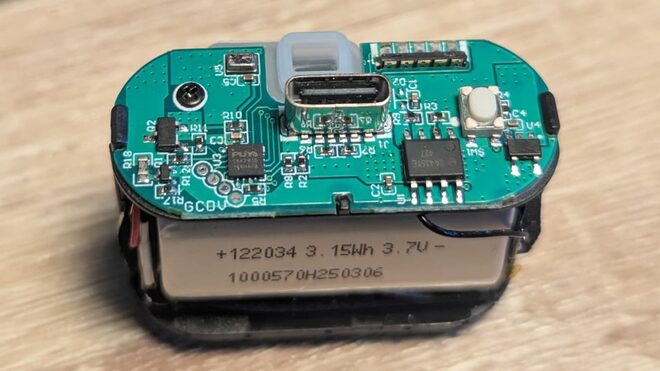
A discarded e-cigarette, a tiny microchip – and suddenly a working web server. Romanian engineer and origami artist Bogdan Ionescu has turned scrap electronics into what he calls the VapeServer, a miniature device that has been making headlines in tech media and maker communities worldwide since mid-September 2025. Reported directly by The WP Times, citing Ionescu’s own blog BogdanTheGeek, the project combines creativity, sustainability and engineering precision, sparking debate from Bucharest to Silicon Valley.
What’s behind the VapeServer
E-cigarettes are among the fastest-growing consumer products. In 2024 alone, over 20 billion devices were sold worldwide, according to industry researchers. Millions are thrown away every month, often with perfectly functioning microchips still inside. One of these chips is the PUYA C642F15, an ARM Cortex-M0+ running at 24 MHz, with just 24 KB of flash memory and 3 KB of RAM.
Ionescu discovered the component while dismantling discarded e-cigarettes collected from recycling bins in Bucharest. For the tobacco industry, the chips are cheap controllers for vapourisers. For hobbyists like Ionescu, however, they are raw material for digital experiments.
How the conversion worked
Ionescu reprogrammed the chip by first implementing the Serial Line Internet Protocol (SLIP) – a method dating back to the early 1980s that once connected home computers to the internet. He then added the uIP 0.9 TCP/IP stack, originally developed for microcontrollers.
The early tests were disappointing: websites took up to 20 seconds to load, ping times averaged 1.5 seconds, and half the data packets were lost. But after several weeks of optimisation, he introduced a ring buffer and leaner routines. The result: a response time of around 20 milliseconds – comparable with basic home routers.
Key technical features of the VapeServer
The VapeServer is not a commercial product but a demonstration of ingenuity. It shows how discarded hardware can still serve as a functioning internet device.
Main specifications at a glance:
- Chip: PUYA C642F15, ARM Cortex-M0+
- Clock speed: 24 MHz
- Flash memory: 24 KB
- RAM: 3 KB
- Protocols: SLIP and uIP 0.9 TCP/IP stack
- Optimised performance: 20 ms response time
What it means in practice
The VapeServer can only deliver tiny HTML pages, up to 20 KB in size. Ionescu put a stripped-down version of his blog online, which could be accessed by visitors worldwide. However, when more than a dozen simultaneous requests arrived, the chip returned only “503 Service Unavailable.”
In other words, the device is not viable for real-world infrastructure. Yet it does prove that even discarded electronics can be transformed into working internet services. Experts describe it as “a textbook case of upcycling and engineering creativity.”
Why the VapeServer matters beyond technology
On the surface, the VapeServer is a playful experiment. But at a deeper level it addresses sustainability, electronic waste and the culture of hacking. E-cigarettes are a source of enormous e-waste, with billions discarded globally each year. By transforming a chip into a functioning server, Ionescu challenges our assumptions about what is “junk.”
Broader implications to consider:
- Highlights the scale of e-waste worldwide
- Demonstrates engineering ingenuity with minimal resources
- Underscores Romania’s emergence as an IT innovation hub
- Encourages upcycling and sustainability in tech
- Inspires global maker and hacker communities
Community reactions
Since the publication of his project on 16 September 2025, discussions have exploded on Reddit, Hacker News and across maker blogs. Some users have called it the “hack of the year,” praising its mix of creativity and sustainability. Others stress its limits, pointing out that it is an inspiring hack rather than a replacement for genuine infrastructure.
In Romania, several tech blogs have featured Ionescu as a figure symbolising how innovation can come not only from global giants but also from small, improvised workshops.
Why Romania plays a role
Over the last decade, Romania has become an IT powerhouse in Eastern Europe. The European Commission estimates that more than 190,000 specialists are now employed in the digital sector. Bucharest is known for affordable hardware development and a growing start-up scene.
Ionescu’s VapeServer illustrates how innovation can emerge outside Silicon Valley or Shenzhen. By building from discarded electronics, Romania’s maker culture positions itself as a source of unconventional ideas.
Who is Bogdan Ionescu
Bogdan Ionescu, 38, lives in Bucharest and works as an electrical engineer. He is well known in the maker community under his YouTube name “BogdanTheGeek”, where since 2016 he has shared projects ranging from recycling experiments to origami art and electronics hacks.
He has won several hackathons in Romania and was described in the local press in 2023 as a “backyard inventor.” His origami models have been displayed in galleries in Bucharest, while his electronics projects have been discussed internationally on Hackaday and Instructables.
“I am a tinkerer by passion,” Ionescu said in his own blog, “and my aim is to give throwaway technology a new life.”
Read about the life of Westminster and Pimlico district, London and the world. 24/7 news with fresh and useful updates on culture, business, technology and city life: The Unseen Revolution: How 5G and 6G are Reshaping Our World.