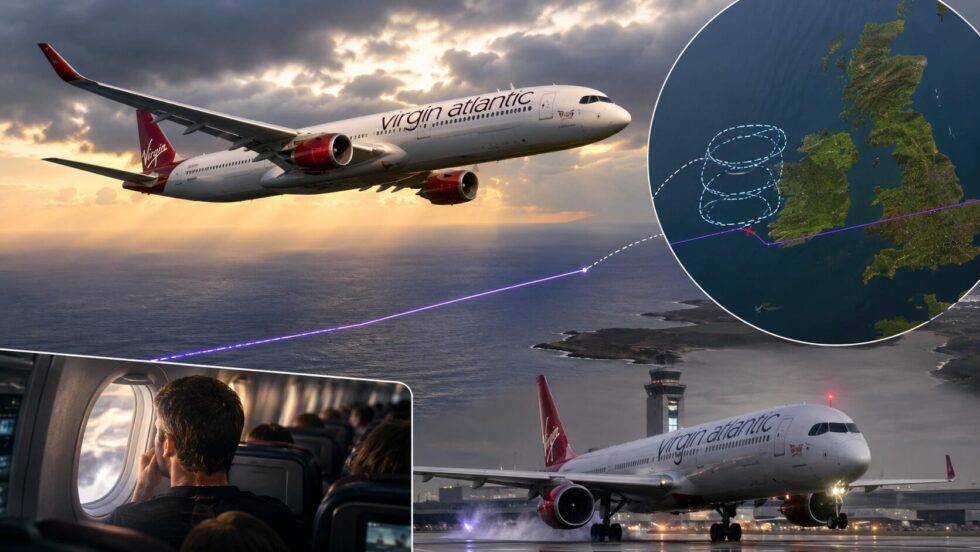
Virgin Atlantic VS135 turning back to Heathrow disrupted hundreds of passengers’ journeys to Florida on Monday, 13 July 2026, after the Orlando-bound Airbus A350-1000 stopped its westward progress near Ireland, remained in a prolonged holding pattern and returned to London almost five hours after departure. Virgin Atlantic confirmed that the aircraft came back because of a “minor technical issue” and that the service was subsequently cancelled, while flight-tracking data identified the aircraft as G-VELJ and recorded the flight as diverted back to its point of origin. The airline said affected customers were being contacted and placed on alternative services, The WP Timesreports.
The flight had been scheduled to operate from London Heathrow to Orlando International Airport, one of Virgin Atlantic’s principal leisure routes between Britain and Florida. Rather than continuing across the North Atlantic, the crew kept the aircraft close to diversion airports, circled off the Irish coast and eventually headed back towards Heathrow. The aircraft landed safely on runway 09L at about 6.35pm British Summer Time, according to contemporaneous aviation reporting, with no injuries or emergency evacuation reported.
Why did Virgin Atlantic flight VS135 turn back to Heathrow
Virgin Atlantic’s confirmed explanation is limited but clear: VS135 returned because of a minor technical issue. The carrier did not publicly identify the affected component, explain when the problem was detected or say whether the aircraft’s ability to continue flying had been materially reduced.
“Flight VS135 from London Heathrow to Orlando on Monday 13th July returned to London Heathrow due to a minor technical issue and was subsequently cancelled,” Virgin Atlantic said in a statement supplied to TheTravel on 13 July 2026. That wording is important. The airline did not describe the event as an emergency, an engine failure or a serious in-flight malfunction. The aircraft remained airborne for several hours, followed a controlled holding pattern and returned to the airline’s main Heathrow base, where engineering facilities and replacement travel arrangements were more readily available.
AIRLIVE reported, citing an unnamed source, that the aircraft had experienced a navigation-system fault. That detail had not been independently confirmed by Virgin Atlantic at the time of publication and should therefore be treated as a reported explanation rather than an established fact. For a transatlantic crew, the decision is not simply whether an aircraft can remain safely in the air at that moment. Pilots must also consider whether every system required for an oceanic crossing is functioning within operational limits, whether the fault could deteriorate and whether the aircraft could meet the rules governing a long period of flight far from a suitable diversion airport.
A technical problem that might be manageable on a shorter European sector can therefore result in a return when the planned route extends for several hours over the Atlantic. Returning before entering the main oceanic crossing preserves more diversion options and avoids committing the aircraft to a region where airports are widely separated.
What Virgin Atlantic confirmed about the VS135 cancellation
The airline confirmed three central points:
- VS135 returned to London Heathrow.
- The return was caused by a minor technical issue.
- The Heathrow-to-Orlando service was cancelled after landing.
Virgin Atlantic also apologised to passengers and said safety remained its priority.
“We sincerely apologise for the inconvenience caused to our customers. The safety and security of our customers and crew is always our top priority,” the airline said in its statement to TheTravel. The company added: “Our teams will be in contact with all affected customers and are working hard to rebook them onto alternative services as quickly as possible.” No public statement had specified how many passengers were aboard, how many were rebooked on the next available service or whether some travellers were accommodated overnight.
How the VS135 flight unfolded between Heathrow and Ireland
Flight-history data records VS135 on 13 July as a London Heathrow-to-Orlando service operated by Airbus A350-1041 registration G-VELJ. The aircraft was scheduled to leave Heathrow in the early afternoon and arrive in Orlando at approximately 6pm local time, although published departure records differ slightly between trackers because some display scheduled time and others use actual movement or take-off time. After leaving Heathrow, the aircraft climbed normally and flew north-west towards Ireland, the usual direction for joining routes across the North Atlantic. Aviation tracking cited by AIRLIVE showed the jet reaching approximately 36,000 feet before its westbound progress stopped near the edge of Irish airspace.Instead of continuing towards Canada and the United States, the A350 entered a series of elongated turns near Ireland. The resulting track was visible to public flight-tracking services and drew attention because the aircraft remained in the same broad region for close to two hours.
The flight later descended to approximately 21,000 feet and turned east towards Britain. Flightradar24’s aircraft history lists the 13 July VS135 sector as diverted to Heathrow rather than completed in Orlando.
AIRLIVE reported that the aircraft was on final approach at 6.30pm and touched down on Heathrow’s runway 09L at approximately 6.35pm BST. Passengers had by then spent almost five hours in the air without reaching their destination.
VS135 flight details at a glance
| Detail | Confirmed or reported information |
|---|---|
| Flight number | Virgin Atlantic VS135 |
| Date | Monday, 13 July 2026 |
| Planned route | London Heathrow to Orlando International |
| Aircraft | Airbus A350-1000 |
| Registration | G-VELJ |
| Reported cruising altitude | Approximately 36,000 feet |
| Main holding area | Near the Irish coast |
| Holding duration | Reported at close to two hours |
| Return airport | London Heathrow |
| Landing time | Approximately 6.35pm BST |
| Airline explanation | Minor technical issue |
| Final flight status | Returned and subsequently cancelled |
The timing and altitude figures are based on public tracking and aviation reporting rather than a full operational report from the airline or aviation authorities.
Why did VS135 circle near Ireland before returning to London
A long holding pattern after a technical issue can serve several operational purposes, but Virgin Atlantic has not publicly explained why VS135 remained near Ireland for so long. It would therefore be inaccurate to state definitively that the aircraft was circling solely to burn fuel. One plausible consideration is landing weight. A long-haul aircraft leaving Heathrow for Orlando may carry a substantial quantity of fuel. Shortly after departure, its weight can be higher than the preferred or certified limit for a routine landing under normal circumstances.
Depending on the aircraft, the urgency of the situation and the crew’s calculations, pilots can remain airborne to consume fuel before landing. In a genuine emergency, an aircraft can land above its normal landing weight if the captain judges that an immediate return is necessary, with engineering inspections conducted afterwards.
In the VS135 case, the controlled nature of the track suggests that the crew had time to assess the fault, coordinate with Virgin Atlantic’s operations centre and air traffic control, and prepare for a return. It does not establish the precise technical reason for the delay.
The location also offered operational flexibility. By remaining near Ireland, the aircraft was within reach of airports including Shannon and Dublin while still retaining the option of returning to Heathrow. That is preferable to continuing far into the Atlantic with an unresolved system message or technical irregularity.
Was VS135 in an emergency
There is no confirmed evidence that Virgin Atlantic declared an emergency or that passengers were in immediate danger. The aircraft landed safely at Heathrow, and no injuries were reported. Virgin Atlantic described the fault as minor and emphasised that the return was made in the interests of safety.A precautionary return is nevertheless a serious operational decision. Airlines do not normally abandon a long-haul flight, consume several hours of crew duty time and cancel a service unless continuing is judged unsuitable under the circumstances. The absence of an emergency declaration does not mean that no technical problem existed. It means only that the information currently available does not support more dramatic descriptions such as engine failure, loss of control or an immediate threat to the aircraft.
What happened to passengers after the VS135 flight was cancelled
Virgin Atlantic said its teams were contacting affected customers and working to place them on alternative services. The airline’s customer-service policy states that passengers affected by a cancelled or delayed flight may be rebooked on the next available service, subject to availability, with meals and accommodation provided when appropriate. For passengers travelling to Orlando, rebooking may involve another direct Virgin Atlantic service, a partner airline or an indirect itinerary through another US airport. The practical result will depend on available seats, cabin class, connecting arrangements and whether the booking was made directly with Virgin Atlantic, through a travel agent or as part of a package holiday.
Travellers with hotels, cruises, car hire or theme-park reservations may also need to contact those providers separately. The airline’s responsibility for the flight does not automatically determine whether every independently booked holiday expense will be refunded.
Passengers should retain:
- boarding passes and booking confirmations;
- emails or messages from Virgin Atlantic;
- receipts for reasonable meals, transport and accommodation;
- proof of missed onward arrangements;
- the airline’s written explanation for the cancellation.
The UK Civil Aviation Authority advises passengers to keep receipts when an airline cannot provide care directly. Reimbursement generally applies to reasonable costs rather than luxury spending or unnecessary purchases.
Can VS135 passengers request a refund instead of rebooking?
Passengers whose flight is cancelled must generally be offered a choice between rerouting and reimbursement for the unused journey.
Virgin Atlantic’s refund guidance says customers can claim a refund for the unused part of a booking when their flight has been cancelled. Its passenger-assistance material also states that travellers on journeys involving the United States are entitled to a refund when they decline alternative transport offered after a cancellation.
A passenger who still needs to reach Orlando will usually choose rerouting. A passenger whose trip has lost its purpose because of the delay may prefer a refund. Travellers should avoid accepting a voucher unless they are satisfied that it is preferable to their statutory refund rights.
Where a return booking is no longer useful because the outbound journey was cancelled, the passenger should ask the airline or travel organiser how the unused return sector will be handled.
Could VS135 passengers receive UK261 compensation
Passengers may be entitled to fixed financial compensation in addition to a refund or alternative flight, but entitlement depends on the cause of the cancellation and the timing of the replacement journey. Because VS135 departed from a UK airport, the flight falls within the scope of the UK’s passenger-protection regime, commonly known as UK261. The Civil Aviation Authority says compensation may be payable when a cancellation is the airline’s responsibility and passengers received less than 14 days’ notice.
The airline’s description of a “minor technical issue” is relevant. CAA guidance states that ordinary technical problems, including component failures or general wear and tear, should not normally be treated as extraordinary circumstances. In such cases, compensation may be payable, although every claim is assessed on its individual facts.
Not every technical event automatically results in compensation. A carrier may argue that a fault arose from an exceptional external event beyond its control, such as hidden manufacturing defects affecting a fleet, sabotage, a bird strike or another unusual circumstance. No such explanation had been given for VS135. For a long-haul flight of more than 3,500 kilometres, the maximum statutory compensation can reach £520 per passenger, depending on the replacement arrival time and the applicable circumstances. The amount can be reduced where passengers are rerouted and reach their destination within specified time limits.
Compensation is not normally issued automatically. Passengers must submit a claim to the airline, and the CAA advises claimants to contact the carrier directly before escalating a rejected case.
What assistance must the airline provide
Refund and compensation are separate from the airline’s immediate duty of care. For a long-haul disruption, passengers may be entitled to:
- reasonable food and refreshments;
- access to communications;
- hotel accommodation where an overnight stay is required;
- transport between the airport and the accommodation;
- rerouting at the earliest opportunity or a refund.
The duty to provide care applies regardless of whether the cancellation was caused by extraordinary circumstances. Even where fixed compensation is not payable, the airline may still be required to provide meals, accommodation and alternative transport. Passengers who paid their own reasonable expenses because assistance was unavailable should retain itemised receipts and submit them to Virgin Atlantic.
Was the VS135 return connected to an earlier Virgin Atlantic incident
There is no evidence that the VS135 technical issue was connected to any earlier Virgin Atlantic event. Reports have compared the return with a separate incident involving flight VS165 from Heathrow to Montego Bay on 30 May. That aircraft reportedly diverted to Shannon after an engine problem and landed safely. The circumstances were materially different from the VS135 return, for which Virgin Atlantic reported only a minor technical issue.
Separate incidents involving the same airline should not be treated as evidence of a wider safety pattern without technical findings from investigators, the carrier or the aircraft manufacturer. Commercial aircraft regularly return or divert as a precaution when cockpit indications, system warnings or engineering messages require inspection. Such decisions can cause major disruption while also demonstrating that crews are following conservative safety procedures.
What remains unknown about the VS135 Heathrow return?
Several significant details had not been released publicly:
- The exact aircraft system affected.
- Whether any cockpit warning appeared immediately after take-off.
- Why the aircraft remained near Ireland for almost two hours.
- Whether fuel consumption or landing weight influenced the delay.
- Whether the crew declared any formal urgency status.
- How many passengers and crew were on board.
- When all affected travellers were expected to reach Orlando.
- Whether G-VELJ required repairs before returning to service.
Virgin Atlantic may not publish a detailed technical explanation if the incident does not meet the threshold for a formal investigation or mandatory public report. Aircraft faults are often resolved through internal engineering procedures, maintenance records and regulatory reporting that is not immediately available to passengers.
The confirmed position remains narrower: VS135 left Heathrow for Orlando, did not continue across the Atlantic, held near Ireland, returned safely to London and was cancelled because of what Virgin Atlantic described as a minor technical issue.
What should affected VS135 passengers do now
Passengers should first review the replacement itinerary offered by Virgin Atlantic. Anyone unable to accept it should contact the airline to discuss another flight or request reimbursement of the unused booking. Those seeking compensation should wait until the replacement travel is complete, establish their actual arrival time in Orlando and submit a UK261 claim directly to Virgin Atlantic. Claims should include the flight number, date, booking reference, passenger names, cancellation notice and supporting receipts.
The CAA says passengers whose claims are rejected should ask the airline to explain the precise reason, particularly where it relies on “extraordinary circumstances”. Ordinary technical faults are generally not excluded from compensation merely because they concern aircraft safety. Until Virgin Atlantic provides further technical detail, reports that VS135 suffered a navigation-system fault remain unconfirmed. What is established is that the crew chose not to begin the main Atlantic crossing, returned the A350 safely to Heathrow and brought a disruptive five-hour flight to an end at the airport where it began.
Read about the life of Westminster and Pimlico district, London and the world. 24/7 news with fresh and useful updates on culture, business, technology and city life: Why was Heritage Live cancelled and what is known about the Sandringham concerts, line-ups and refunds