

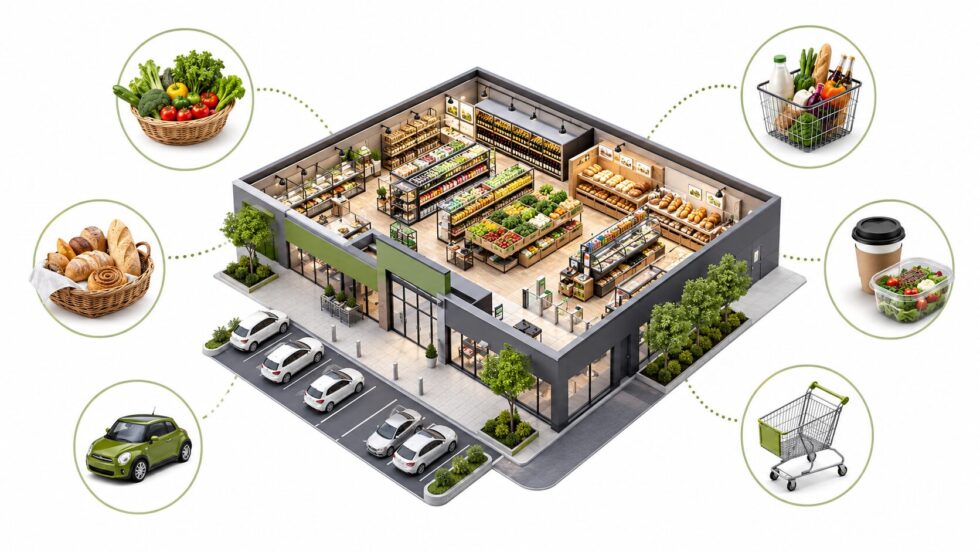
Waitrose new store formats are being developed around a mid-sized “neighbourhood” supermarket designed for suburban districts and commuter towns where a full-scale branch may be too large but a Little Waitrose cannot offer enough choice. The approximately 7,000 sq ft shops are expected to carry around 6,500 products, devote more room to fresh food, baking and ingredients for home cooking, and generally provide about 50 parking spaces, placing them between the retailer’s traditional supermarkets and its smallest convenience outlets.
The format forms part of Waitrose’s multi-year £1 billion investment programme, which includes new branches, extensive refurbishments and improvements to customer service, availability and store design. Its expansion also places the employee-owned retailer in more direct competition with M&S Food, which is opening and renewing larger Foodhalls as both businesses pursue customers who want premium-quality meals without relying on one large weekly supermarket visit, The WP Times reports.
What Are the Waitrose New Store Formats
The neighbourhood concept is intended to close a physical gap in the Waitrose estate. A Little Waitrose branch may occupy roughly 2,500 to 3,000 sq ft and concentrate on immediate purchases, lunches, drinks and household top-ups. A conventional Waitrose supermarket can range from approximately 10,000 to 25,000 sq ft or considerably more, allowing it to carry a broader grocery selection and specialist counters.
At about 7,000 sq ft, the neighbourhood store sits almost precisely between those two models. It is large enough to support a meaningful fresh-food range, a stronger bakery offer and ingredients for several days of home cooking, but small enough to fit into retail parks, district centres and affluent commuter locations where a conventional supermarket would require too much space.
Around 6,500 products are expected to be available in a typical branch. That is not the range of a major full-line supermarket, but it should allow customers to complete more than a basic convenience shop. The layout is intended to serve residents buying dinner for the same evening, several meals for the week, fresh bread, fruit and vegetables, household necessities or premium food for entertaining. Reported specifications for the emerging format include:
| Store feature | Neighbourhood Waitrose model |
|---|---|
| Approximate selling space | 7,000 sq ft |
| Expected product range | About 6,500 lines |
| Typical parking provision | About 50 spaces |
| Main locations | Suburbs and commuter towns |
| Core emphasis | Fresh food, bakery and cooking |
| Position in the estate | Between Little Waitrose and a full supermarket |
The individual design will depend on each building and local planning conditions. The figures therefore describe the broad format rather than an undertaking that every future branch will have an identical floor plan, product count or car park.
Why Is Waitrose Opening Neighbourhood Supermarkets
The central argument behind the format is that grocery shopping no longer revolves around a single weekly journey to one large supermarket. Households now divide spending between stores, online deliveries, rapid top-up visits and purchases made on the way home from work. Tina Mitchell, Waitrose retail director, said the company’s growth strategy was being shaped around changes in how customers live and shop. She described modern grocery buying as an “omnichannel experience” and said Waitrose was seeking high-footfall sites offering the right size and location. The message is commercially important: the retailer is not simply trying to build smaller supermarkets, but to occupy more of the places where customers already make frequent food purchases.
The neighbourhood branch is meant to accommodate several shopping missions at once. A customer should be able to enter for milk and bread without navigating a huge building, while another should be able to assemble several complete meals rather than visit a second supermarket. This makes the format potentially useful in areas with strong residential demand but insufficient land or population density for a traditional Waitrose. Its planned parking capacity also indicates that the concept is not merely a high-street convenience shop. Around 50 spaces would allow it to attract drivers from a broader local catchment while retaining a faster, more compact layout than an out-of-town supermarket.
How Will the New Shops Differ From Little Waitrose
Little Waitrose stores are designed primarily for convenience. Their smaller floor plates inevitably limit how many product varieties, fresh departments and cooking ingredients they can carry. They work particularly well in railway stations, petrol stations, city centres and other locations dominated by short visits. A neighbourhood shop is intended to offer substantially more choice. Customers can expect a wider fresh-food range, a larger bakery and more products for preparing meals at home. The expanded assortment may include additional varieties within core grocery categories rather than simply adding premium or specialist products.
That distinction matters because the new branches are being positioned as local supermarkets rather than enlarged convenience stores. Waitrose needs the format to demonstrate that shoppers can complete a useful grocery trip there, not merely buy a sandwich, bottle of wine or forgotten ingredient. The model also gives the retailer greater flexibility when considering property. A 7,000 sq ft requirement opens more potential locations than a conventional supermarket of 20,000 sq ft or more, particularly in established towns where large development sites are scarce.
Where Have Waitrose Neighbourhood Stores Already Opened
Waitrose has reportedly established around 20 shops following the emerging neighbourhood model. Locations associated with the format include Leatherhead and Oxted in Surrey, Bromsgrove in Worcestershire, Knutsford in Cheshire and Jesmond in Newcastle. The latest confirmed opening is at Chelmer Village Retail Park in Essex. The 7,000 sq ft store opened on 10 July 2026 and created 39 local jobs. Waitrose presented it as another step in its £1 billion UK-wide investment plan and designed it to provide a broad selection of the company’s food and household products in a relatively compact space. The choice of Chelmer Village illustrates the type of site Waitrose is pursuing. It is a retail-park location serving nearby residential communities, with road access and existing customer traffic. That combination supports both quick visits and larger grocery purchases without demanding the footprint of a full-line supermarket.
The wider list of locations suggests Waitrose is not limiting the model to the South East. Although Surrey and Essex fit the retailer’s traditional geographic strength, Bromsgrove, Knutsford and Jesmond demonstrate how the format could be used in prosperous districts across England.
Waitrose has not published a complete confirmed list of every neighbourhood branch it intends to open. Reports that it is planning “dozens” of the stores should therefore be treated as a national expansion objective rather than a final schedule containing named towns and opening dates.
Could a New Waitrose Open Near You
The retailer says it is looking nationwide for high-footfall sites offering the appropriate size and position. In practice, several characteristics are likely to make a location attractive:
- A substantial residential population within a short journey
- Regular commuter or local shopping traffic
- Space for a branch of around 7,000 sq ft
- Convenient pedestrian and road access
- Parking or nearby shared parking provision
- Demand for premium fresh food and prepared meals
- Limited availability of suitable full-sized supermarket sites
A suburban retail park, redeveloped local centre or former medium-sized shop could therefore be more suitable than either a tiny city-centre unit or a very large out-of-town development.
The strategy may also allow Waitrose to enter towns where it previously decided that a traditional supermarket would be commercially difficult. A smaller building requires less space, can be quicker to fit out and may reduce operating costs, although the company has not published a standard investment figure for each neighbourhood opening. Customers should not assume that every rumoured commercial unit will become a Waitrose. New shops remain dependent on property agreements, planning consent, licensing, construction and local trading assessments. Confirmed openings are normally announced by Waitrose or the relevant property owner once those arrangements are sufficiently advanced.
How Does the £1 Billion Waitrose Investment Plan Work
The neighbourhood rollout is only one element of a much broader programme. Waitrose’s £1 billion multi-year investment covers new shops, store refurbishments, service improvements and changes intended to make shopping more convenient.
Thirty Waitrose stores were scheduled for refurbishment during 2026. Early projects included supermarkets in Haslemere, Barnet, Chiswick, Ruislip and Menai Bridge, as well as smaller branches in Knutsford and Muswell Hill. Improvements have included redesigned bakeries and modernised meat and fish departments.
Waitrose is also investing in larger supermarkets. Two full-line branches with more than 30,000 sq ft of combined selling space were announced for Hale Barns in Greater Manchester and Cricklewood in north-west London, with openings expected in autumn 2026. A substantially larger 30,000 sq ft supermarket is planned for the Brabazon development in Bristol in 2028, where the retailer expects to create about 150 jobs.
The estate strategy can consequently be divided into three parts:
- Neighbourhood shops: Medium-sized branches for suburbs and commuter towns.
- Little Waitrose: Convenience stores for immediate and top-up purchases.
- Full-line supermarkets: Larger destinations with an extensive range and more departments.
This allows Waitrose to choose a format according to local demand rather than applying the same supermarket model in every town.
Why Is Waitrose Competing More Directly With M&S Food?
Waitrose and M&S are not identical businesses, but their grocery operations increasingly compete for overlapping customers. Both emphasise quality, meal ideas, fresh food, prepared dishes, bakery products and food for entertaining. Both are also trying to demonstrate that premium positioning does not exclude everyday value.
M&S reported food sales growth of 7 per cent for the 52 weeks ending 28 March 2026, with UK food volumes increasing by 3.3 per cent. It opened 12 new Food stores during the year and said a further 18 openings were planned for 2026-27. M&S Food’s market share was reported at 4.1 per cent.
Its property strategy also calls for the number of Food locations to rise from 335 to 420, with an emphasis on larger, more productive stores capable of carrying a broader range. That expansion creates a direct property and customer battle in suburbs, retail parks and regional centres where Waitrose may also be seeking space.
Waitrose, however, enters this phase with improving commercial momentum. For the year ending 31 January 2026, Waitrose sales rose by 7 per cent to £8.5 billion. Volumes increased by 3 per cent, adjusted operating profit reached £256 million and the company recorded a tenth consecutive quarter of customer growth. Waitrose said it was attracting 5 per cent more shoppers than two years earlier.
The strategic contest is therefore not simply about which company operates more stores. It concerns which retailer can provide the most convenient combination of quality, value, location and range for customers who may shop several times a week.
Will Waitrose Neighbourhood Stores Be Cheaper?
A different store format does not automatically mean a separate pricing structure. Waitrose has not announced that neighbourhood branches will operate as a discount format or carry permanently lower prices than its other shops.
Instead, the retailer is addressing affordability across its broader own-brand range. In May 2026, Waitrose committed more than £20 million to reducing prices on over 160 own-label products by an average of 12 per cent. Nearly half of the affected lines came from the Essential Waitrose range.
The reductions formed the ninth round of the company’s New Lower Prices programme since 2023. Waitrose said cumulative investment had reached £162.5 million across more than 1,000 products. Examples of products covered by the latest reductions included everyday fruit, vegetables and meat.
For neighbourhood shops, the decisive question will be product selection. Even when prices are consistent across the business, a compact branch cannot carry every size, flavour and alternative stocked by a full supermarket. Customers may therefore need to compare availability as well as price.
Nathan Ansell, Waitrose customer director, said shoppers remained careful about their spending but should not have to sacrifice quality. The company’s declared objective is to make regular essentials more competitive while preserving its standards on sourcing, welfare and product quality.
What Will Customers Find Inside a Neighbourhood Waitrose?
The precise range will vary, but the concept is built around fresh food and practical home cooking. A typical shop can be expected to allocate meaningful space to:
- Fruit and vegetables
- Fresh meat, fish or prepared proteins, depending on the branch
- Bread, pastries and an expanded bakery selection
- Chilled meals and food-to-go
- Dairy products and everyday groceries
- Cooking sauces, herbs, seasonings and ingredients
- Wine, beer and other drinks, subject to licensing
- Essential household and personal-care products
- Selected premium and seasonal lines
The format is unlikely to reproduce every specialist department found in Waitrose’s largest supermarkets. Its purpose is to edit the range around the products most useful to the surrounding community. A successful neighbourhood branch must balance premium discoveries with ordinary necessities. Too many specialist lines could make the shop unsuitable for routine grocery buying; too narrow a range could leave it indistinguishable from an existing convenience store. The larger bakery and cooking sections therefore have strategic value. They support Waitrose’s “Home of Food Lovers” positioning while also encouraging customers to use the store for everyday meals rather than only special occasions.
What Does the Waitrose Expansion Mean for Local Areas
A new branch can create jobs, occupy an empty commercial property and attract customers to neighbouring businesses. Chelmer Village’s shop created 39 positions, while larger future supermarkets will employ considerably more people. There may also be local concerns. Additional car journeys can increase pressure on roads and parking, deliveries may affect nearby residents, and established independent shops can face stronger competition. These matters are normally considered through planning applications, traffic assessments and licensing procedures where required.
The neighbourhood model may nevertheless be less disruptive than a large supermarket development because it can use existing retail premises and a smaller footprint. Much depends on whether a project involves a simple conversion, an extension or new construction. For consumers, the immediate benefit is greater access to the Waitrose range. The commercial test will be whether the shop attracts enough repeat local visits to justify a substantial fresh assortment without suffering excessive waste or out-of-stock products.
When Will More Waitrose Neighbourhood Shops Open
Waitrose has confirmed its intention to locate suitable sites nationwide, but it has not released a single public timetable naming every future neighbourhood store. Openings are likely to be announced individually as leases, property purchases and planning arrangements are completed.
The company’s wider activity indicates that expansion is already accelerating. Alongside Chelmer Village, Waitrose is refurbishing dozens of existing stores, preparing full-line supermarkets in Hale Barns and Cricklewood, progressing a Little Waitrose in Ascot and planning the larger Bristol branch. Customers looking for a new store in their area should rely on formal announcements from Waitrose, local councils or confirmed property documentation. Social-media rumours and planning speculation may identify possible locations, but they do not establish that an opening will proceed. The broader direction is clear: Waitrose wants a more flexible physical estate that can operate in several types of location. The 7,000 sq ft neighbourhood supermarket gives the company a format capable of entering areas that are too large for a basic convenience offer but too constrained for a conventional full-line branch.
Waitrose New Store Formats: The Essential Answers
Are the neighbourhood shops full supermarkets?
They are intended to function as compact local supermarkets, but their approximately 6,500-product range will be smaller than that of a large Waitrose.
How big will the shops be?
The reported model is approximately 7,000 sq ft, although individual branches may differ according to the site.
Will they have parking?
A typical neighbourhood location is expected to provide around 50 spaces, but this will depend on the building and any shared retail-park facilities.
Where are they likely to open?
Waitrose is concentrating on high-footfall suburban districts, commuter towns and local centres where the 7,000 sq ft format suits demand and available property.
How many are planned?
Reports describe an ambition to open dozens nationwide. Waitrose has not published a definitive list of all sites or a final total.
Is Waitrose closing its larger supermarkets?
The new model does not replace full-line stores. Waitrose is simultaneously opening larger supermarkets and refurbishing existing branches.
Are prices being reduced?
More than £20 million has been committed to average reductions of 12 per cent across over 160 own-brand products. This is a company-wide value initiative rather than a special neighbourhood-store tariff.
The neighbourhood strategy gives Waitrose a practical answer to one of the central problems facing established supermarkets: how to expand when shoppers demand convenience but still expect enough products to complete a proper grocery trip.
Its performance will depend on disciplined site selection, a carefully edited range and reliable availability. The stores must be small enough to remain convenient, broad enough to replace several separate shopping visits and commercially strong enough to support fresh-food departments. Waitrose’s £1 billion programme indicates that the company is prepared to invest across several years rather than rely on a limited trial. Its improving sales, volume and customer figures provide a stronger base for expansion, but M&S Food is also growing rapidly and investing in larger, higher-productivity locations. For shoppers, the clearest change will be physical: Waitrose may become available in more suburban neighbourhoods without requiring the space needed for one of its traditional supermarkets. The new format is neither a miniature Foodhall nor simply a bigger Little Waitrose. It is an attempt to create a fully usable local supermarket for a period in which British households shop more frequently, use several channels and expect quality food to be available closer to home.
Read about the life of Westminster and Pimlico district, London and the world. 24/7 news with fresh and useful updates on culture, business, technology and city life: How old is Madonna? Her age as she opens the 2026 World Cup halftime show
Materials used: John Lewis Partnership corporate announcements and 2025/26 full-year results, Marks & Spencer 2026 annual report and full-year results, The Times, The Grocer.