
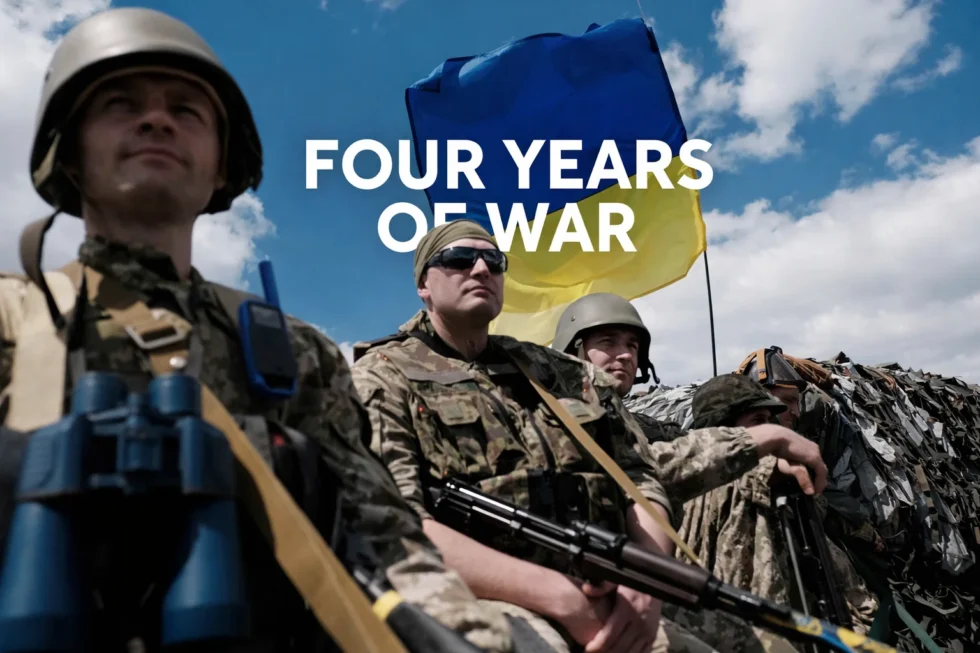
Russia’s full-scale invasion of Ukraine has entered its fourth year, reaching 1,418 days as of 12 January 2026. This duration places the war among the longest and most consequential military conflicts in modern European history. The war in figures illustrates the magnitude of transformation Ukraine has undergone since 24 February 2022: tens of thousands of military deaths, more than 15,000 confirmed civilian fatalities, millions of displaced people, and hundreds of billions of dollars in reconstruction needs. Beyond battlefield dynamics, the conflict has reshaped Ukraine’s demographic structure, fiscal architecture, labor market and energy security system. The country is facing its most difficult wartime winter amid sustained attacks on infrastructure and systemic energy shortages. Economic growth remains fragile and heavily dependent on external financing. International support patterns have shifted, with reduced US assistance and growing EU responsibility. This is reported by The WP Times newsroom, citing Ukraine 7 Days.
Duration of the war: historical comparison and long-term consequences
As of 12 January 2026, 1,418 days have passed since Russia launched its full-scale invasion. This timeframe is not only a numerical milestone but a structural indicator of endurance and cumulative strain. Prolonged warfare increases pressure on defense budgets, accelerates capital depreciation, and deepens social fatigue. It also reshapes generational experiences, with millions of children spending formative years under wartime conditions. The length of the conflict has required repeated adaptation of military logistics, energy systems and fiscal policy. For businesses, extended uncertainty complicates investment planning and risk assessment. For households, long-term instability alters consumption patterns and migration decisions. Historical comparisons provide context for understanding the magnitude of endurance required.
| War | Duration (days) |
|---|---|
| Full-scale war of Russia against Ukraine (as of 12.01.2026) | 1,418 |
| World War I | 1,567 |
| World War II | 2,194 |
| 1941–1945 period in Soviet historiography | 1,418 |
The current war has equaled the duration of the 1941–1945 period in Soviet historiography. This comparison underscores the scale of sustained military engagement and its profound societal consequences.
Military losses: official statements and analytical estimates
Military casualty data remain one of the most sensitive aspects of wartime reporting. In early February 2026, President Volodymyr Zelenskyy stated in an interview with France 2 that 55,000 Ukrainian soldiers had officially been killed. One year earlier, he cited 45,100 killed and approximately 390,000 wounded. These figures reflect confirmed battlefield deaths but do not necessarily include missing personnel or unverified cases. Independent and analytical sources provide alternative assessments based on broader methodologies. Variations in estimates stem from differences in verification standards, inclusion criteria and modeling assumptions. In large-scale conflicts, casualty accounting evolves over time as documentation improves.
| Source | Estimate |
|---|---|
| Presidential statement | 55,000 killed |
| UAlosses (name-based database) | 92,330 killed |
| Center for Strategic and International Studies | ~600,000 total Ukrainian losses (killed, wounded, missing) |
| CSIS estimate of Russian losses | Nearly 1.2 million |
Key considerations include classification restrictions, political sensitivity, and methodological divergence. Casualty levels have long-term implications for veteran care systems, labor supply and demographic balance.
Civilian casualties: scale, patterns and weapon evolution
Civilian casualties continue to shape the humanitarian dimension of the war. UN data confirm at least 15,172 civilian deaths since 2022, including 2,514 in 2025 alone. The actual number is likely higher due to limited access to occupied territories and incomplete documentation. Sixty-three percent of confirmed civilian casualties occurred in frontline areas, indicating geographic concentration of risk. However, expanded use of long-range weapons has increased vulnerability beyond immediate combat zones. In 2025, 577 civilians were killed by drone strikes, representing a 120% increase compared to 2024. Over one-third of civilian deaths were linked to long-range strike systems.
These trends highlight:
- Growing role of drone warfare.
- Increased strike precision but broader geographic exposure.
- Continued urban vulnerability.
- Persistent humanitarian monitoring challenges.
The evolution of military technology directly affects civilian risk distribution and emergency response systems.
Energy crisis: infrastructure damage and systemic deficit
Winter 2025–2026 became the most challenging since the invasion began. Russian strikes targeted electricity generation, heat production facilities and gas extraction infrastructure simultaneously. During peak cold periods, approximately 6,000 apartment buildings in Kyiv were without heat and electricity. Repeated reconnections were necessary after successive waves of attacks. President Zelenskyy stated that all Ukrainian power plants had been damaged. This situation created a systemic generation deficit requiring emergency outage schedules. Energy insecurity also influenced migration decisions and industrial productivity. Businesses faced production interruptions, and households experienced repeated disruptions.
| Indicator | Data |
|---|---|
| Kyiv buildings affected (peak) | ~6,000 |
| Share citing electricity shortage as migration reason | 78% |
| Share citing heating shortage | 57% |
| Status of generation | All power plants damaged |
Amy Pope, Director General of the International Organization for Migration, emphasized that resilience alone cannot offset repeated infrastructure damage. Energy infrastructure remains a strategic vulnerability and an economic constraint.
Economic performance: growth under pressure
Macroeconomic indicators reflect both resilience and limitation. Real GDP growth in 2025 reached 1.8%, according to the National Bank of Ukraine. Without energy shortages, potential growth was estimated at 2.2%. In January 2026, GDP contracted by 1.4% year-on-year due to renewed infrastructure attacks. Reconstruction needs are estimated at $588 billion, including more than $90 billion required for the energy sector over the next decade. War-related spending, inflationary pressures and energy constraints continue to limit expansion. Businesses operate under high risk premiums and restricted credit conditions. External financing plays a stabilizing role but increases long-term dependency.
| Indicator | Value |
|---|---|
| GDP growth 2025 | 1.8% |
| Potential growth | 2.2% |
| GDP January 2026 | -1.4% |
| Total recovery cost | $588B |
| Energy recovery need | $90B+ |
Economic sustainability depends on security conditions, donor consistency and infrastructure stabilization.
Migration and demographic impact
More than 10 million Ukrainians have been displaced since 2022. Of these, 3.7 million are internally displaced persons and 5.9 million remain abroad. Around 1.4 million have returned for at least three months. Net outflow for 2026 is projected at approximately 200,000. Large-scale return is expected no earlier than 2027 under baseline scenarios. Migration affects labor supply, tax revenue and regional population balance. Extended displacement increases integration into host labor markets, reducing return probability over time. Children and women constitute a large share of displaced populations, influencing demographic structure. Regional depopulation of frontline areas presents long-term recovery challenges.
Ukrainians in the European Union: distribution and structure
By the end of 2025, 4.35 million Ukrainians held temporary protection in EU states. Germany hosted 1.25 million, Poland 969,000, and the Czech Republic 393,000. Women accounted for 43.6% of the displaced population, children 30.5%, and adult men 25.9%. Host country integration policies influence employment rates and educational continuity. Access to housing and stable legal status affects long-term settlement decisions. Per capita, the Czech Republic and Poland host the highest shares relative to national population. The longer temporary protection regimes remain in place, the more structural migration patterns may solidify.
Internally displaced persons: housing and psychological strain
Ukraine has officially registered 4.62 million internally displaced persons. Sixty-two percent report housing destroyed or located in occupied territory. Forty-two percent report psychological distress linked to war experiences. Thirty-five percent intend to integrate locally, while 16% plan to return after the war ends. Housing shortages remain the primary integration barrier. Employment mismatch and reduced income stability complicate adaptation. Mental health services face increased demand. Long-term displacement requires coordinated housing, labor and social support policy.
International assistance: financial dependence and balance shift
In 2025, Ukraine secured $52.4 billion in external financing. Since 2022, total budget support reached nearly $168 billion. Germany became the largest military donor in 2025, providing €9 billion. After Donald Trump’s return to the White House, new US assistance volumes declined significantly compared to earlier periods. The European Union assumed a more central fiscal role. Donor consistency directly influences macroeconomic stability. Long-term reconstruction will require sustained multilateral engagement. Fiscal dependence remains a structural feature of wartime budgeting.
Public sentiment: resilience amid fatigue
According to the Kyiv International Institute of Sociology, 65% of Ukrainians are prepared to endure the war as long as necessary. Eighty-eight percent believe energy strikes aim to force capitulation. Sixty-six percent expect EU membership within ten years. Despite fatigue and psychological strain, support for unfavorable concessions has not increased. Public resilience remains a key strategic factor. Social cohesion continues to underpin defense capacity. However, prolonged uncertainty intensifies emotional exhaustion and long-term stress indicators.
Structural transformation after 1,418 days
| Dimension | Structural effect |
|---|---|
| Military | High attrition and veteran care burden |
| Energy | Systemic infrastructure vulnerability |
| Economy | Slow growth and donor dependence |
| Demography | Labor shrinkage and migration risk |
| Society | Endurance under sustained stress |
After 1,418 days of Russia’s full-scale invasion, the war in figures demonstrates deep transformation across economic, demographic and institutional dimensions. Ukraine faces simultaneous military, fiscal and social challenges while preparing for long-term reconstruction and European integration.
Read about the life of Westminster and Pimlico district, London and the world. 24/7 news with fresh and useful updates on culture, business, technology and city life: UK entry rules change from 25 February 2026, as dual nationals must travel using a British passport