

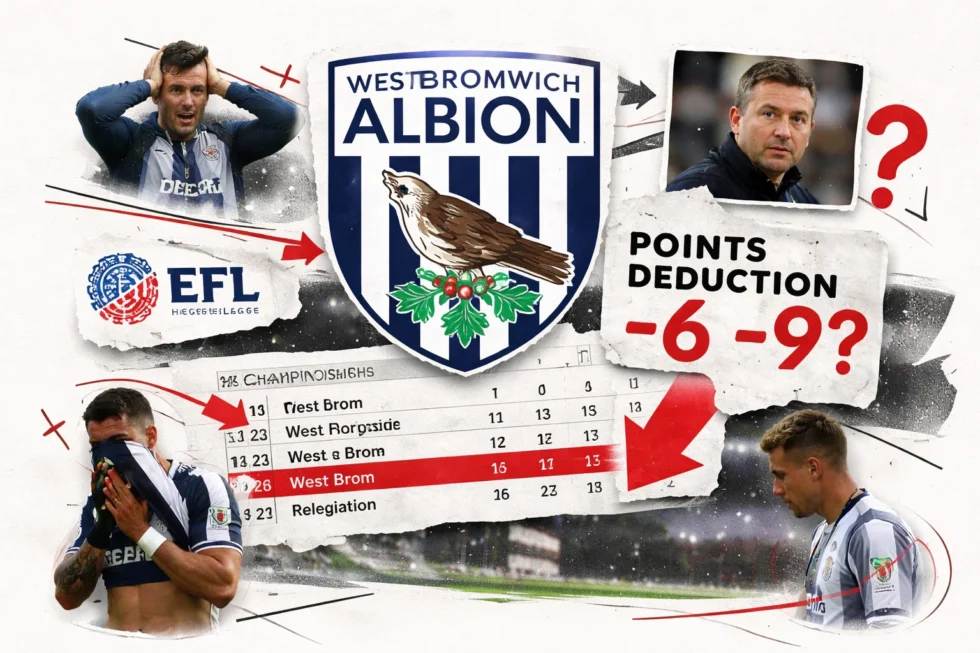
West Brom points deduction fears have intensified after reports that West Bromwich Albion F.C. could face sanctions for a potential breach of the English Football League profitability and sustainability rules, with the Championship club currently sitting just two points above the relegation zone with four matches remaining in the 2025–26 season. The situation centres on an alleged breach of the £39 million loss threshold across a three-year financial cycle to 2024–25, which, if confirmed, could trigger an immediate points deduction and materially alter the relegation battle in the EFL Championship, The WP Times reports.
West Bromwich Albion have responded by stating they have “fully complied” with financial regulations while continuing to cooperate with the EFL’s financial reporting unit, but the timing of any potential ruling—possibly after the final day of the season—creates uncertainty for clubs around them, including relegation rivals and those already sanctioned this season, such as Leicester City F.C. and Sheffield Wednesday F.C., both of whom have faced points deductions under the same regulatory framework.
What is the West Brom points deduction risk and how big could it be
The core issue relates to whether West Brom exceeded the EFL’s permitted financial losses over the monitoring period ending in 2024–25. Under current rules, clubs in the Championship are limited to £39 million in cumulative losses across three seasons.
If a breach is confirmed, the scale of punishment depends on the size of the overspend. Early indications suggest the breach—if proven—could be relatively small, which directly affects the number of points deducted.
Potential sanctions structure:
- Breach up to £2 million → 3-point deduction
- Breach up to £4 million → 4-point deduction
- Mitigation (loss reduction year-on-year) → possible 1-point return
- Final sanction → could range between 2–4 points net
A deduction of even two points would likely drop West Brom into the relegation zone based on current standings, highlighting the immediate competitive impact. The EFL may also consider mitigating factors, particularly if the club has demonstrated improved financial discipline across reporting periods.
Timeline: when could a decision on West Bromwich Albion be made
The procedural timeline is tightly structured but may extend beyond the season itself. Clubs were required to submit their financial accounts by 31 December 2025, after which the EFL’s Club Financial Reporting Unit (CFRU) reviews compliance. Key stages in the process:
| Stage | Timeline | Details |
|---|---|---|
| Accounts submission | 31 December 2025 | Clubs submit financial data |
| Compliance review | Early 2026 | CFRU assesses breaches |
| Notification | Issued to club | Alleged breach communicated |
| Response period | 14 days | Club can challenge findings |
| Hearing | Within 28 days | Independent panel decision |
| Appeal (if needed) | Post-decision | Could delay enforcement |
This structure means any confirmed penalty could realistically be applied after the final Championship fixtures on 2 May 2026, creating the possibility of retrospective league adjustments.
Club response and regulatory position
West Bromwich Albion have stopped short of confirming that a formal charge has been issued, but the club has publicly acknowledged the reports and made clear that it rejects the suggestion that it has breached the EFL’s profitability and sustainability framework. In its response, Albion did not dispute that the matter is under review, but insisted that its financial reporting and conduct fall within the rules currently applied by the league.
“The club considers that it has fully complied with the P&S rules. The club will continue to co-operate with the EFL’s Club Financial Reporting Unit and looks forward to resolving this matter,” West Bromwich Albion said in an official statement (West Bromwich Albion, UK, 13 April 2026).
That wording is significant because it indicates two things at once: first, that the club is aware of an active regulatory process linked to its financial submissions, and second, that it intends to challenge any interpretation suggesting non-compliance. Albion also made clear that no further public comment would be made at this stage, reflecting the legal and procedural sensitivity of cases involving EFL financial oversight. Under the league’s regulatory structure, clubs submit their annual accounts before compliance is assessed by the Club Financial Reporting Unit, which then determines whether a breach case should proceed. Once that process reaches the stage of formal review or response, clubs typically avoid detailed public comment in order not to prejudice legal arguments, mitigation claims or any later appeal. In that context, West Brom’s statement is both defensive and procedural: it protects the club’s public position while signalling continued engagement with the EFL process.
Timing risk: how West Brom points deduction could reshape the Championship table
The potential West Brom points deduction introduces a high-impact variable into the most volatile phase of the EFL Championship season, where margins between survival and relegation are minimal and outcomes are typically decided on the pitch. West Bromwich Albion F.C. are currently positioned just above the bottom three, meaning even a minimal sanction—potentially as low as two or three points after mitigation—would be sufficient to move the club into the relegation zone without any change in on-field results.
The structural issue is timing. With only a limited number of fixtures remaining, the regulatory process risks overlapping with the competitive end of the season, creating a scenario in which final league positions may not be determined by sporting performance alone. If a decision is delayed beyond the final round, the Championship table could be subject to retrospective adjustment, directly affecting relegation outcomes, prize distributions and contractual triggers linked to league status.
Immediate competitive implications:
- A points deduction could move West Brom into the relegation zone instantly
- Survival outcomes may be determined administratively rather than through matches
- Clubs around the bottom three face uncertainty in planning and selection
- Retrospective rulings could alter final standings after 2 May
This season has already demonstrated the scale of impact financial sanctions can have. Leicester City F.C. have been deducted six points for breaching P&S regulations, while Sheffield Wednesday F.C. received an 18-point penalty linked to administration and financial issues. In both cases, sanctions materially reshaped the table, reinforcing that regulatory outcomes are now as decisive as sporting results in the Championship environment.
Financial context: losses, ownership and mitigation factors
West Brom’s latest financial disclosures indicated reduced losses of approximately £17 million, suggesting a shift towards stabilisation following a period of structural imbalance. That trajectory is relevant under EFL rules, where mitigation can be applied if a club demonstrates year-on-year improvement in its financial position.
Since the 2024 takeover, ownership has directed significant capital into restoring operational stability, primarily focused on legacy liabilities rather than aggressive expansion. Key financial dynamics since 2024:
- Substantial funding used to cover inherited debt obligations
- Cost control measures introduced across football and operational departments
- Continued investment to maintain squad competitiveness in the Championship
- Strategic focus on reducing long-term financial exposure
These elements may be critical in determining the final sanction, as the EFL’s framework does not operate solely on breach size but also considers financial direction and intent. A marginal breach combined with demonstrable loss reduction could reduce the effective penalty through mitigation.
What happens next for West Brom and the EFL
The next stage depends on whether the EFL formally upholds a breach following its compliance assessment. If the case proceeds, it will be referred to an independent disciplinary panel, which will determine both liability and sanction in line with established guidelines.
The key uncertainty is not only the outcome, but the timing of that outcome. A decision issued before the final round would allow the table to settle on sporting and regulatory terms simultaneously. However, a delayed ruling—particularly if followed by an appeal—raises the possibility of post-season adjustments, which would create administrative and legal complexity for the league and affected clubs. For now, West Brom remain above the relegation line in the live standings, but the risk profile has shifted significantly. The club’s survival is no longer determined solely by results over the remaining fixtures, but also by an external regulatory process that could intervene at any stage before or after the season concludes.
Read about the life of Westminster and Pimlico district, London and the world. 24/7 news with fresh and useful updates on culture, business, technology and city life: The Masters 2026: Augusta National Commences 90th Edition in a Post-Tiger Era