
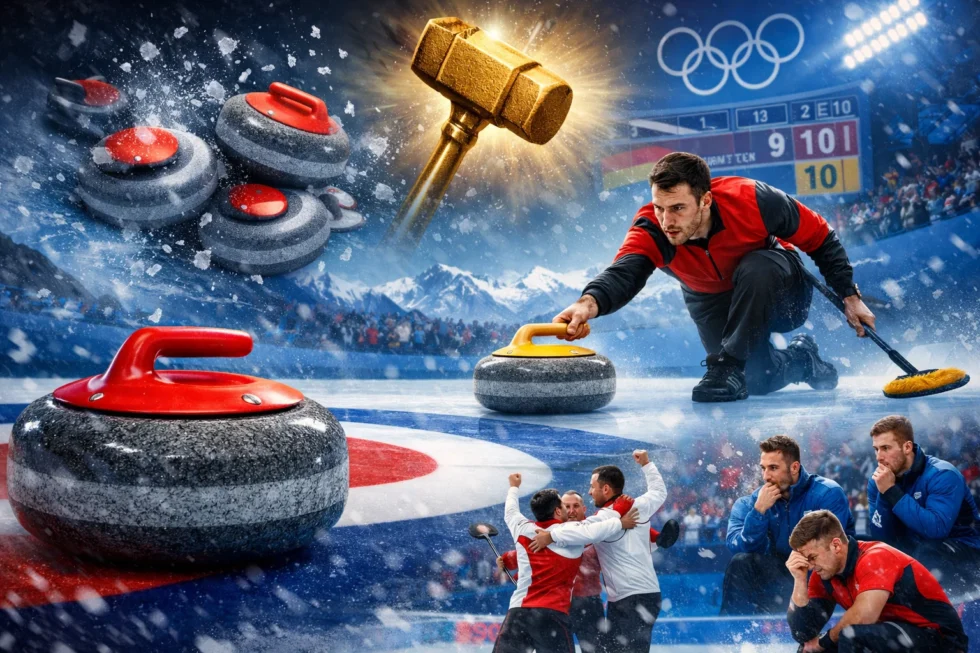
As the 2026 Winter Olympics in Milan–Cortina unfold, curling has once again returned to the global sporting conversation — particularly in the UK, where Team GB’s historic medal success at the Beijing Games in 2022 reignited public interest in a sport long considered niche. Beneath the calm, deliberate pace of curling lies a level of tactical complexity that rivals any elite team sport. At the heart of that complexity is one deceptively simple concept: the hammer. Understanding what the hammer is — and how teams manipulate it — is essential to understanding why Olympic curling matches can swing dramatically from one end to the next, why favourites sometimes appear passive, and why teams occasionally choose not to score at all. This is reported by The WP Times editorial team, following BBC-style Olympic coverage.
What is the hammer in curling
In curling, the hammer refers to the advantage of delivering the final stone in an end. Each end functions like a round or a mini-match within the larger contest, with both teams delivering all of their stones in alternating order. In Olympic men’s and women’s curling, each team throws eight stones per end, for a total of sixteen. The team that throws last holds the hammer, meaning they have the final opportunity to shape the scoring outcome once all other stones are already in play.
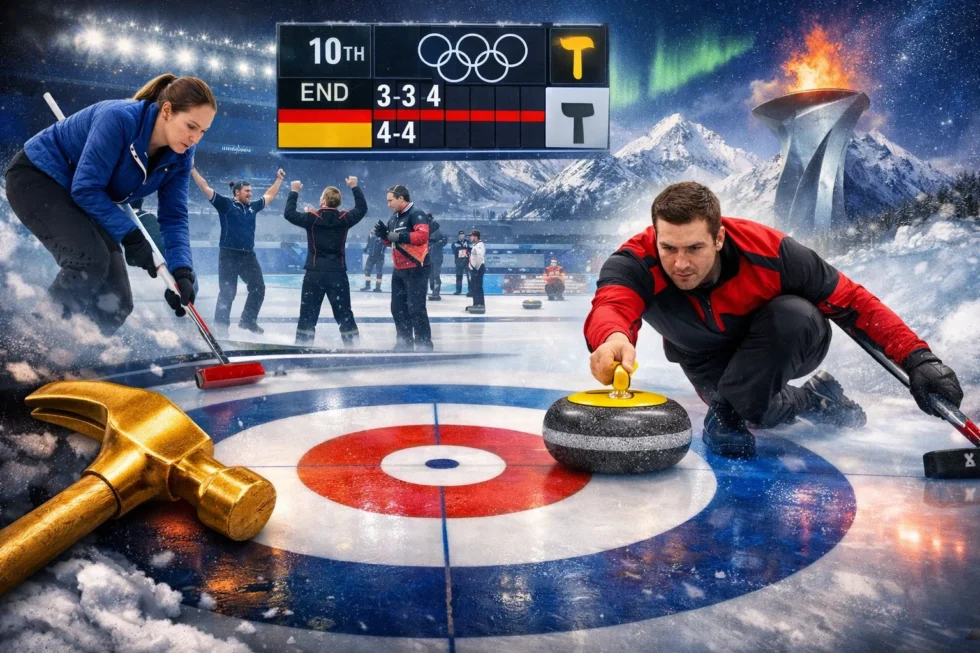
At elite level, this final stone is rarely symbolic. It is often the most rehearsed, most analysed and most pressured delivery of the entire end. With the ice fully read, the opposition’s stones already placed, and sweeping calls refined down to millimetres, the hammer shot frequently decides whether a team scores, how many points they score — or whether the end produces no score at all.
Why the hammer matters so much
The hammer is not simply about going last; it is about control. A team with the hammer can react to everything that has happened before, rather than guessing what might come next. That advantage allows teams to choose from a full tactical menu: executing a precise draw into the house to steal a point, playing a controlled take-out to remove opposition stones, or deliberately limiting risk to secure a minimal score.
Crucially, curling’s scoring system means that only one team can score in any given end. That amplifies the hammer’s importance. With the final stone, a team can decide whether an end produces one point, two or three points — or whether it remains blank. As a result, possession of the hammer often determines the tempo of the match, dictating whether play is aggressive or conservative. This layered decision-making is why curling is so often described by analysts as “chess on ice”.
How is the hammer decided
The hammer is not assigned randomly. Before the match begins, teams compete in a last-stone draw, a precision exercise that doubles as a skills test and a psychological marker. Each team slides stones towards the centre of the house, aiming for the button. The stone that finishes closest earns its team the hammer for the opening end.
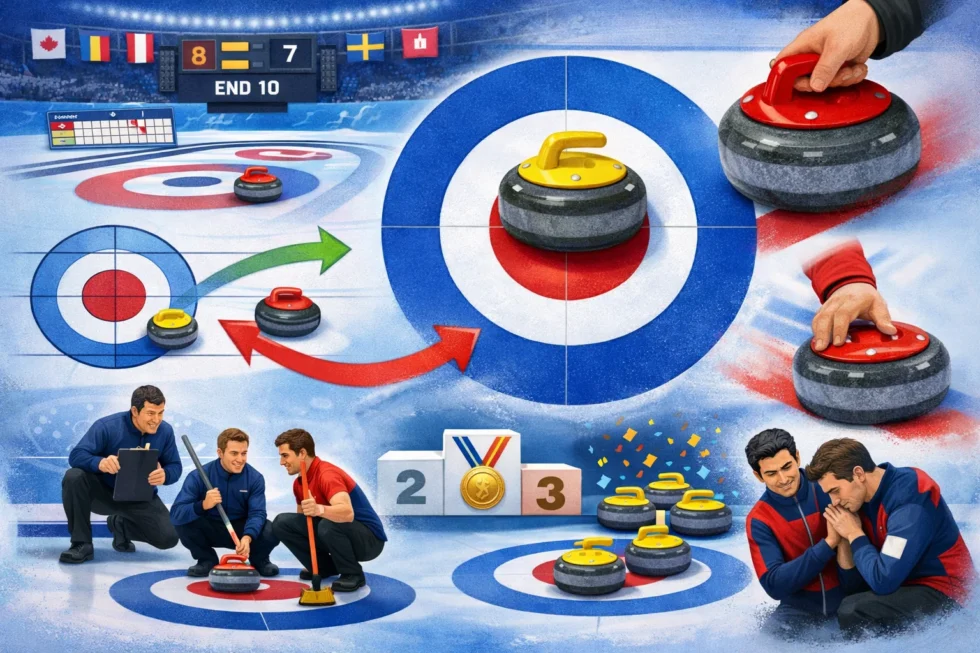
From that moment on, hammer possession follows a strict and elegant rule. If you score, you lose the hammer. If you concede, you gain it for the next end. This creates a constant strategic loop, where teams are not only thinking about the current end but also positioning themselves for future ones. A single point can sometimes be less valuable than hammer control later in the match, especially as the final ends approach.
Why teams sometimes choose not to score
One of the most counter-intuitive concepts for casual viewers is the blank end. If, after all stones have been delivered, no stones remain in the house, no points are awarded. Importantly, the team with the hammer retains it for the following end. At Olympic level, teams will often engineer blank ends deliberately, particularly when only a single point appears available.
This decision is rooted in probability and match management. With the hammer, teams statistically have a higher chance of scoring two or more points. Sacrificing a guaranteed single point in favour of retaining hammer control can therefore be a rational, long-term choice.
These calls are typically made by the skip, the on-ice captain, who balances scoreboard pressure, opponent form and ice conditions in real time.
Who throws the hammer stone
In traditional four-player teams, the final two stones of each end are thrown by the fourth player, who is usually also the skip. One of those deliveries is the hammer stone itself. This dual role demands both technical excellence and leadership under pressure, as the skip must execute the decisive shot they have just called. However, team structures are not rigid. In some national teams, including Great Britain’s women’s programme, leadership and throwing order have occasionally been separated to maximise strengths. In mixed doubles, the format changes significantly, with fewer stones per end — making the hammer even more influential, as a single error can swing the entire match.
How the hammer fits into how curling works overall
To fully grasp the hammer’s importance, it helps to understand the rhythm of a curling match. Olympic matches are played over ten ends in the men’s and women’s events. Stones are delivered alternately, and scoring is determined by which stones finish closest to the button at the end of each round. Teams rely on three primary shot types: guards to protect scoring stones, draws to place stones precisely in the house, and take-outs to remove opposition threats. Sweeping adds another layer of control, subtly altering distance and curl by warming the ice surface. On hammer shots, where margins are smallest and consequences greatest, sweeping decisions are often the difference between success and failure. At this level, the hammer is not just a stone — it is the culmination of an entire end’s strategy.
Why the hammer is central to Olympic curling
At the Olympic level, matches are frequently decided by moments that revolve around the hammer: a missed final take-out, an over-curled draw that slides past the button, or a perfectly executed multi-point end created through careful hammer management. Because of this, commentators and analysts track hammer possession almost as closely as the score itself. As Milan–Cortina 2026 progresses, viewers will repeatedly hear references to “hammer advantage” in the closing ends. Those words often signal where the true balance of power lies. In curling, more than in almost any other Olympic sport, the final move does not merely end the play — it defines it.
Read about the life of Westminster and Pimlico district, London and the world. 24/7 news with fresh and useful updates on culture, business, technology and city life: Olympics Games Milano Cortina 2026: what defines the Winter Games as competition intensifies