

The question of what salary is required to live comfortably in London in 2026 has become increasingly urgent for workers, families, and professionals considering relocation to the UK capital. London continues to rank among the most expensive European cities for housing, transport, childcare, food, and energy costs. Understanding a realistic salary benchmark—after rent, income tax, National Insurance, and everyday expenses—is essential for financial planning and quality of life. This affects long-term residents, new arrivals on work visas, and households across different boroughs from inner London (such as Westminster or Camden) to outer zones (such as Ealing or Croydon). By outlining common living costs and income thresholds for different household types, this article provides clarity on salary expectations for 2026, as The WP Times reports.
What salary comfort means in London and how it works in 2026
“Living comfortably” in London typically means earning enough to cover all essential costs (rent, utilities, taxes, transport), contribute to savings or pensions, and retain some discretionary spending for health, leisure, and contingency costs without excessive financial pressure.
London salaries are subject to UK income tax and National Insurance contributions, which together reduce gross pay by approximately 20–32% depending on income level. For example, a gross salary of £70,000 may result in a net income of around £4,100–£4,200 per month. This net income must then absorb rent, council tax, utilities, transport, groceries, private expenses, and savings.
In 2026 the “living comfortably” threshold varies widely by household type:
- Single professional: needs higher proportional income due to solitary rent obligations.
- Couple without children: can share housing costs but still face high living costs.
- Families with children: face added childcare, schooling-related transport, and larger accommodation costs.
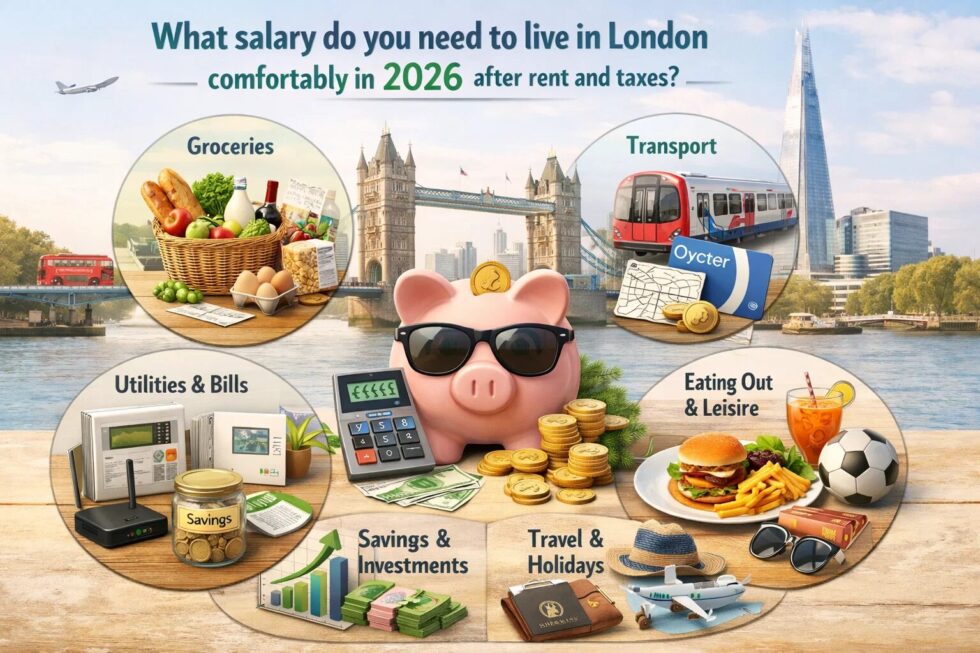
Typical monthly expense breakdown (expanded)
| Feature | Details | 2026 London context |
|---|---|---|
| Rent – 1 bedroom | £1,400–£2,400 | Zone 1–2 highest; Zone 3–4 lower but still above UK average |
| Rent – 2 bedroom | £1,900–£3,000 | Family-sized flats more expensive in central zones |
| Council tax | £120–£200 | Varies by borough and council tax band |
| NHS surcharge (international workers) | £470 (annual) | Often paid upfront for visa holders |
| Utilities & internet | £180–£280 | Heating costs vary by season |
| Transport (Oyster/Travelcard) | £160–£240 | Zones 1–4 Monthly |
| Food & groceries | £300–£450 | Supermarkets vs local markets |
| Childcare (full-time) | £1,200–£1,800 | One child, varies by provider |
| Leisure & miscellaneous | £250–£400 | Gym, dining, occasional travel |
How salary works in real life for London residents
Gross vs. net income
In the UK, gross salary is subject to:
- Income tax: Basic (20%), higher (40%) or additional (45%) rate depending on annual income.
- National Insurance: Around 12% on earnings above a threshold and reduced rate above higher thresholds.
Example tax calculation for 2026 (approximate):
- Gross £50,000 → net ~£2,900–£3,000/month
- Gross £70,000 → net ~£4,100–£4,200/month
- Gross £90,000 → net ~£5,000–£5,100/month
Take-home pay determines what is realistically available for housing and essentials.
Housing and location trade-offs
Rent is the largest and most variable expense. The choice of borough significantly affects affordability:
- Inner London (Zones 1–2): Highest rents but shortest commute times.
- Zone 3–4 areas: Lower rents but increased transport costs and time (e.g., South Norwood, Acton, Leytonstone).
- Outer London (Zones 5–6): Best rent savings but often require express transport fares (e.g., Kingston, Hounslow).
Services such as Docklands Light Railway (DLR), London Underground, and Overground define commuting cost structures. Many residents select housing near major transport nodes to balance rent and commuting expenses.
Household scenarios with practical salary ranges
- Single adult living alone: Comfortable living often starts around £60,000–£65,000 gross if renting independently in Zones 2–3 and includes modest savings.
- Couple sharing housing (no children): Combined gross income of £80,000–£90,000 allows shared rent, joint transport costs, and balanced discretionary spending.
- Family with one child: A gross household income of £90,000–£110,000 is a practical benchmark to cover rent for a 2-bed flat, childcare, council tax, and everyday costs.
- Family with two children: Household income above £110,000+ is often needed, particularly if private childcare or larger housing is required.
Living farther from central zones can reduce rent by up to 20–30%, but increased travel time and cost must be factored in.
Step-by-step practical actions for residents:
- Calculate net monthly income using current UK tax and NI brackets.
- Assess borough-specific rent using property portals (e.g., Zoopla, Rightmove).
- Include council tax band based on chosen accommodation.
- Add transport and utility cost estimates.
- Reserve at least 10% of net income for savings/emergencies.
Core London living considerations
- important requirement: Accurate net income calculation after UK taxes
- key document or step: Employer payslip and contract with salary details
- useful local tip: Check council tax band before signing tenancy
- common rule: Target rent at no more than 40–45% of net income
- practical recommendation: Prioritize transport accessibility when choosing a location
Real-life situations in London
London’s diverse neighbourhoods shape actual cost experiences. For example, living in Stratford (East London) may offer more affordable rent but requires consideration of overlap between housing cost savings and the need for daily transport passes.
“Many London residents reassess their housing each year as rents change,” explains a housing market analyst. Frequent rental increases—typically annual—mean that a salary comfortable at the start of a lease may feel tighter over time if rent adjustments outpace income growth.
Shared living remains an economic reality even for professionals earning above £45,000 per year; flatshares in areas like Clapham, Shepherd’s Bush, or Dalston are common. Shared tenancies reduce individual rent but may increase exposure to variable household bills and shorter lease security.
“Understanding borough-level costs is essential in London,” notes a community adviser. For instance:
- Bromley and Croydon (outer zones) regularly report rent savings compared to inner zones.
- Areas with strong rail links (e.g., Wimbledon, High Barnet) balance rent savings with manageable commutes.
For families, childcare is a major driver of required income. Many nurseries charge £1,200–£1,800 per month for full-time care for one child, significantly increasing a household’s break-even salary. These real-world dynamics illustrate why straight salary figures without cost context do not fully reflect living standards in London.

Salary scenarios by living arrangement
| Option | Benefits | Limitations |
|---|---|---|
| Living alone | Full autonomy | Highest housing cost burden |
| Shared flat (2+ adults) | Lower rent per person | Less privacy/control |
| Outer-zone living | Cheaper rent | Longer commute, higher transport cost |
| Inner-zone living | Close to work | Highest rent, slower savings growth |
Common mistakes London residents should avoid
A frequent mistake is overestimating disposable income by ignoring council tax, which varies by borough and property band. Boroughs such as Westminster and Camden are among the highest in council tax charges, while outer boroughs may be lower but still non-trivial.
Another common error is underbudgeting for childcare or after-school programs. Full-time childcare costs are among the highest in London, often exceeding £12,000 annually per child. Families who budget only for rent often find their disposable income is insufficient without accounting for childcare.
Failing to factor in annual rent increases is another persistent pitfall. Many landlords raise rent upon lease renewal; therefore the salary that felt adequate at the start of a lease may not cover increased costs 12–18 months later without income growth.
Lastly, some residents underestimate energy and utility costs, particularly in winter months. Heating expenses can spike, and older properties (pre-WWII stock) may have poor insulation, increasing annual energy costs beyond national averages.
Frequently asked questions
Q: What salary do you need to live comfortably in London in 2026 after rent and taxes?
A: Most single adults living alone need a gross salary of about £60,000–£65,000 to cover rent, taxes, transport, utilities, and basic savings in 2026.
Q: Is £50,000 a comfortable salary in London?
A: A £50,000 gross salary can cover basic living costs, especially if housing is shared or located in outer zones, but it may feel insufficient for independent living in central boroughs.
Q: How does council tax affect salary requirements in London?
A: Council tax adds £120–£200 per month depending on borough and property band, which must be included in net income planning.
Q: What impact does childcare have on salary needs?
A: Full-time childcare can cost £1,200–£1,800 per month per child, significantly raising the gross income needed for comfortable family living.
Q: Can living farther from central London reduce required salary?
A: Yes, residing in outer zones like Croydon or Bromley generally reduces rent but increases transport costs and commute times, so total cost savings vary by location.
Read about the life of Westminster and Pimlico district, London and the world. 24/7 news with fresh and useful updates on culture, business, technology and city life: Which London Borough Is Best to Live in 2026 for Families with Children