
In a nation that once built the world’s greatest highways and aircraft industries, the United States remains curiously slow when it comes to trains. While Europe and Asia continue to expand their high-speed rail networks, America’s efforts have barely left the station.
The WP Times reports, citing analyses from heise.de, the Congressional Research Service and the American Public Transportation Association (APTA). Despite decades of ambition and tens of billions invested, high-speed rail in the US remains more concept than reality — blocked by freight dominance, fragmented governance and outdated infrastructure priorities.
As Vox noted earlier this year, “The United States has consistently failed to build high-speed rail, and there’s been conversation about it for a long time.” The problem isn’t just money, but mindset. American railways were historically designed for cargo, not passengers. Today, Amtrak — the country’s only intercity rail operator — still leases most of its tracks from private freight companies, meaning that even its flagship trains must often pull aside to let coal or container trains pass.
According to the Congressional Research Service, U.S. policy has oscillated between two approaches: upgrading existing shared tracks or building entirely new dedicated lines. Neither strategy has yet delivered a network comparable to France’s TGV or Japan’s Shinkansen.
Brightline and the hope of private innovation
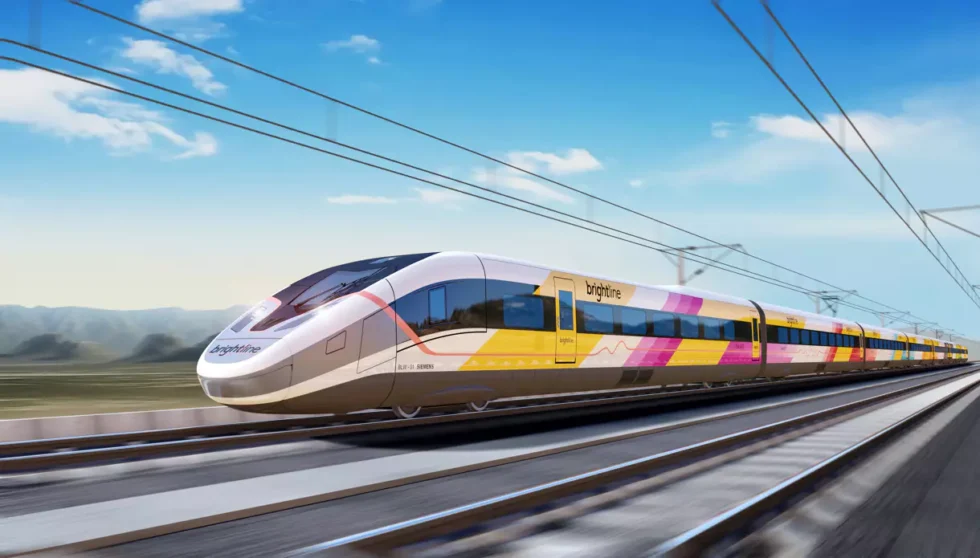
There is, however, one glimmer of progress: Brightline. The private operator has revitalised passenger travel in Florida, running modern diesel-electric trains between Miami and Orlando at up to 125 mph (200 km/h). Its stations are clean, digital and commuter-friendly — more reminiscent of airports than old depots.
The company’s next project, Brightline West, aims to connect Las Vegas and Los Angeles by 2029, using Siemens Mobility’s American Pioneer 220 trainsets capable of 354 km/h. The route follows the Interstate 15 corridor, reducing land-acquisition issues. Yet it will still fall short of true metropolitan integration: the LA terminus is planned for Rancho Cucamonga, 65 km from downtown, while in Las Vegas the line will end in Paradise, south of the Strip.
Door-to-door, the trip may take roughly five hours — similar to flying. Still, Brightline’s design, comfort and private funding model represent a major cultural shift. It has proven that Americans will ride trains — if they are clean, fast and independent of public bureaucracy.
California’s dream, Washington’s caution
The California High-Speed Rail (CAHSR) was once the most ambitious infrastructure project in the nation’s history — designed to link San Francisco and Los Angeles in under three hours. Fifteen years later, it remains mired in construction delays, lawsuits and budget overruns.
At present, only a 171-mile stretch in the Central Valley is being built. The total cost has ballooned beyond $100 billion. In 2025, the U.S. Department of Transportation withdrew $4 billion in funding, forcing California to self-finance at roughly $1 billion per year until 2045. Officials now estimate an operational segment could open in the early 2030s.
Meanwhile, Amtrak’s Northeast Corridor (NEC) — linking Boston, New York and Washington D.C. — remains the country’s only true high-frequency rail line. Its new Acela trains can reach 160 mph (258 km/h), yet average speeds are closer to 70 mph due to tight curves and ageing infrastructure. Compared with the 300 km/h average of Japan’s Shinkansen, the NEC feels more evolutionary than revolutionary.
A separate Maglev project between Washington D.C. and Baltimore, based on Japan’s Chūō Shinkansen, remains at concept stage after losing federal backing.
Comparative overview of U.S. high-speed projects
| Project / Operator | Route | Top Speed | Length | Status (2025) | Launch | Cost (approx.) |
|---|---|---|---|---|---|---|
| Brightline Florida | Miami – Orlando | 125 mph / 200 km/h | 378 km | Operating | 2023 | $5.4 bn |
| Brightline West | Rancho Cucamonga – Las Vegas | 220 mph / 354 km/h | 350 km | Under development | 2029 | $12 bn |
| California High-Speed Rail | San Francisco – Los Angeles | 220 mph / 354 km/h | 1,287 km (planned) | Partial construction | 2033–2040 ? | $100 bn + |
| Northeast Corridor (Amtrak Acela) | Boston – New York – Washington D.C. | 160 mph / 258 km/h | 735 km | Operating | Ongoing | $30 bn (modernisation) |
| Northeast Maglev | Washington D.C. – Baltimore | 310 mph / 500 km/h | 56 km | Planning | TBD | $10–15 bn |
A country still waiting for its train
As the APTA reminds policymakers, high-speed rail is more than a transport project — it’s an economic and environmental strategy. Cleaner travel, regional jobs and reduced carbon emissions are tangible benefits long proven in Japan, France and Spain.
But until Washington commits to a national rail policy with consistent standards, America’s future will remain divided between highways and runways. The Brightline experiment and California’s determination may one day change that — but for now, the richest nation on Earth is still waiting for the future to arrive by train.
Read about the life of Westminster and Pimlico district, London and the world. 24/7 news with fresh and useful updates on culture, business, technology and city life: Artificial Intelligence Regulation: The UK’s Light-Touch Strategy for Global Leadership and Safety