
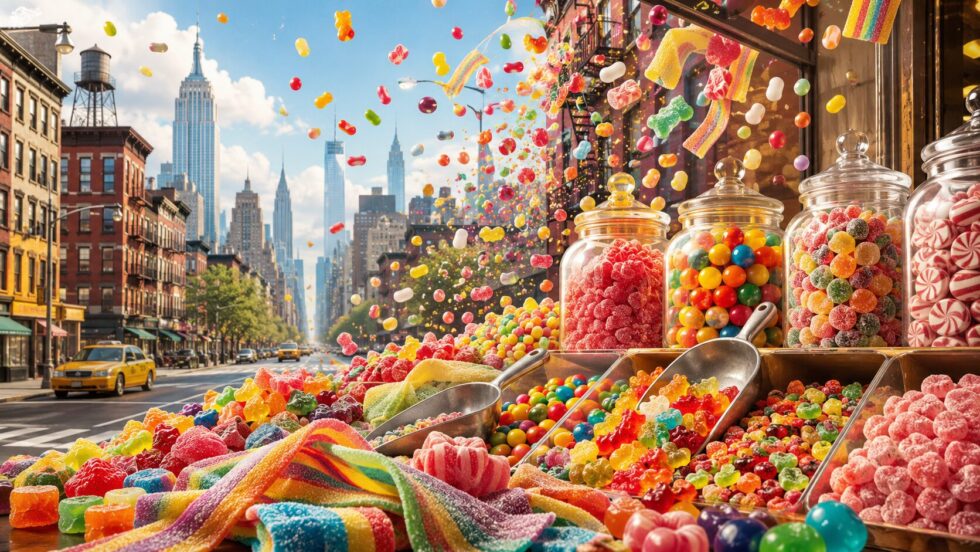
New candy stores are opening across New York City at a moment when American shoppers are anxious, prices remain under pressure and consumer confidence has fallen to historic lows. The growth is not a contradiction but a revealing retail signal: when people delay expensive purchases, they still look for small, emotional and affordable treats, and the candy store has become one of the clearest examples of that behaviour, The WP Times reports.
The trend is visible from Manhattan’s Lower East Side to Brooklyn, the West Village, the Hamptons and nearby commuter towns such as Sleepy Hollow and Greenwich. Old family businesses, Swedish pick-and-mix specialists and new independent retailers are all working with the same basic idea: sweets are cheap enough to survive a difficult economy, attractive enough for social media, and simple enough to sell from small shops with relatively low overheads. The result is a niche boom inside a cautious retail market, where the customer may not buy a new sofa, a holiday or a luxury handbag, but may still spend a few dollars on sour jelly, liquorice, chocolate or nostalgic American candy.
Why candy stores work when consumer confidence is weak
The central reason is price. Candy sits in a retail category where the purchase is small, fast and emotionally satisfying, which makes it more resilient when households feel squeezed. A customer who is worried about rent, fuel, groceries or credit card bills may still be willing to buy a small bag of sweets because the decision does not feel financially dangerous. That is why the candy boom fits the old “lipstick effect” idea: when consumers cannot justify a large indulgence, they often choose a cheaper luxury instead. In this case, the little luxury is not lipstick but a bag of pick-and-mix, imported Swedish sweets or an old-fashioned chocolate bar.
Mitchell Cohen, the third-generation owner of Economy Candy on Manhattan’s Lower East Side, summarised the logic clearly. Speaking in the BBC report published on 11 June 2026, he said: “there’s always candy.” The line matters because Economy Candy is not a new trend-led concept; it is one of New York’s oldest sweet shops, opened in 1937, near the end of the Great Depression. Its origin story is unusually relevant to today’s market: the family business began with hat and shoe repairs, but when customers could no longer afford repairs, candy sold from a cart outside became the stronger business.
That history explains why today’s expansion is not only about nostalgia or TikTok. Candy has a practical advantage: it is affordable, easy to understand and usually does not require explanation from the retailer. In uncertain times, that simplicity is powerful. A sweet shop offers a quick emotional reward without asking the customer to make a major financial commitment.
Key reasons candy can stay resilient in a weak mood economy:
- Low price point: most purchases are small enough to feel manageable.
- Emotional reward: sweets offer comfort, nostalgia and a sense of escape.
- Impulse-friendly format: customers can buy without planning.
- Gift potential: candy works as a small present, party item or office treat.
- Visual appeal: colourful shelves and pick-and-mix walls are strong for social media.
- Long shelf life: many products are easier to manage than fresh food.
- Small-store economics: operators can work from compact spaces rather than large retail units.
How Swedish candy turned into a New York retail story
One of the strongest forces behind the current boom is Swedish candy. BonBon, founded in 2018 by three Swedish expatriates, has built a New York business around imported Swedish confectionery and a shop format designed to feel playful, small and distinctive. The company now has several locations across Manhattan and Brooklyn, with another in the Hamptons, and it has also been preparing expansion beyond New York into Greenwich, Connecticut. The business is not selling only sugar; it is selling a recognisable world of pastel interiors, colourful walls, imported products and European taste cues.
Swedish sweets have benefited from social media because they photograph well and feel different from standard American supermarket candy. The pick-and-mix model also creates a small ritual: customers choose, scoop, weigh and build their own bag. That process makes the purchase more personal and more interactive than simply picking up a packaged chocolate bar at a checkout. For younger shoppers, tourists and families, the store becomes part of the outing rather than just a transaction.
BonBon co-founder Leo Schaltz described one important part of the model in the BBC report: “You wouldn’t want to be on Broadway.” That is a revealing retail strategy. Instead of paying premium rents on the most obvious avenues, the company chooses smaller side-street locations where rent is lower and the atmosphere can feel more intimate. In a city where rent can destroy a retail margin, that discipline matters as much as the product itself.
CandyKing has followed a related path. The Swedish pick-and-mix chain opened its first US store in Manhattan’s West Village in December 2025, bringing a European bulk-candy model into a neighbourhood already known for lifestyle retail and foot traffic. The timing is important: the opening came just before the wider 2026 conversation about candy stores as one of the rare bright spots in a nervous consumer market.
What makes Swedish candy commercially attractive?
| Factor | Why it matters for NYC stores |
|---|---|
| Pick-and-mix format | Customers build their own bags, increasing interaction and basket size |
| Imported identity | Swedish sweets feel distinctive and premium without being luxury-priced |
| Social media appeal | Colour, texture and store design create shareable visuals |
| Small footprint | Stores can operate from compact units rather than large premises |
| Repeat visits | Customers return to try new flavours or restock favourites |
| Giftability | Bags and boxes work for birthdays, office treats and informal presents |
The Swedish candy trend also shows how modern retail can mix old and new behaviour. Buying sweets is an old habit, but discovering them through Instagram, TikTok or lifestyle content is very current. That combination helps explain why these stores can feel both nostalgic and new at the same time.
What the Economy Candy story says about New York shoppers
Economy Candy is the anchor of the story because it proves that candy is not just a fashionable category for 2026. The Lower East Side shop has been part of New York retail life since 1937 and has survived major changes in neighbourhood demographics, rents, tourism, shopping habits and consumer taste. Its survival gives credibility to the idea that sweets have a defensive quality in tough times. People may change what they buy, but they do not completely stop seeking small pleasures.
The Great Depression-era origin of Economy Candy also offers a useful comparison with today’s consumer mood. The economic context is not the same, but the psychology has similarities. When households feel poorer, they often become more selective rather than completely inactive. They postpone large purchases, compare prices more carefully and reduce discretionary spending, but small treats can remain part of weekly life.
That is why Cohen’s comments are important beyond one shop. In the BBC material, he pointed to inflation and uncertainty as pressures on customers, but argued that candy still has a place. He also noted a harder side of the business: wholesale prices have risen, imported supplies are more expensive, and some overseas suppliers have struggled with customs costs. The business is not immune to inflation; it is simply better positioned than many retailers because the final product remains comparatively affordable.
A Hershey bar example makes the pressure concrete. Cohen said a bar that cost the shop about 62 cents before the pandemic now costs more than a dollar. Even an American brand such as Hershey is exposed to global supply chains because cocoa comes from overseas. That detail matters because it shows that the candy-store boom is not happening in a cost-free environment. Retailers are absorbing or managing higher costs while trying not to push prices so far that candy loses its “small treat” role.
How tariffs, transport costs and cocoa prices complicate the sweet-shop boom
The candy boom is real, but it is not easy money. Many sweets rely on imported ingredients, imported finished goods or global transport routes. That makes shop owners vulnerable to tariffs, fuel prices, customs paperwork and currency movements. When a store sells imported Swedish candy, British sweets or chocolate made with foreign cocoa, the final retail price is connected to trade policy and shipping costs, not only to local demand.
The BBC report connected those pressures to President Donald Trump’s import tariffs and higher global transport costs linked to fuel price increases during the US-Israeli conflict with Iran. For a small shop, these pressures can quickly narrow margins. If wholesale costs rise but the customer expects candy to remain affordable, the retailer has only a few options: raise prices, reduce margin, adjust the product mix or push higher-value items such as gift boxes and branded bags.
This is why the strongest operators are not relying only on candy jars. They are building concepts. BonBon uses design, imported identity and brand detail. CandyKing uses the Swedish pick-and-mix experience. Candor Candy’s in Brooklyn adds pantry items from independent producers, including granola, rice, soft drinks and beef jerky, to widen the revenue base. Economy Candy leans on history, variety and New York loyalty.
The business model works best when several things happen together:
- The store keeps rent under control.
- The shop creates a strong visual identity.
- The product mix includes both cheap impulse items and higher-margin gifts.
- The retailer manages imported stock carefully.
- The store becomes a destination, not just a convenience stop.
- Customers feel they are buying a small experience, not only sugar.
Why new independent candy shops are choosing neighbourhoods, not only tourist streets
Another important detail is geography. The expansion is not limited to Times Square-style tourist retail. New shops are appearing in neighbourhoods such as Fort Greene, the West Village and Sleepy Hollow, as well as affluent or visitor-heavy locations outside the city. That shows the category is not only chasing tourists. It is also chasing local repeat customers, families, commuters and people who want a small weekend destination.
Kate Bolger’s planned shop, The Village Confectionery in Sleepy Hollow, is a good example. Sleepy Hollow already has a strong identity because of Washington Irving’s 19th-century story The Legend of Sleepy Hollow. A candy store there can work as a local business, a family stop and a visitor purchase at the same time. Bolger told the BBC that candy has a low price point and “everyone can partake.” That idea is central to the business case: it is democratic retail, not exclusive retail.
In Brooklyn, Cat Cirino’s Candor Candy’s in Fort Greene shows another version of the model. It combines sweets with independent pantry products, which helps the shop serve more than one shopping occasion. A customer may come in for candy but also buy a drink, a snack or a small grocery item. That hybrid structure can improve daily revenue and make the shop feel less dependent on one product category. The neighbourhood strategy also protects the brand from becoming too generic. A small candy shop on a side street can feel curated, local and discoverable. A large store on a major avenue may get more traffic, but it also needs higher sales to cover rent and can easily feel like a tourist trap. In modern urban retail, charm can be an economic asset.
What this trend tells us about American consumer behaviour in 2026
The candy-store boom should not be misread as proof that American consumers are carefree. It points to a more complicated situation. Official retail sales can still grow while households feel pessimistic. People may continue spending, but they change the shape of that spending. Big-ticket decisions become harder; low-cost emotional purchases remain possible. That is why candy stores are a useful retail signal. They sit at the intersection of affordability, nostalgia, social media and small indulgence. The same shopper who worries about inflation may still want a treat after work, a colourful bag for a child, a nostalgic sweet from childhood or an imported product discovered online. Retailers that understand this emotional economy can grow even when the wider mood is weak.
The category also benefits from the fact that candy is not tied to one demographic. Children want it, adults remember it, tourists photograph it, office workers share it, and families buy it for small celebrations. That wide customer base makes the business less narrow than it first appears. It is not only about children; it is about memory, mood and price. Still, the limits are clear. If wholesale prices keep rising, rents climb further or customers become more cautious, some newer operators may struggle. The shops most likely to survive will be those with disciplined rents, strong sourcing, clear identity and enough product variety to manage margins. Candy may be resilient, but it is not magic.
What happens next for NYC candy stores
The next phase will probably separate trend-driven shops from durable businesses. Stores built only on novelty may face pressure once the first wave of social media attention fades. Operators with better rent discipline, repeat customers, strong gifting formats and a distinctive product mix are more likely to remain. The category can expand, but it cannot ignore the same economics affecting every retailer in New York.
Economy Candy’s history suggests that sweets can survive hard periods when the business keeps the offer simple and affordable. BonBon and CandyKing suggest that imported identity and design can bring new energy into an old category. Candor Candy’s and The Village Confectionery suggest that local shops can use candy as the core of a broader neighbourhood retail experience. The broader lesson is that consumers are not only rational price calculators. They are also emotional buyers, especially during uncertain times. When the economy feels heavy, a small bag of sweets can carry more meaning than its price. As Cohen put it in the BBC report, “a little candy goes a long way.” That may be the simplest explanation for why, in a difficult retail climate, New York’s candy shops are still finding room to grow.
Read about the life of Westminster and Pimlico district, London and the world. 24/7 news with fresh and useful updates on culture, business, technology and city life: Shrek 5 official teaser trailer reveals the ogre’s 2027 return — and a fan debate over the new look