
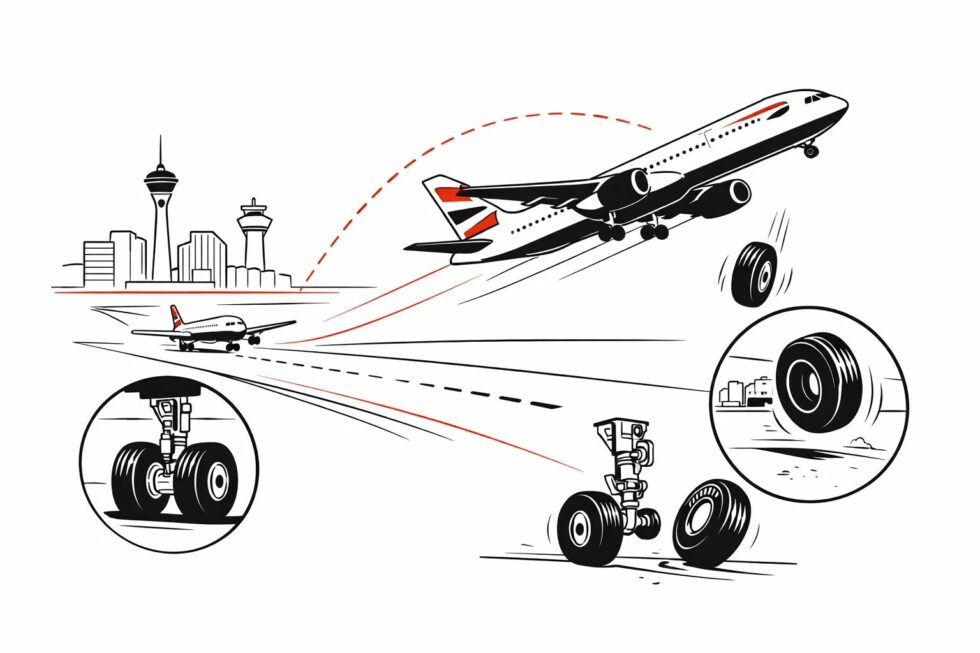
A British Airways flight bound for London lost part of its landing gear shortly after take-off from Las Vegas, US aviation authorities confirmed on Monday, 26 August 2025. Video footage showed a right rear wheel detaching from an Airbus A350-1000 moments after departure from Harry Reid International Airport, before falling back onto the airfield. The aircraft, operating as BA274, continued its transatlantic journey and landed at Heathrow Airport around nine hours later with no injuries reported. Airport officials said the tyre was recovered, there was no damage on the ground, and the National Transportation Safety Board (NTSB) was notified. British Airways said it was cooperating with investigators and that safety procedures were followed. Reports The WP Times, citing a Harry Reid International Airport.
What happened during the Las Vegas departure
The incident occurred shortly after rotation from runway at Harry Reid International Airport on Monday night local time. Passenger-recorded video, later verified by airport officials, shows a single wheel separating from the aircraft’s right main landing gear assembly while the jet was climbing out. Airport operations confirmed the wheel landed on the airfield perimeter and was secured by ground crews. There were no reports of injuries or property damage on the ground.
Flight tracking data from Flightradar24 indicated that BA274 maintained altitude and route, crossing the Atlantic before making a routine approach into Heathrow. British Airways said the landing was “safe and uneventful,” adding that the aircraft taxied normally after touchdown and passengers disembarked as scheduled.
Aircraft type and operational context
The aircraft involved was an Airbus A350-1000, a wide-body long-haul jet introduced into service in 2018 and widely used on transatlantic routes. The A350 family employs multi-wheel main landing gear assemblies designed to tolerate tyre failures and, in limited scenarios, the loss of a single wheel without compromising landing capability.
Airbus has not indicated any immediate fleet-wide action. Under standard practice, responsibility for the investigation rests with the state authority where the occurrence happened, with technical support from the manufacturer and the airline. The NTSB said it had been notified and would coordinate as appropriate.
Safety record and frequency of landing-gear events
According to the International Air Transport Association (IATA), landing-gear-related occurrences were the fourth most common accident category between June 2024 and June 2025, but resulted in zero fatalities globally during that period. Most events involve tyre deflations, brake overheating, or sensor warnings rather than structural failures.
The Las Vegas event followed another recent US incident in which the nose wheel of a United Airlines aircraft detached during landing in Orlando, reported eight days earlier. Investigators have not linked the two cases. Both aircraft types are Airbus models, but the events occurred at different phases of flight and under different operational conditions.
How pilots manage a lost wheel or tyre failure
Commercial aircraft are certified to land safely with degraded landing gear. Procedures depend on which component is affected and whether any secondary systems are compromised.
Main gear tyre loss
A single missing or deflated main-gear tyre is typically managed by adjusting approach speed, flap configuration, and touchdown technique. Crews brief air traffic control in advance, and emergency services may be positioned as a precaution. In most cases, the aircraft remains fully controllable.
Nose gear issues
Nose-gear problems pose a higher risk of runway contact. If the nose wheel is jammed or misaligned, crews may divert to an airport with a longer runway and conduct a controlled landing with emergency services standing by. Airbus and other manufacturers publish aircraft-specific checklists for these scenarios.
Gear fails to extend
If landing gear does not extend using normal hydraulics, pilots can deploy it by gravity. Rare “belly landings” have occurred historically; evacuations have typically been completed without injury when procedures are followed.
Pilot training and regulatory standards
Pilots receive recurrent simulator training that includes landing-gear malfunctions. Training covers abnormal checklists, crew coordination, and communications with air traffic control and cabin crew. Regulators require airlines to demonstrate competence in these scenarios during audits and line checks.
Former airline pilots interviewed by UK broadcasters note that gear-failure landings may be shorter and noisier than standard approaches but are rarely associated with injuries. Fire services are alerted in advance to address potential brake overheating or sparks during rollout.
Fuel, routing, and why BA274 continued to London
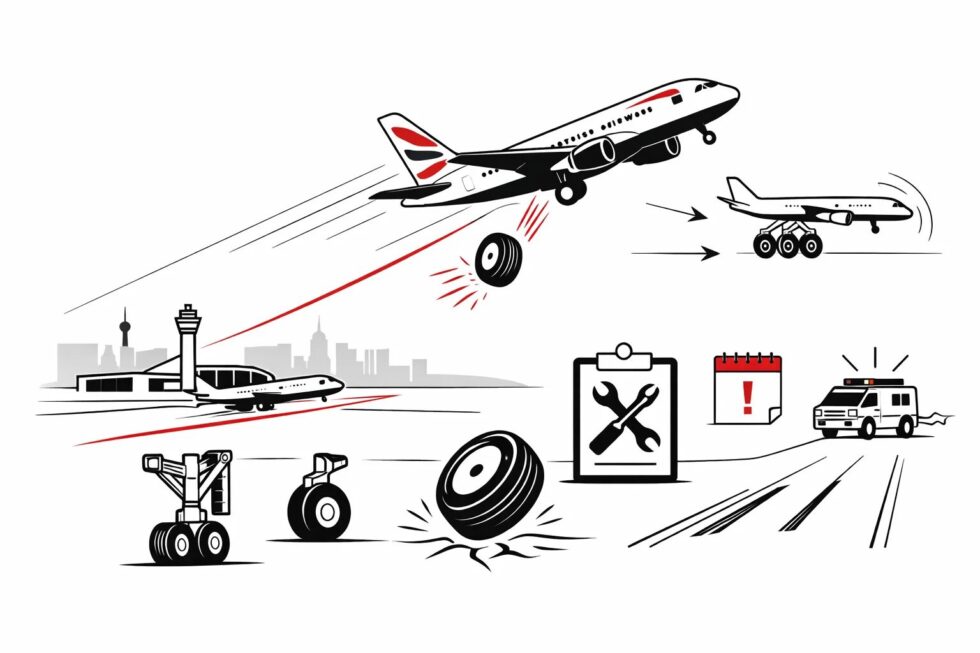
One operational consideration is whether to divert immediately or continue. If a wheel is lost after take-off but the remaining gear retracts normally and there are no secondary warnings, crews may elect to proceed to destination provided fuel margins and performance allow. By contrast, if gear fails to retract, the increased drag often forces an early landing because fuel burn rises sharply.
In this case, tracking data showed no prolonged low-altitude holding or diversion. British Airways has not disclosed cockpit indications beyond confirming the safe landing and absence of injuries.
What investigators will examine next
The investigation will focus on the wheel assembly, brake unit, and attachment hardware. Key questions include whether the separation was caused by a mechanical fault, maintenance issue, or foreign-object damage during the take-off roll. Data from the aircraft’s onboard systems and maintenance records will be reviewed, alongside runway inspections and metallurgical analysis of recovered parts.
Airlines typically remove the aircraft from service pending inspection. If investigators identify a systemic issue, manufacturers or regulators can issue service bulletins or airworthiness directives.
Practical guidance for passengers seeking information
Passengers affected by such incidents can verify official updates through the following channels:
- Airline statements: britishairways.com → Help & Contacts → Travel updates
- Airport notices: harryreidairport.com → Newsroom
- Investigation updates: ntsb.gov → News & Events
- Flight tracking: flightradar24.com → Flight history (BA274)
Claims related to delays or expenses are handled by the airline under its customer care policy and, where applicable, international conventions governing air travel.
Key facts at a glance
| Item | Detail |
|---|---|
| Flight | BA274 Las Vegas–London |
| Date | Monday, 26 August 2025 |
| Aircraft | Airbus A350-1000 |
| Issue | Right rear wheel detached after take-off |
| Landing | Safe landing at Heathrow |
| Injuries | None reported |
| Authority notified | NTSB |
The event underscores how modern certification standards and crew training mitigate the impact of rare mechanical failures. For passengers in the US–UK market, the immediate implication is operational transparency rather than heightened risk: flights continued, no injuries occurred, and investigators are assessing technical causes under established procedures.
Read about the life of Westminster and Pimlico district, London and the world. 24/7 news with fresh and useful updates on culture, business, technology and city life: Is Britain Truly Prepared for War as US 70-Year Security Guarantee Is Claimed No Longer Valid