
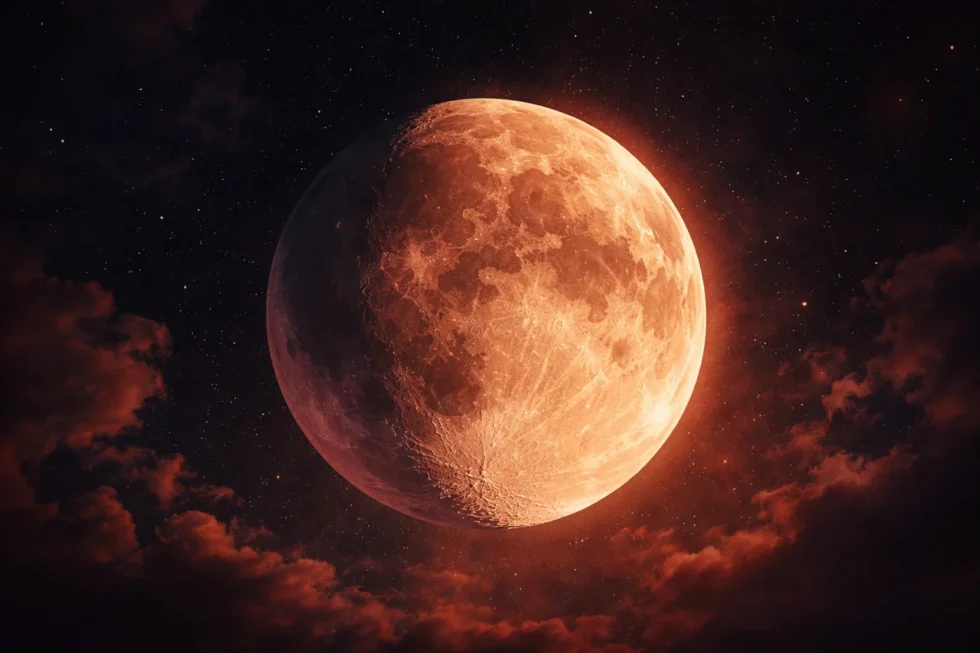
Moon phase today and is it a full moon tonight are among the most searched astronomy queries at the start of March, as skywatchers prepare for a major lunar event. On March 3, the Moon reaches the Full Moon phase, marking the peak of the lunar cycle that began nearly 29.5 days earlier. Although on March 1 the Moon was in a Waxing Gibbous phase at approximately 94 percent illumination, by March 3 it becomes fully illuminated as seen from Earth. According to NASA, the lunar cycle progresses through eight distinct phases driven by the relative positions of the Sun, Earth, and Moon. For observers in the United Kingdom, this Full Moon coincides with a total lunar eclipse visible in the early morning hours, reports The WP Times.
Moon phase today and is it a full moon tonight in the UK
Moon phase today in the United Kingdom depends on the precise date and time, as lunar phases are calculated based on exact astronomical alignments rather than calendar days. On March 1, the Moon was in a Waxing Gibbous phase, meaning more than half of its visible surface was illuminated but it had not yet reached Full Moon. By March 3, the Moon officially enters the Full Moon phase, when Earth lies approximately between the Sun and the Moon. This alignment allows the entire near side of the Moon to be illuminated by sunlight. However, whether it appears perfectly full all night depends on the exact timing of the phase peak. The question is it a full moon tonight can only be answered precisely with reference to Universal Time and UK local time.
Key illumination details:
| Date (UK) | Lunar Phase | Approx. Illumination | Visible Appearance |
|---|---|---|---|
| March 1 | Waxing Gibbous | ~94% | Nearly full |
| March 2 | Waxing Gibbous | >98% | Visually full |
| March 3 | Full Moon | 100% | Fully illuminated |
What the Moon will look like on March 3 from the United Kingdom
On March 3, observers across England, Scotland, Wales, and Northern Ireland will see a fully illuminated lunar disc rising around sunset and setting near sunrise. The Moon will appear bright white or slightly golden when near the horizon due to atmospheric scattering. During the night, surface features such as Mare Imbrium, Mare Crisium, and Tycho crater will be visible to the naked eye as darker and lighter regions. The contrast between maria and highlands is most noticeable during the Full Moon because the entire surface reflects sunlight directly toward Earth. However, shadows along crater rims are minimal at Full Moon, which slightly reduces visible surface relief. For UK observers, local weather conditions will significantly influence visibility.
Surface features visible without equipment:
- Mare Imbrium
- Mare Crisium
- Tycho Crater
- Oceanus Procellarum
- Mare Tranquillitatis
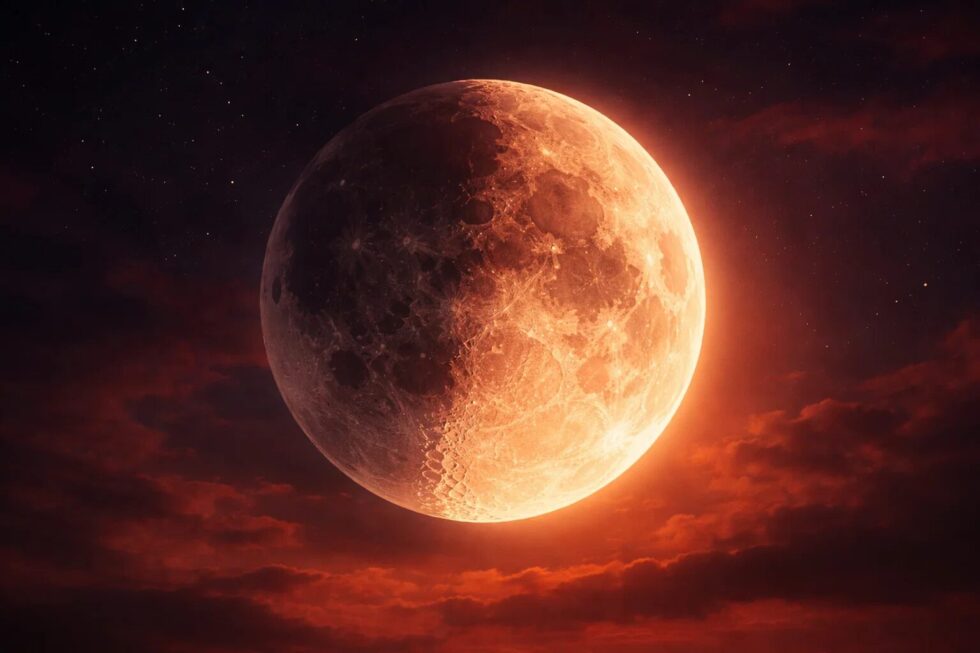
Total lunar eclipse on March 3: visibility from the UK
On March 3, the Full Moon coincides with a total lunar eclipse. A total lunar eclipse occurs when Earth passes directly between the Sun and the Moon, casting Earth’s umbra (dark central shadow) onto the lunar surface. During totality, the Moon does not disappear but turns a copper-red colour due to Rayleigh scattering of sunlight through Earth’s atmosphere. This phenomenon is commonly called a blood moon. According to published eclipse visibility maps and timing data from NASA and major astronomical almanacs, this specific March 3 eclipse is not visible from most of Europe, including the United Kingdom. The primary visibility zone includes North America and parts of the Pacific region. Therefore, UK observers will not see the total phase.
Eclipse visibility summary:
| Region | Visible? |
|---|---|
| United Kingdom | No |
| North America | Yes |
| Pacific Region | Yes |
| Africa | No |
| Most of Europe | No |
Understanding Moon phases: the 29.5-day lunar cycle
The Moon takes approximately 29.5 days to complete one synodic orbit around Earth. During this time, it transitions through eight standard lunar phases defined by the changing angle between the Sun, Earth, and Moon. The same hemisphere of the Moon always faces Earth due to tidal locking, but the fraction illuminated by the Sun changes continuously. The lunar cycle begins with the New Moon and progresses through waxing phases to Full Moon, followed by waning phases back to darkness. Each phase has distinct observational characteristics and rising and setting times. Understanding this cycle helps explain why moon phase today changes gradually rather than abruptly. Astronomical phase timing is calculated in Coordinated Universal Time.
The eight lunar phases:
| Phase Name | Illumination Trend | Visibility Pattern |
|---|---|---|
| New Moon | 0% | Not visible |
| Waxing Crescent | Increasing | Evening |
| First Quarter | 50% | Afternoon-evening |
| Waxing Gibbous | Increasing | Evening-night |
| Full Moon | 100% | All night |
| Waning Gibbous | Decreasing | Night-morning |
| Third Quarter | 50% | Late night |
| Waning Crescent | Decreasing | Early morning |
Best ways to observe the Full Moon in the United Kingdom
Observing the Full Moon does not require specialised equipment, but certain strategies improve clarity and detail. A clear horizon view enhances moonrise photography, especially near coastal or rural areas. Light pollution does not significantly hinder Full Moon visibility due to its brightness, but darker locations enhance contrast. Binoculars (7x50 or 10x50) reveal crater detail and maria boundaries. Small telescopes allow closer inspection of prominent craters and ray systems such as Tycho’s ejecta patterns. Smartphone photography is possible using night mode and manual exposure reduction. Weather forecasts should be checked in advance to avoid cloud cover.
Observation tips:
- Check Met Office cloud cover forecasts
- Use binoculars for crater detail
- Avoid direct overhead street lighting
- Reduce smartphone exposure for sharper images
- Observe moonrise for colour effects
Key facts about the March 3 Full Moon
The March 3 Full Moon represents the midpoint of the lunar cycle and occurs when the Sun and Moon are approximately 180 degrees apart in the sky. The Full Moon rises at sunset and sets at sunrise due to this opposition alignment. Tidal forces are stronger during Full and New Moon phases, producing spring tides in UK coastal regions. The apparent size of the Moon may vary slightly depending on whether it occurs near perigee or apogee, though this March 3 event is not classified as a supermoon. Lunar brightness peaks during Full Moon, often washing out fainter stars. Astronomical timing is based on precise celestial mechanics calculations.
Important considerations:
| Factor | Effect |
|---|---|
| Opposition alignment | Full illumination |
| Spring tides | Higher tidal ranges |
| Light pollution | Minimal impact |
| Cloud cover | Primary limiting factor |
| Perigee proximity | Determines supermoon status |
Moon phase today exact timing for the United Kingdom on March 3
Moon phase today is determined by precise astronomical calculations expressed in Coordinated Universal Time (UTC), which is the standard reference for the United Kingdom during winter months. A Full Moon occurs at the exact moment when the Moon’s geocentric ecliptic longitude differs from the Sun’s by 180 degrees. This instant may happen at a specific hour and minute, meaning that is it a full moon tonight depends on whether the peak occurs before or after local midnight. Astronomical almanacs and observatories publish the exact Full Moon time in UTC to ensure accuracy. In practical terms, the Moon appears visually full for about one day before and after the exact moment of peak illumination. However, from a scientific standpoint, only one precise instant marks the official phase change. For the UK, local observers should convert published UTC times if British Summer Time is in effect. Reliable timing data is provided by institutions such as U.S. Naval Observatory and Royal Observatory Greenwich.
Official timing principles:
| Parameter | Definition |
|---|---|
| Phase reference | Based on Sun–Earth–Moon geometry |
| Time standard | Coordinated Universal Time (UTC) |
| Visual fullness window | ~24–36 hours around peak |
| UK winter time | GMT (UTC+0) |
| UK summer time | BST (UTC+1) |
Why the Full Moon looks different at moonrise in the UK
Moon phase today may indicate Full Moon, yet its appearance changes depending on altitude above the horizon. When the Full Moon rises over the UK skyline, it often appears larger and more orange. This is known as the Moon illusion, a psychological effect rather than a physical enlargement. The reddish or golden tint results from atmospheric scattering, where shorter blue wavelengths are filtered out as light passes through thicker layers of Earth’s atmosphere. As the Moon climbs higher, it appears whiter and smaller. The brightness during Full Moon can reach approximately −12.7 magnitude, making it the brightest natural object in the night sky after the Sun. This intensity reduces contrast for faint stars. Observers asking is it a full moon tonight should note that horizon colour does not indicate phase change but atmospheric conditions.
Atmospheric effects on appearance:
- Rayleigh scattering produces warmer tones near horizon
- Increased atmospheric thickness alters colour
- Perceived size change is optical illusion
- Brightness remains constant regardless of colour shift
- Higher altitude improves clarity
Tides and the Full Moon March 3 in the United Kingdom
Moon phase today has measurable physical consequences, especially during a Full Moon. When the Moon and Sun align on opposite sides of Earth, their gravitational forces combine to produce spring tides. These tides are characterised by higher high tides and lower low tides compared to average tidal ranges. In coastal regions of the United Kingdom, including the Bristol Channel and parts of Scotland, tidal differences can be significant. Spring tides occur during both Full Moon and New Moon phases due to gravitational alignment. The term spring refers to the concept of “springing forth,” not the season. Harbour authorities and coastal communities monitor these tidal peaks carefully. Accurate tide predictions are calculated using long-term harmonic analysis models.
Tidal impact summary:
| Lunar Phase | Tidal Effect |
|---|---|
| Full Moon | Spring tides (higher range) |
| New Moon | Spring tides (higher range) |
| First Quarter | Neap tides (lower range) |
| Third Quarter | Neap tides (lower range) |
Lunar surface visibility during Full Moon March 3
Moon phase today reaching Full Moon affects the visibility of lunar topography. During Full Moon, sunlight strikes the lunar surface directly from Earth’s perspective, minimising shadows along crater walls. While this maximises brightness, it reduces surface contrast compared to First or Third Quarter phases. Prominent dark plains known as maria are easily visible, including Mare Imbrium and Mare Tranquillitatis. Bright ray systems extending from Tycho crater become particularly striking under full illumination. Through binoculars, observers in the UK can distinguish major crater boundaries and some large impact basins. Telescopes reveal finer ejecta patterns but still limited shadow relief. Understanding this helps observers set realistic expectations when asking is it a full moon tonight and planning observations.
Best features during Full Moon:
- Major lunar maria
- Tycho crater ray system
- Copernicus crater
- Oceanus Procellarum
- Bright highland regions
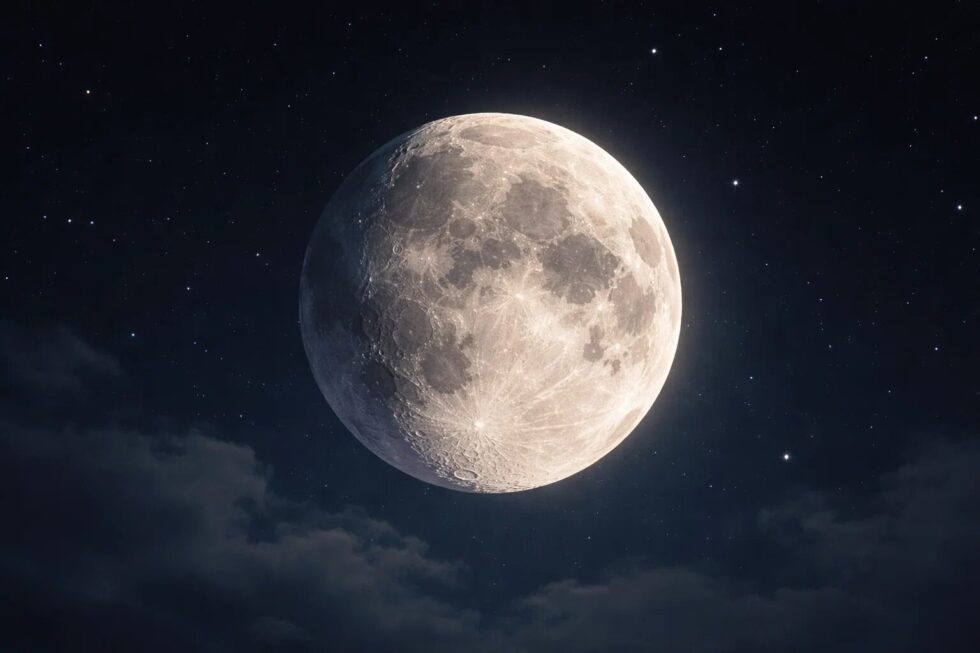
Lunar eclipse mechanics and UK observational limitations
Moon phase today coinciding with a Full Moon is a necessary condition for a lunar eclipse, but not every Full Moon produces one. A lunar eclipse requires the Moon to pass through Earth’s orbital plane at a node. Because the Moon’s orbit is tilted about 5 degrees relative to Earth’s orbit, most Full Moons pass above or below Earth’s shadow. When alignment is exact, Earth’s umbra covers the lunar disc, producing totality. However, eclipse visibility depends on geographic position and time of day. For the March 3 event, published visibility charts confirm that the total phase is not observable from the United Kingdom. UK observers will therefore see a standard Full Moon rather than a blood moon. Eclipse prediction models are maintained by agencies such as NASA.
Eclipse alignment conditions:
| Requirement | Explanation |
|---|---|
| Full Moon phase | Earth between Sun and Moon |
| Node alignment | Moon near orbital node |
| Clear horizon | Necessary for visibility |
| Geographic location | Determines observability |
| Timing | Must occur above local horizon |
Moon phase today can be verified using authoritative astronomical data services. These tools calculate lunar phases using precise ephemeris data rather than visual estimation. The United Kingdom has access to global astronomical databases and observatory resources. Accurate tools allow users to determine is it a full moon tonight with exact timestamps. Many services also provide rise and set times specific to UK cities. It is important to rely on established observatories rather than unverified social media claims. Lunar phase calculations are based on predictable orbital mechanics and are published years in advance.
Read about the life of Westminster and Pimlico district, London and the world. 24/7 news with fresh and useful updates on culture, business, technology and city life: What is an annular solar eclipse — will it be visible in the UK on 17 February and what time is it