London / Vienna — The United Kingdom has confirmed a significant strategic shift in its Eurovision policy, naming Look Mum No Computer as its representative for the Eurovision Song Contest 2026, according to the BBC. The contest will take place in Vienna in May, with the Grand Final scheduled for 16 May 2026, positioning the UK entry within one of the most closely watched cultural broadcasts in Europe.
The decision, announced live on BBC Radio 2 and BBC Sounds, formally launches the UK’s Eurovision 2026 campaign and signals a clear departure from recent British strategies that have prioritised conventional pop appeal over artistic risk. By selecting Look Mum No Computer — an artist known for experimental electronics, self-built instruments and performance-led spectacle — the BBC is reframing its approach to Eurovision as a platform for cultural identity rather than safe chart alignment. This article is published by The WP Times, citing BBC.
A strategic recalibration rather than a casting decision
For more than a decade, the UK’s participation in Eurovision has been accompanied by recurring questions about ambition, cultural confidence and tolerance for creative risk. Despite the global reach and influence of the British music industry, UK entries have often struggled to assert a clear identity on the Eurovision stage, frequently criticised for being technically polished but conceptually cautious.
The decision to select Look Mum No Computer for UK Eurovision 2026 points to a deliberate strategic recalibration rather than a routine artist selection. According to the BBC, the internal framework guiding the 2026 choice moved away from chart compatibility and short-term radio appeal, and instead focused on entries capable of projecting a strong, coherent artistic signal in a crowded international field. In this context, experimentation is positioned as a competitive asset rather than a novelty risk.
The broadcaster’s brief for Eurovision 2026 reportedly prioritised the following criteria:
- Immediate recognisability on screen and stage, even to non-English-speaking audiences
- Visual authorship, where staging and sound design form a unified concept
- Cultural specificity, reflecting British music heritage beyond current pop trends
- Live performance credibility, rather than reliance on backing tracks or generic choreography
- Audience memorability, particularly in the context of televoting dynamics
BBC Radio 2 presenter Scott Mills described the choice as an explicit attempt to move beyond the UK’s long-standing reputation for playing Eurovision “too safely”, acknowledging criticism that previous entries often prioritised caution over distinction.
Who Look Mum No Computer is — and why that matters
Look Mum No Computer is the performance identity of Sam Battle, a UK-based electronic musician, composer and live performance engineer whose work operates at the intersection of sound design, mechanical engineering and visual spectacle. Battle first entered the mainstream music ecosystem as the frontman of the indie band Zibra, which gained wider attention after appearing at Glastonbury in 2015 via BBC Introducing. However, his international profile has been shaped less by traditional industry routes and more by independent digital platforms since 2016.
By documenting the construction of self-built synthesisers and unconventional musical machines, Look Mum No Computer has built a substantial online audience. His YouTube channel has accumulated more than 85 million views, while his combined social media following is estimated at approximately 1.4 million. These platforms function not only as promotional tools but as an integral part of his artistic practice.
His projects include playable instruments built from Furbies and Game Boys, synthesiser-powered bicycles, mechanical keyboards and large-scale audio-visual installations. This fusion of engineering, performance and spectacle is central to his creative identity — and to the BBC’s rationale for selecting him as the UK’s Eurovision 2026 representative. engineering, performance and spectacle — rather than genre conformity — is central to why he was selected for Eurovision 2026.
Reaction to the announcement
Following confirmation by the BBC, Look Mum No Computer responded with a mixture of disbelief and measured seriousness, describing his selection as “completely bonkers” while underlining the responsibility that comes with representing the UK on one of the world’s largest live broadcast stages.
He framed Eurovision not as a novelty detour, but as a long-standing cultural reference point, noting that the contest had shaped his understanding of live electronic performance long before his own career took shape. While acknowledging the scale and pressure of the role, he confirmed that the project would remain fully self-produced, a decision that preserves the creative autonomy central to his work and distinguishes the entry from more heavily managed Eurovision productions.
His remark — “I hope Eurovision is ready to get synthesised” — was not treated within industry circles as a throwaway line. Instead, it has been widely interpreted as an early signal that the UK’s 2026 performance will prioritise live machinery, physical sound generation and visible process, rather than relying on pre-programmed backing tracks or purely visual effects.
What is known about the UK’s Eurovision 2026 entry
The BBC has not yet released the UK’s official Eurovision 2026 song, nor confirmed its title or running time. However, early insight has been provided through internal listening sessions. Scott Mills, who has heard the track privately, described it on BBC Radio 2 as deliberately engineered for the Eurovision environment rather than adapted to it. According to his account, the entry combines:
- Eurodance structures familiar to the Eurovision audience
- British pop references, rather than pan-European neutrality
- Classic analogue synth textures, foregrounding electronic heritage
- Punk-inflected energy, favouring urgency over polish
- Audience participation cues, designed for televoting impact
Mills emphasised that the track is built for scale — not radio subtlety — suggesting a conscious rejection of chart-driven minimalism. While subjective, this description points to an entry rooted in British electronic culture rather than contemporary streaming trends.
Why Vienna is a critical test
Eurovision 2026 will be staged at Vienna’s Wiener Stadthalle, a venue known within the industry for its technical constraints as much as its capacity. Semi-finals will take place on 12 and 14 May, with the Grand Final on 16 May, broadcast across BBC platforms.
For Look Mum No Computer, whose performances depend on physical machines, custom-built instruments and live signal paths, staging is not a secondary concern but a defining factor. Unlike artists who can scale performances through choreography or backing visuals, his work requires spatial planning, power management and camera integration. The BBC has not confirmed how many devices will appear on stage, but has indicated that visual originality and visible performance mechanics will be central to the UK’s presentation — a choice that carries both risk and differentiation in a tightly timed live broadcast.
BBC and industry response
Kalpna Patel-Knight, Head of Entertainment at the BBC, said the broadcaster was “absolutely thrilled” with the selection, describing Look Mum No Computer as an artist whose bold vision reflects the creative ambition the UK wants to project internationally.
Suzy Lamb, Managing Director of BBC Studios Entertainment, said he stood out during the selection process for being “very different musically”, citing not only innovation but also his ability to sustain a large, engaged digital audience — an increasingly relevant factor in Eurovision-era promotion. Within the industry, the choice has been read as an attempt to align broadcast credibility with online-native creativity, rather than treating them as separate ecosystems.
What this represents for the UK at Eurovision
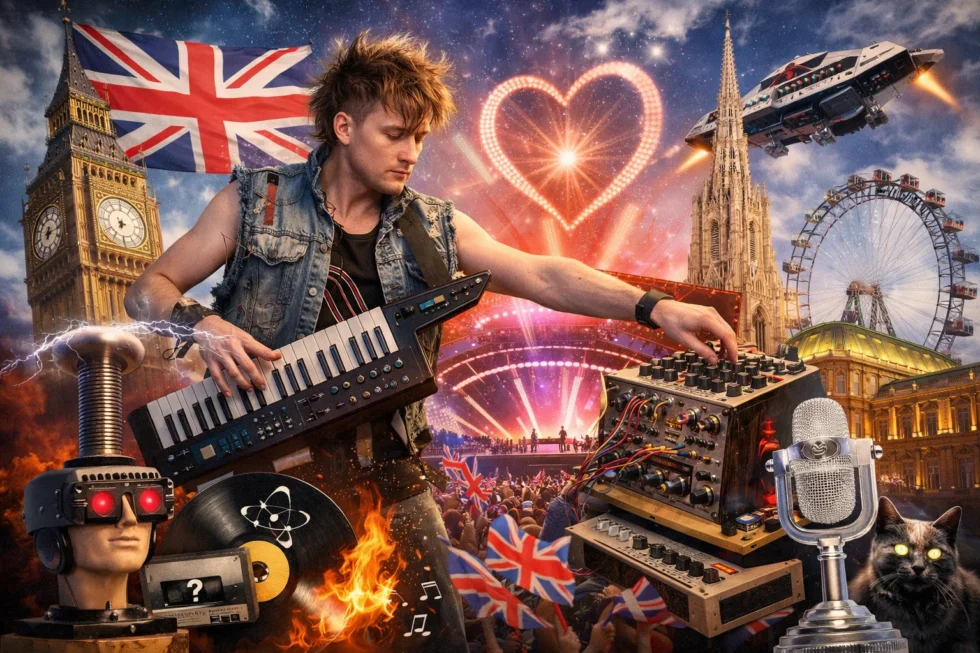
Sending Look Mum No Computer to Eurovision 2026 reflects a broader reassessment of how the UK positions itself within the contest. Rather than refining familiar pop structures, the BBC appears to be prioritising authorship, recognisability and cultural specificity. Whether this strategy delivers a top-table result remains uncertain. Eurovision history, however, consistently shows that entries with a clear internal logic and strong visual-musical identity often achieve lasting recognition — regardless of final rankings.
The UK’s Eurovision 2026 entry will receive its first official radio play and interview on BBC Radio 2 and BBC Sounds in the coming weeks. Rehearsals, staging disclosures and international promotion will follow ahead of May. What is already clear is that the UK has chosen visibility over caution — and that Look Mum No Computer will arrive in Vienna not as a compromise candidate, but as a statement.
Read about the life of Westminster and Pimlico district, London and the world. 24/7 news with fresh and useful updates on culture, business, technology and city life - When is Ramadan 2026 in the UK and London and how 30 days of fasting affect your body