
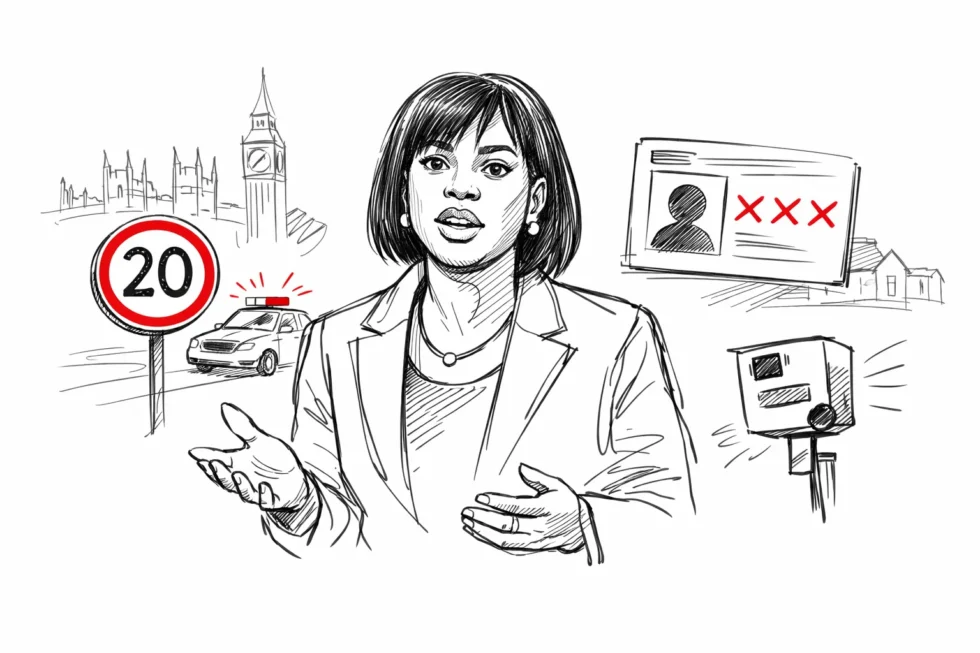
20mph fines UK — Conservative leader Kemi Badenoch has signalled a potential overhaul of how minor speeding offences are punished, arguing that drivers exceeding 20mph limits by just 1–2mph should not automatically face penalty points that could ultimately cost them their licence. Speaking on 13 April 2026, she framed the issue as one of proportionality at a time when 20mph zones now cover a significant share of Britain’s road network, including more than half of all streets in London, bringing enforcement into direct contact with millions of everyday journeys.
Her intervention comes amid growing scrutiny of enforcement data showing that nearly 500,000 speeding fines were issued in 2024 on 20mph roads, intensifying concerns that marginal breaches are being treated in a way that risks equating them with genuinely dangerous driving. Badenoch warned that repeated low-level offences can accumulate into disqualification, disproportionately affecting otherwise law-abiding motorists, particularly those whose livelihoods depend on driving. The WP Times reports, citing UK media sources.
At the centre of the debate is the UK’s penalty points system, which allows even minor speeding offences to trigger both financial penalties and points on a licence. Once a threshold is reached, drivers face disqualification regardless of whether their offences involved minimal deviations or serious risk. In the context of expanding 20mph zones, this structure has increased the likelihood that drivers will be penalised for small, often unintentional breaches, particularly in urban areas where enforcement cameras are widespread and speed limits have been reduced as part of safety strategies. The scale of enforcement has become a defining factor. Police forces across Britain issued close to half a million fines on 20mph roads in 2024, while roughly 39,000 miles of the UK’s 246,500-mile road network are now subject to such limits. This expansion has fundamentally changed the enforcement landscape, shifting a large proportion of speed-related penalties into lower-speed environments where differences of just 1–2mph can determine whether a driver is sanctioned.
Badenoch’s position draws a clear distinction between marginal speeding and dangerous behaviour. She argued that driving at 21–22mph should not carry the same consequences as actions that pose a direct risk to public safety, suggesting that enforcement should focus on outcomes rather than technical breaches. “They should be getting points on their licence for driving dangerously,” she said, adding that small excesses over 20mph limits do not meet that threshold. Her argument is rooted in the principle of fairness, particularly for those who rely on driving for their income. She highlighted cases in which drivers, including taxi operators, risk losing their licence after multiple minor infractions, with each offence adding points until disqualification becomes unavoidable. For professional drivers, this creates immediate financial consequences, effectively turning low-level errors into threats to employment.
Crucially, the proposal does not challenge the existence of 20mph limits themselves. These zones remain a core element of road safety policy, especially in residential and densely populated areas where lower speeds are associated with reduced accident severity. In London, Mayor Sadiq Khan has overseen the rollout of more than 150 miles of additional 20mph roads, contributing to the widespread adoption of lower speed limits across the capital. Supporters of strict enforcement argue that consistency is essential to achieving safety outcomes. Evidence indicates that even small increases in speed can significantly affect stopping distances and collision impact, reinforcing the case for maintaining clear and enforceable limits. From this perspective, any relaxation of penalties risks undermining compliance and weakening the effectiveness of 20mph zones.
However, critics contend that enforcement must remain proportionate to maintain public trust. They argue that a system which penalises minor infractions too harshly may be perceived as punitive rather than protective, particularly if drivers feel they are being sanctioned for negligible deviations rather than meaningful risk. This perception is further amplified by the scale of fines issued in low-speed zones, which has led to accusations that enforcement may be driven as much by revenue considerations as by safety objectives. The practical implications of the current system are increasingly visible. A driver travelling at 21–22mph in a 20mph zone may receive a fine and penalty points; repeated occurrences—especially in areas with dense camera coverage—can lead to licence suspension over time. While this may represent a manageable inconvenience for some, for those working in transport, logistics or delivery services, the consequences are immediate and severe, potentially removing their primary source of income.
Badenoch has also linked the issue to broader policing priorities, arguing that enforcement resources should be focused more heavily on serious crimes such as burglary, theft and violent offences. Her comments suggest a rebalancing of law enforcement strategy, where minor traffic violations are deprioritised relative to offences that pose a greater threat to public safety.
The timing of the debate reflects deeper structural tensions. As 20mph zones continue to expand and enforcement becomes increasingly automated, the number of recorded minor offences is likely to remain high. This creates an ongoing conflict between the objectives of road safety policy and the perception of fairness among drivers, particularly those who view minor breaches as unavoidable in real-world conditions.
Although Badenoch’s remarks do not yet amount to formal policy, they point towards potential reforms, including the introduction of tolerance thresholds before penalty points are applied, greater differentiation between levels of speeding, and increased use of warnings or educational measures for low-level offences. Any such changes would require legislative adjustment and are likely to prompt debate between safety advocates and those calling for a more flexible approach. At its core, the issue raises a fundamental question about how enforcement systems should operate in a modern transport environment: whether strict, uniform penalties remain the most effective tool, or whether a more nuanced approach is needed to distinguish between minor error and genuine danger. As Britain’s road network continues to evolve, that balance is becoming an increasingly central concern in both policy and public debate.
Background: who is Kemi Badenoch and why her position matters
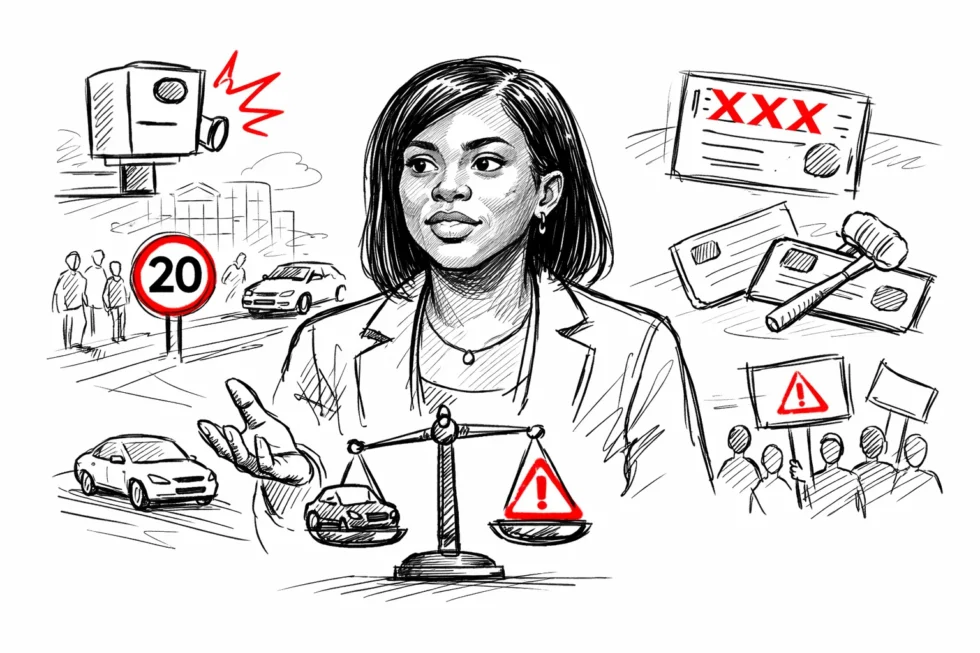
Kemi Badenoch is the current leader of the Conservative Party and one of the most prominent voices shaping the party’s post-government strategy on law, regulation and economic policy. A former Business and Trade Secretary, she built her profile on themes of deregulation, personal responsibility and a more selective approach to state intervention. Since becoming leader, she has increasingly positioned herself around “law and order” priorities, while also arguing that enforcement should be targeted and proportionate rather than broad and punitive. Her intervention on 20mph fines reflects that wider political line. Rather than opposing road safety measures outright, Badenoch is attempting to reframe how rules are applied in practice—drawing a distinction between technical breaches and behaviour that presents a genuine risk to the public. This approach is designed to appeal to drivers and working households who feel affected by rising regulation, while maintaining a firm stance on serious crime.
The issue also sits within a broader political contrast with policies introduced at city level, particularly in London under Sadiq Khan, where the expansion of 20mph zones has been a key part of road safety strategy. By questioning enforcement rather than the limits themselves, Badenoch is navigating a middle position—acknowledging safety concerns while challenging the way penalties are currently applied. Her comments therefore carry weight beyond transport policy. They signal how the Conservative leadership may approach regulation more broadly: maintaining rules where necessary, but seeking to reduce what it sees as disproportionate impacts on everyday, law-abiding citizens.
Read about the life of Westminster and Pimlico district, London and the world. 24/7 news with fresh and useful updates on culture, business, technology and city life: London elections on 7 May 2026: who can vote, voter ID rules and what Londoners need to know before polling day