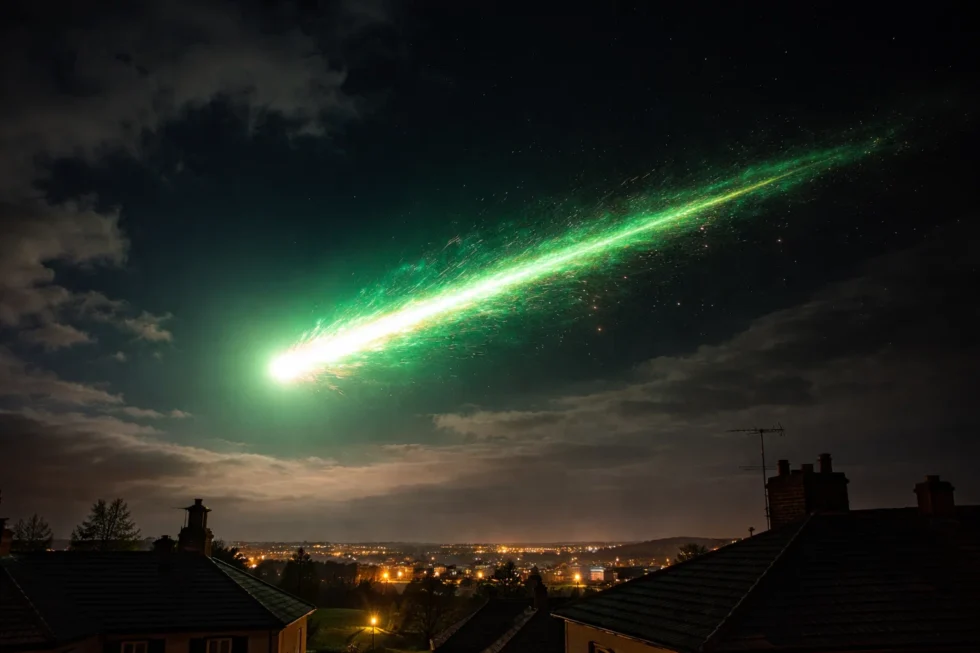
A massive green fireball, suspected to be a large meteorite, illuminated the night sky across the United Kingdom in the early hours of Monday, April 13, 2026, triggering over 190 reports from Cardiff to the North East. The celestial event, which featured intense flashes of light and a distinct emerald trail, was captured by home security systems at approximately 00:30 BST, sparking intense scientific interest and public speculation regarding its origin and eventual landing site in the North Sea, as reported by The WP Times via BBC.
The phenomenon was notably documented in West Rainton, County Durham, where resident Lex Adair discovered the "bizarre" footage on his CCTV system. Unlike common meteors that disintegrate high in the atmosphere, experts believe this object was of sufficient calibre and density to survive the intense thermal friction of entry.
Astronomers have tracked the trajectory of the suspected meteorite across a vast diagonal corridor of the UK, suggesting that while the light show was visible over land, any surviving fragments likely impacted the water off the coast of Grimsby.
Technical Analysis of the 2026 Fireball: Meteor vs. Meteorite
According to Roy Alexander, Director of Learning at Battlesteads Dark Sky Discovery Observatory in Northumberland, the sheer scale of the event distinguishes it from standard "shooting stars." The green hue often observed in such fireballs indicates the presence of nickel or magnesium in the rock's composition, which glows as the object reaches speeds of tens of thousands of miles per hour.
While meteors are a nightly occurrence, a "large meteorite" capable of producing multiple visible flashes—indicating fragmentation—is a rare event for the British Isles.
- Time of Event: 00:30 BST, Monday, April 13, 2026.
- Visual Characteristics: Bright green glow followed by two rapid, high-intensity flashes.
- Trajectory: Tracked from South Wales (Cardiff) through the Midlands to the North East (Hull/Grimsby).
- Scientific Consensus: High probability of a meteorite survival due to brightness and duration.
- Public Impact: 190+ official reports submitted to astronomical monitoring networks.
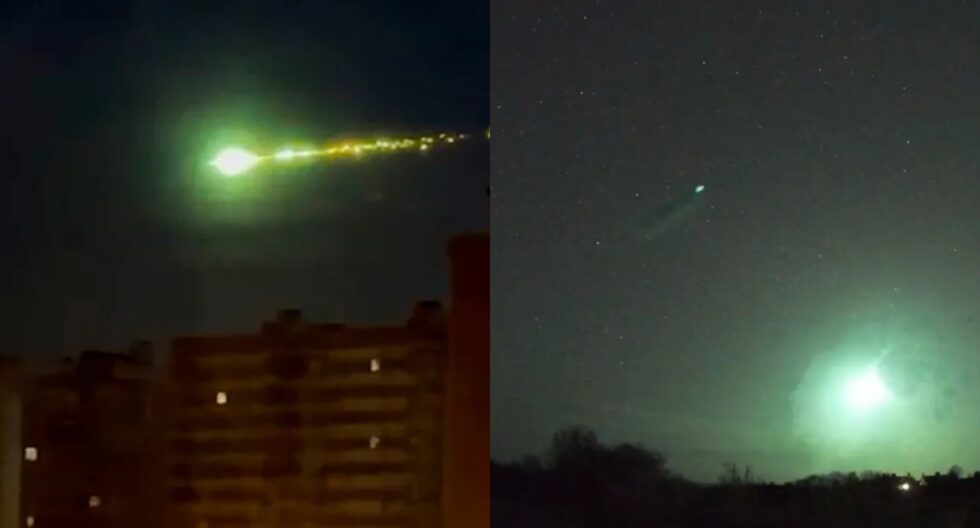
Witness Accounts and Public Speculation: The Artemis II Theory
The timing of the fireball coincided with heightened public interest in space exploration, leading some social media users to jokingly link the event to the historic Artemis II mission. While there is no scientific evidence suggesting the fireball was man-made debris or "retaliatory space rocks," the intensity of the flashes led some initial observers to mistake the event for low-flying aircraft or high-altitude flares.
The clarity of the CCTV footage provided by photographers and residents has given researchers a rare opportunity to triangulate the exact speed and angle of the entry.
| Witness Location | Observation | Interpretation |
| West Rainton, Durham | "Massive meteor" captured on CCTV | Bizarre morning discovery; confirmed by partner. |
| Northumberland | Large fireball tracking North East | Scientific tracking indicates North Sea impact. |
| Cardiff, Wales | Initial sighting of green trail | South-to-North trajectory established. |
| Hull/Grimsby | Last visible flashes | Potential burnout or sea landing coordinates. |
Expert Commentary on Celestial Debris Survival
The distinction between a meteor and a meteorite is crucial for understanding the potential danger and scientific value of such events. Most space rocks are no larger than a grain of sand and evaporate completely; however, the object witnessed on Monday was large enough to penetrate the lower atmosphere. If recovered, such fragments could provide invaluable data on the early solar system, though the current projected landing site in the North Sea makes recovery efforts extremely difficult for the UK astronomical community.
"Meteors are common and burn up in the atmosphere, whereas meteorites are less frequent and generally big enough to survive the heat and land on the Earth's surface. This was tracked from near Cardiff across to Hull before potentially landing in the North Sea." — (Roy Alexander, Battlesteads Dark Sky Discovery Observatory, April 2026).
Future Monitoring and Space Situational Awareness
As the UK government and global agencies increase their focus on space situational awareness, events like the April 13 fireball highlight the importance of amateur monitoring networks and home security technology in tracking cosmic debris.
The data gathered from the 190+ online reports is currently being processed by the UK Fireball Network to determine if any terrestrial recovery is possible. For now, the event serves as a vivid reminder of the Earth's constant interaction with the surrounding solar system.
- Data Triangulation: Using CCTV and dashcam footage to map the final 50 miles of the flight path.
- Composition Testing: Spectroscopic analysis of the green light to identify mineral content.
- Impact Zone: Confirming the North Sea coordinates to rule out any land-based damage.
- Public Safety: Authorities confirm no reports of structural damage or injuries despite the intense flashes.
Frequently Asked Questions
What caused the green light in the UK sky?
The green glow is typically caused by the combustion of metals like nickel, iron, or magnesium within the meteorite as it hits the Earth's atmosphere at high speeds.
Was the meteorite linked to the Artemis II mission?
No, scientists have confirmed this was a natural cosmic event and not related to any man-made spacecraft or mission remnants.
Where did the meteorite land?
Based on trajectory tracking from Cardiff to Grimsby, experts believe the meteorite likely landed in the North Sea.
How rare is a meteorite of this size?
While small meteors are common, meteorites large enough to produce multiple flashes and survive the atmosphere are relatively rare, occurring only a few times a decade over the UK.
Can I find fragments of the meteorite?
Since the suspected landing site is the North Sea, recovery of fragments is highly unlikely for the general public or scientists.
Read about the life of Westminster and Pimlico district, London and the world. 24/7 news with fresh and useful updates on culture, business, technology and city life: Will the Super El Niño affect the UK summer? Expert forecasts on 2026 record heat and flood risks