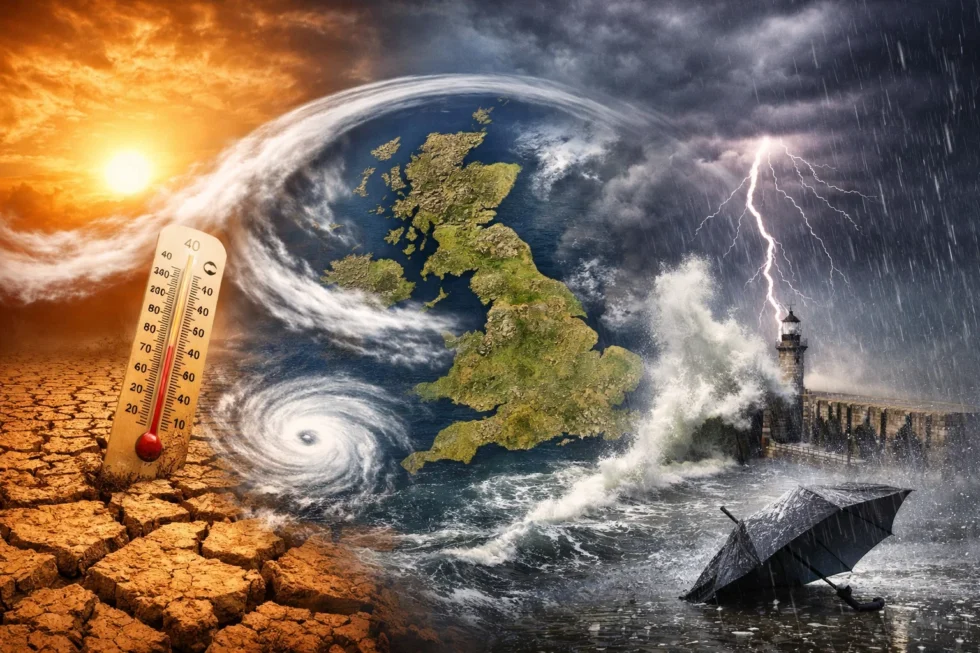
El Niño UK summer impact is moving into sharper focus as meteorologists track rapidly evolving Pacific Ocean conditions that could reshape global weather patterns into late 2026 and beyond. Early indicators suggest a high probability that El Niño will develop during the summer, with some models pointing to a potentially strong or even “super” event capable of amplifying heat, disrupting rainfall systems and influencing atmospheric circulation across the Northern Hemisphere — including indirect effects on the UK. In practical terms, while El Niño does not control British weather directly, it alters the global climate engine, shifting jet streams, ocean temperatures and storm tracks, and therefore raising the probability of unusual seasonal patterns, The WP Times reports, citing The Guardian.
The central question for Britain and London is not whether El Niño will “hit” the UK directly, but how its global influence will translate into regional variability. Forecast agencies and long-range climate models indicate that a developing El Niño in summer 2026 could contribute to a warmer-than-average pattern across parts of Europe, with increased volatility — meaning alternating spells of heat, humidity and unsettled Atlantic-driven systems. The signal remains probabilistic rather than deterministic, but the risk profile for extremes — heatwaves, intense rainfall bursts and atmospheric instability — is clearly elevated compared with neutral years.
El Niño is part of the El Niño–Southern Oscillation (ENSO), a naturally occurring climate cycle driven by fluctuations in sea surface temperatures and atmospheric pressure across the equatorial Pacific. During an El Niño phase, warmer waters spread eastward toward South America, weakening trade winds and shifting convection patterns. This disrupts the global distribution of heat and moisture, influencing weather systems thousands of kilometres away.
In the UK context, the impact is indirect but measurable through teleconnections — large-scale climate linkages that alter the behaviour of the North Atlantic jet stream. A stronger or more displaced jet stream can determine whether Britain experiences prolonged high-pressure blocking (bringing heat and dryness) or a succession of low-pressure systems (bringing rain and wind).
Experts monitoring current Pacific anomalies note that subsurface warming is already building, a key precursor to El Niño development. As one climate scientist cited in reporting explains: “The ocean is loading heat below the surface, and once that reaches the top, it can trigger a rapid shift into El Niño conditions” (climate analysis cited via The Guardian, April 2026).
What is a ‘super El Niño’ and why it matters
A “super El Niño” refers to an exceptionally strong event where sea surface temperature anomalies exceed +2.0°C in the central-eastern Pacific. These events are rare but historically linked to significant global climate disruptions. Key characteristics of a strong or super El Niño include:
- Intensified global heat distribution
- Increased likelihood of record-breaking global temperatures
- Amplified extreme weather events (heatwaves, floods, droughts)
- Disrupted monsoon systems in Asia and Africa
- Altered storm tracks across the Atlantic and Europe
The significance lies in amplification. A moderate El Niño may subtly tilt seasonal outcomes, but a strong one can push systems beyond thresholds, increasing the frequency and severity of extremes rather than just shifting averages. Historical comparisons often reference the 1997–98 and 2015–16 El Niño events, both associated with global temperature spikes and widespread weather anomalies. While each event is unique, these benchmarks inform current risk modelling.

Projected timeline: when El Niño is expected to develop
Current forecasts from major meteorological centres converge on a similar timeline:
| Phase | Expected period | Key developments |
|---|---|---|
| Pre-conditioning | Spring 2026 | Subsurface ocean warming builds |
| Onset | Early–mid summer 2026 | Surface warming begins to emerge |
| Strengthening | Late summer–autumn 2026 | Peak atmospheric coupling |
| Peak phase | Winter 2026/27 | Maximum global climate influence |
This timeline is critical for the UK because the strongest teleconnection effects often appear several months after onset. In other words, even if El Niño begins in summer, its most pronounced influence on European weather patterns may emerge in late summer and autumn. Meteorologists stress that uncertainty remains regarding intensity. However, the probability of at least a moderate El Niño developing is considered high based on current ocean-atmosphere coupling signals.
What this means for the UK summer 2026
For Britain, El Niño does not produce a single predictable outcome but shifts probabilities across several weather scenarios. Most likely impacts include:
- Increased chance of warmer-than-average conditions
- Greater variability between settled and unsettled periods
- Potential for short, intense heatwaves rather than prolonged stable heat
- Elevated humidity during warm spells
- Risk of heavy, convective rainfall events
London, due to its urban heat island effect, is particularly sensitive to short-term heat amplification. Even a modest increase in baseline temperatures can translate into significantly higher peak temperatures in dense urban areas. However, it is equally important to note that El Niño does not eliminate Atlantic influence. The UK remains exposed to maritime systems, meaning periods of rain and wind will continue to interrupt any warm phases.
Jet stream shifts and atmospheric instability
The core mechanism linking El Niño to UK weather is the jet stream — a fast-moving band of air that guides weather systems across the Atlantic. During El Niño years, the jet stream can:
- Shift southward or become more wavy
- Slow down, increasing the persistence of weather patterns
- Intensify storm development in certain regions
This leads to a more “blocked” atmosphere, where high-pressure systems linger longer than usual, or conversely, low-pressure systems repeatedly track over the same area. For the UK, this can manifest as:

- Stalled heatwaves followed by abrupt breakdowns
- Repeated rainfall over short periods, increasing flood risk
- Sharp contrasts between regions (e.g. dry southeast vs wetter northwest)
A meteorological assessment summarised the situation: “El Niño does not dictate UK weather, but it tilts the odds toward more unstable and extreme configurations” (long-range forecast commentary, April 2026).
London-specific outlook: heat, humidity and urban risk
London’s weather response differs from rural Britain due to infrastructure and density. Expected urban effects include:
- Higher nighttime temperatures (reduced cooling)
- Increased discomfort during humid conditions
- Greater pressure on transport and energy systems
- Elevated health risks during heat spikes
Typical summer scenarios influenced by El Niño may involve:
- 2–5 day heat episodes exceeding seasonal norms
- Sudden thunderstorms following heat build-up
- Localised flooding due to intense rainfall bursts
Transport systems, particularly rail and underground networks, are vulnerable to both heat and heavy rainfall. Past El Niño-influenced summers have shown increased disruption frequency.
Global context: why UK weather is now tied to Pacific shifts
The mechanics of El Niño extend far beyond the Pacific, acting as a planetary-scale heat engine that redistributes energy across oceans and continents. What begins as a warming of equatorial Pacific waters quickly cascades into atmospheric adjustments that reshape pressure systems, jet streams and rainfall patterns globally (The Guardian, global climate analysis, April 2026). In practical terms, this is why British weather — seemingly distant from the Pacific — becomes increasingly sensitive to developments thousands of kilometres away.
At its core, the Pacific functions as a vast thermal reservoir. When El Niño strengthens, it releases stored heat into the atmosphere, raising global average temperatures and destabilising established weather regimes. The downstream effects are measurable and historically consistent:
- Elevated global temperature baselines (NOAA data shows spikes during strong El Niño years)
- Intensified drought cycles across Australia and Southeast Asia (UN climate assessments)
- Enhanced rainfall across western South America (Peru/Ecuador flood records)
- Suppressed or altered Atlantic hurricane activity (due to increased wind shear)
Crucially, scientists now stress that these outcomes are no longer occurring in isolation. They are interacting with long-term anthropogenic warming, effectively amplifying their intensity. As noted in recent climate briefings, “today’s El Niño operates on a warmer baseline, increasing the probability of record-breaking outcomes” (The Guardian, citing climate researchers, London, April 2026).
Risk layer: what remains uncertain — and why it matters
Despite high confidence in El Niño formation, forecasting its exact behaviour remains complex. Climate systems are non-linear, and small variations in ocean-atmosphere coupling can significantly alter regional impacts. Key uncertainties shaping the UK outlook include:
- Magnitude of the event (moderate vs strong vs “super El Niño”)
- Timing of peak intensity (early vs late summer)
- Interaction with the North Atlantic Oscillation (NAO), which directly governs UK pressure systems
- Secondary influences such as Arctic conditions and Atlantic sea surface temperatures
This uncertainty means forecasts are framed not as fixed outcomes, but as probability-based scenarios. For Britain, the risk profile is increasingly defined by volatility rather than predictability. Primary exposure points for the UK:
- Short-duration but high-intensity heatwaves
- Sudden convective storms causing flash flooding
- Rapid shifts between dry and unsettled conditions
- Increased strain on transport, water and energy infrastructure
At the same time, forecasters caution that a weaker El Niño could result in only marginal deviation from typical summer patterns — highlighting the wide spectrum of possible outcomes.
Signals and outlook: how summer 2026 is likely to unfold in the UK
Forecasters are now narrowing in on a defined set of indicators that will determine how strongly El Niño feeds into European weather patterns. The most decisive signals sit in the Pacific — sea surface temperature anomalies above +0.5°C, weakening trade winds and shifts in upper-atmospheric circulation — but the UK outcome will ultimately depend on how these forces interact with Atlantic dynamics. In particular, the positioning of the jet stream over the North Atlantic, pressure stability across western Europe and early blocking patterns will dictate whether heat or instability dominates.
Operationally, the framework is already clear. The Met Office will refine projections through late spring, while heat-health alerts and Environment Agency flood warnings remain the primary public safeguards during extremes. May and June are the decisive calibration window — early signals in this period typically lock in the trajectory for July and August. The conclusion from current modelling is not a single outcome but a risk profile. El Niño is not a direct driver of UK weather; it is an amplifier. For summer 2026, the most credible scenario is a fragmented pattern rather than a stable season:
- above-average warmth in short, concentrated phases
- Atlantic-driven interruptions bringing rain and volatility
- increased frequency of sharp, localised extremes
In effect, the UK is moving into a more reactive weather regime. Stability becomes less likely, variability more dominant — and planning shifts from seasonal expectations to short-term response.
Read about the life of Westminster and Pimlico district, London and the world. 24/7 news with fresh and useful updates on culture, business, technology and city life: Will the Super El Niño affect the UK summer? Expert forecasts on 2026 record heat and flood risks