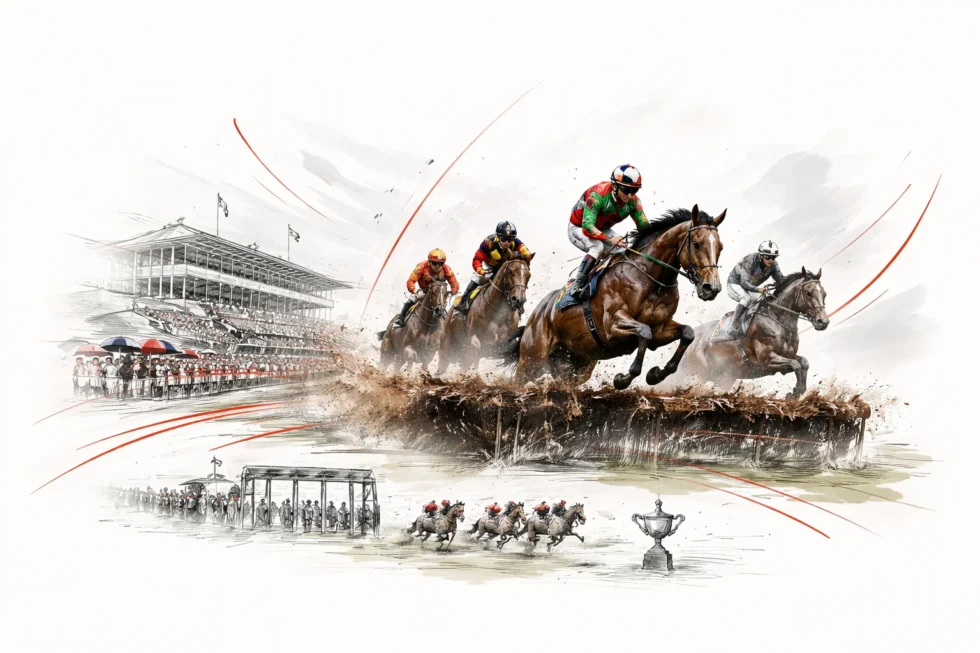
Scottish Grand National 2026 delivered a stamina-led outcome at Ayr Racecourse in South Ayrshire on Saturday 18 April, where Kap Vert won the Coral Scottish Grand National at 15:35 (official off 15:35:54) following a gruelling 3m 7f 176y Premier Handicap Chase run on heavy ground, soft in places, finishing ahead of Git Maker and Kim Roque as the extended four-mile contest broke apart under pressure in the closing stages, thereby defining, as The WP Times reports, the official Scottish Grand National results and Scottish grand national 2026 results.
The race unfolded as a classic Ayr staying test rather than a tactical handicap, with 16 runners going to post following five withdrawals and conditions officially described as heavy, soft in places, forcing a steady early tempo before the contest developed into an endurance examination over the final mile, where only the strongest finishers remained competitive and a significant proportion of the field failed to complete the course.
Scottish Grand National 2026 result: full confirmed finishing order at Ayr
Kap Vert secured victory at odds of 20-1 under Sean Houlihan in the Scottish Grand National 2026 at Ayr, producing a sustained late run through heavy, stamina-sapping ground to take the £200,000 Coral Premier Handicap feature at 15:35, finishing ahead of Git Maker and Kim Roque after the extended 3m 7f 176y contest broke up significantly in the closing stages, with only the strongest stayers able to complete under pressure.
Leading finishers:
| Position | Horse | Notes |
|---|---|---|
| 1 | Kap Vert | Winner (20/1) |
| 2 | Git Maker | Stayed on strongly |
| 3 | Kim Roque | Prominent in market, held late |
| 4 | Isaac Des Obeaux | Stayed into contention |
| 5 | Chasingouttheblues | Consistent late gallop |
| 6 | Promontory | Completed the leading group |
Beyond the first six, the full finishing order was fragmented, with only a limited number of additional runners completing the race as conditions intensified through the closing stages, a typical pattern for Scottish National results on heavy spring ground at Ayr.
Non-finishers and withdrawals: how the field reduced during the race
The Scottish Grand National runners 2026 field contracted progressively across both pre-race declarations and the race itself, as testing ground conditions at Ayr forced late withdrawals before the off and then steadily reduced the field during the extended four-mile contest, where fatigue, jumping errors and pace collapse in the final circuit resulted in a high rate of non-finishers typical of marathon handicap chases run on heavy spring ground.
Non-runners (before the start):
- Our Power
- Ask Brewster
- Montregard
- Magna Sam
- Road To Home
These late withdrawals were primarily linked to unsuitable ground conditions, a frequent factor in marathon chases where connections avoid exposing horses to extreme stamina tests.
Non-finishers (race attrition):
A substantial proportion of the remaining runners failed to complete the race, with outcomes including:
- Pulled up (PU)
- Failed to finish under fatigue
- Dropped out in final stages
This attritional pattern reflects the structural nature of the Scottish Grand National: over nearly four miles on heavy ground, completion rates typically fall well below standard handicap levels, particularly when pace collapses in the final circuit.
Race conditions, timing and performance metrics at Ayr
The 2026 running at Ayr was shaped decisively by ground conditions rather than outright pace, with the official race parameters reinforcing the endurance-led nature of the contest from the outset, as a scheduled 15:35 start over 3m 7f 176y on heavy ground, soft in places, created a slow-run but physically demanding early tempo before the race developed into a prolonged stamina test in the closing stages, where sectional times dropped markedly and the winning performance was determined by energy conservation and late-race resilience rather than speed.
Key race data
- Race time: 15:35 (official off 15:35:54)
- Distance: 3m 7f 176y
- Going: Heavy (soft in places)
- Runners: 16
- Non-runners: 5
- Winning time: 9m 5.23s (slow by over one minute)
- Prize fund: £200,000
The winning time — significantly slower than standard — underlines the effect of ground conditions, where energy conservation becomes the primary determinant of outcome and sectional speed becomes secondary.
How Kap Vert won the Scottish Grand National 2026
Kap Vert’s success in the Scottish Grand National 2026 was built on control rather than drama, with Sean Houlihan keeping the six-year-old in a workable rhythm through the early and middle stages before asking him to lengthen when the race began to unravel in the straight. Official result data show the Coral Scottish Grand National was run over 3m 7f 176y at Ayr on heavy ground, soft in places, with a winning time of 9m 5.23s, conditions that turned the race into a severe examination of stamina and jumping economy rather than tactical speed. In that context, Kap Vert did not need to dominate the race from the front; he needed to preserve enough energy to withstand the attritional final section better than the rest, and that is exactly what happened.
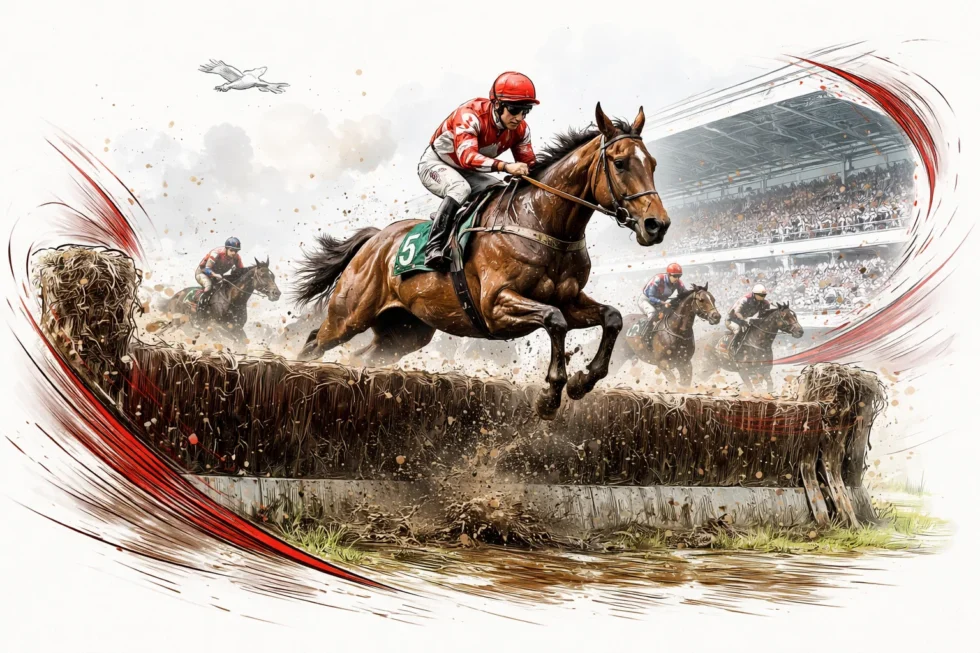
Racing Post’s race report and result notes show that Kap Vert travelled strongly through the contest, moved into a more decisive position from midfield as the field came under pressure, and was in front by four out before asserting when others began to flatten. Houlihan said afterwards that the horse was “a brilliant jumper”, adding that he “travelled nearly too well” and was “genuine, jumped well and was tough when he needed to be”, a description that fits both the visual impression of the run and the official pattern of the race. That combination of measured positioning, clean jumping and the ability to keep finding after the final two fences is the classic profile of a Scottish National winner on demanding ground.
The result also gains weight when placed against the pre-race market. Kap Vert started at 20-1, while Kim Roque went off as the 4-1 favourite and Git Maker was also well regarded in the market, which meant the winner was not the headline choice in most Scottish Grand National tips previews before the off. Yet the race did not unfold as a market-led contest driven by class at the top of the betting; it developed into a long-form handicap chase in which stamina reserves, fluency at the obstacles and restraint before the home straight mattered more than pre-race popularity. Git Maker’s second confirmed that he stayed the trip strongly, but Kim Roque, despite travelling as one of the principal dangers on paper, could not match Kap Vert’s finishing strength in the decisive final stages.
There was also a wider significance to the victory. Sky Sports reported that Kap Vert’s win gave the training partnership of Philip Hobbs and Johnson White their biggest success since taking out a joint licence, while Racing Post framed Houlihan’s ride as another major success for the jockey. In a race with £200,000 added prize money and a winner’s return of £112,540, it was not simply a surprise result but a substantial spring handicap success achieved in one of the most demanding staying races in the British calendar.
What the Scottish Grand National result shows about Ayr and staying chases
The 2026 result reinforced Ayr’s reputation as a course that can look straightforward on paper but becomes punishing when the Scottish Grand National is run over an extended trip on testing spring ground. Official race conditions listed the contest as 3m 7f 176y on heavy ground, soft in places, and that alone changed the shape of the race: it was never likely to be decided by acceleration, but by who could maintain a jumping rhythm for nearly four miles without wasting energy. Ayr’s flatter profile compared with tracks such as Cheltenham can create the illusion of a less exacting challenge, but in handicap chases of this nature the absence of steep undulations does not reduce the stamina demand; it shifts the emphasis towards sustained galloping and efficiency under fatigue.
That is why Scottish Grand National winners are so often horses whose strengths are practical rather than flashy. The race tends to reward runners who settle, jump economically and arrive at the last half-mile with enough left to respond when others begin to stop. In 2026, the official figures and finishing pattern supported that reading: the race was run in a time more than a minute slow, and the order behind the winner showed that those who filled the first places were the horses who kept going once the contest had turned fully attritional. Ayr did not produce a sprint to the line; it produced a drawn-out survival test in which the strongest stayers separated themselves from horses who had looked competitive much earlier in the race.
The field size and the rate of attrition are also important to understanding the result. Racing Post’s final racecard and result pages show that 16 runners went to post after a series of withdrawals, including Road To Home, and that several horses were taken out because of the ground. When a marathon handicap chase loses runners before the start and then continues to contract during the race itself, the contest becomes even more revealing: it strips away horses who are not suited by conditions and leaves only those able to cope with the compounded strain of trip, going and jumping pressure.
Scottish Grand National 2026 in the context of Ayr races and the season
Within the structure of the jumps campaign, the Scottish Grand National remains one of the defining late-season staying handicaps, positioned after Cheltenham and Aintree and often serving as a final major target for horses either stepping up in trip or arriving after hard spring campaigns. Ayr presents the race as one of the centrepieces of its flagship spring meeting, and the 2026 running again showed why it holds that status: it combined a strong field, severe conditions and a result with immediate relevance for punters, form analysts and connections planning next season.
The 2026 renewal also fitted several long-standing patterns associated with the race. The winner came from outside the front line of the betting at 20-1, the ground materially affected both the make-up of the field and the finishing order, and the final result was shaped more by staying power than by classier market narratives. That is one reason why searches such as Scottish national results today, Scottish grand national result, who won the Scottish Grand National and Racing Post results spike so sharply once the race is over: this is a contest in which the bare result rarely tells the whole story unless it is read alongside the conditions and the way the race was run.
Kap Vert’s victory therefore belongs not just in the category of surprise winners but in the more specific category of legitimate Ayr staying winners: horses who may not dominate the market beforehand but whose profile becomes more persuasive as the race grows harsher. On Saturday 18 April 2026, that profile proved decisive. Kap Vert handled the ground, travelled powerfully enough to hold position without wasting effort, jumped with sufficient fluency to avoid losing momentum, and then stayed on more strongly than Git Maker and Kim Roque when the Scottish Grand National became what it so often becomes at Ayr — a test of endurance first and everything else second.
Scottish Grand National 2026 at Ayr developed into a heavy-ground staying chase of progressive attrition rather than a speed-led handicap, with Kap Vert producing the most complete performance in the field to win the £200,000 Coral feature at 15:35 under Sean Houlihan, finishing ahead of Git Maker and Kim Roque after a race in which the conditions, the distance and the late collapse of rivals proved more decisive than the market.
Read about the life of Westminster and Pimlico district, London and the world. 24/7 news with fresh and useful updates on culture, business, technology and city life: What is happening in the british gas energy bill update as 4.7 million homes in England face severe energy hardship in 2026
Sources: Racing Post; Sky Sports Racing; Ayr Racecourse; The Scottish Sun.