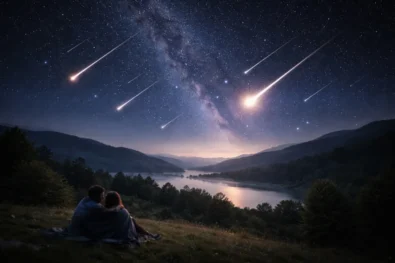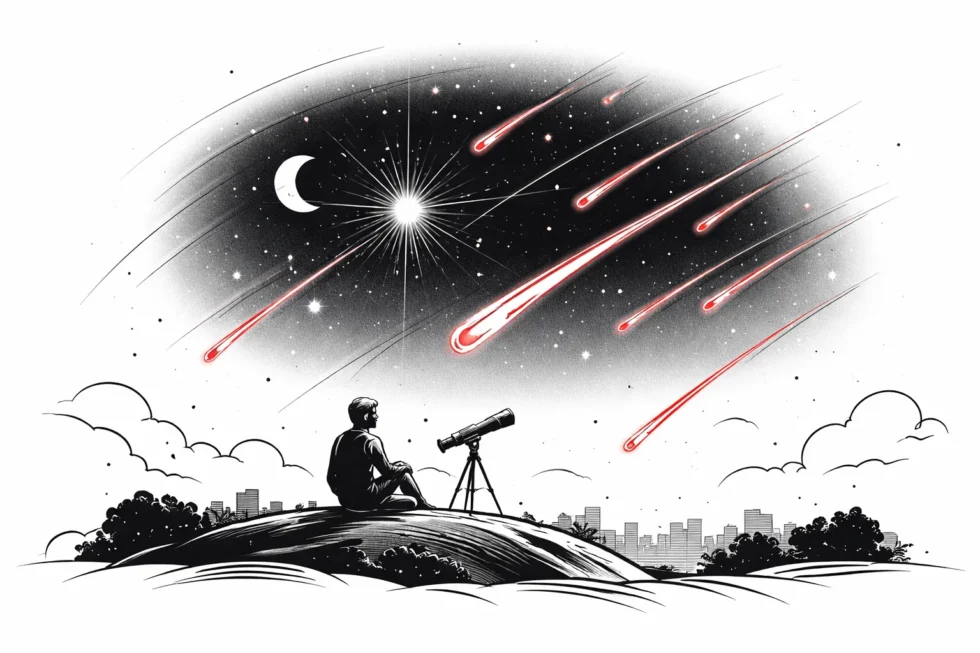
The Lyrid meteor shower 2026 peaks overnight from Tuesday 21 April into Wednesday 22 April, with observers in Europe expected to see the strongest activity in the pre-dawn hours and again after sunset, as Earth passes through debris left by the long-period comet Comet C/1861 G1 Thatcher. Under optimal dark-sky conditions, rates can reach around 15–20 meteors per hour, though urban viewers should expect lower counts due to light pollution; nevertheless, occasional bright “fireballs” remain visible even from city centres, making the event one of the most accessible spring skywatching opportunities, The WP Times reports, citing Space.
The 2026 viewing window is supported by favourable lunar conditions following a new moon on 17 April, reducing sky brightness during peak mornings and allowing fainter meteors to become visible. While the official peak is forecast around 20:00 UTC on 22 April, this falls in daylight for much of Europe, meaning practical viewing times shift to early morning (around 04:00–05:00 local time) when the radiant in the constellation Lyra rises higher in the northeast sky, increasing meteor visibility and trajectory length across the horizon.
Lyrid meteor shower 2026: peak timing, visibility and conditions
The Lyrids are among the oldest recorded meteor showers, with documented observations dating back over 2,500 years, and are characterised by fast meteors entering Earth’s atmosphere at roughly 49 km per second. Unlike more intense showers such as the Perseids, the Lyrids produce moderate but steady rates, occasionally punctuated by unusually bright fireballs that can leave persistent glowing trails.
Key viewing details for 2026
| Factor | Details |
|---|---|
| Peak dates | Night of 21–22 April 2026 |
| Peak time | ~20:00 UTC (best viewed before dawn in Europe) |
| Expected rate | 15–20 meteors/hour (dark skies) |
| Radiant location | Constellation Lyra (near Vega) |
| Best viewing time | 04:00–05:00 local time |
| Moon phase | Minimal interference (post-new moon) |
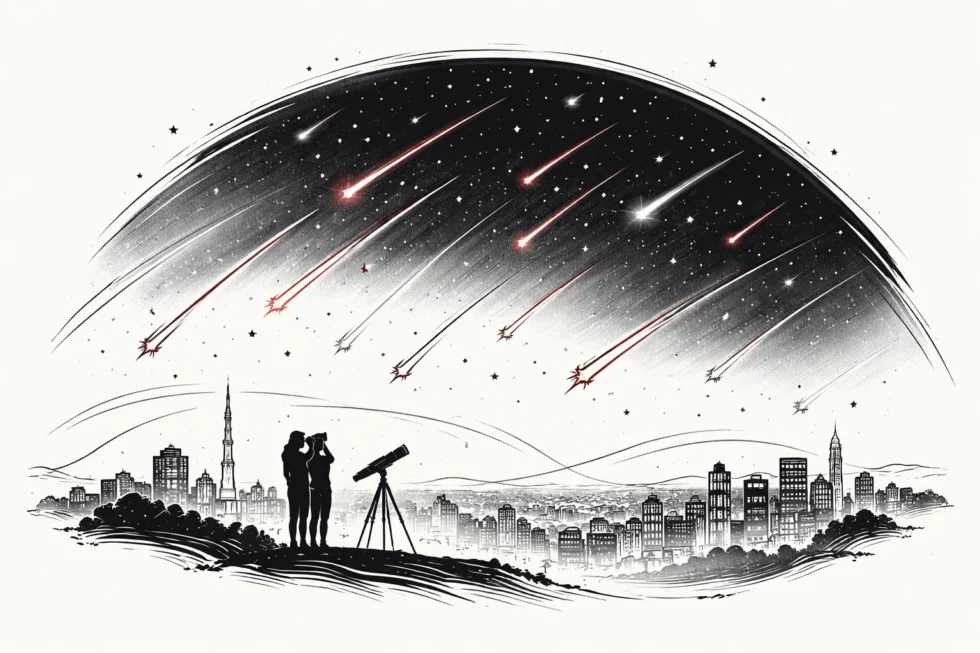
For observers in urban environments such as Basel, visibility will depend on limiting artificial light exposure and allowing sufficient time for eyes to adapt. Even in city conditions, brighter meteors and fireballs remain detectable, particularly when looking away from direct light sources.
How to watch meteor showers from a city: practical strategy
Observing meteor showers in a city requires adaptation rather than ideal conditions. Telescopes are not recommended, as they restrict field of view; instead, the key is maximising sky coverage and patience. Effective urban viewing approach:
- Choose the darkest available location (parks, riversides, rooftops)
- Face northeast, where Lyra rises
- Avoid direct street lighting and building glare
- Allow 20–30 minutes for eye adaptation
- Observe continuously for at least 1–2 hours
A reclining position or wide field of view significantly improves detection rates, as meteors can appear anywhere in the sky rather than strictly at the radiant point. In dense urban areas, the perceived rate may drop below 10 per hour, but the probability of seeing at least one bright meteor remains high over an extended observation period.
Astrophotography method: capturing Lyrids with a camera
For those unable to continuously observe the sky, long-exposure photography provides an alternative method to increase detection probability. This technique, widely used by amateur and professional astronomers, relies on automated image capture over extended periods. Recommended camera setup:
| Setting | Value |
|---|---|
| Lens | Wide-angle (14mm–24mm) |
| ISO | 800–1600 |
| Exposure | ~30 seconds |
| Focus | Manual (infinity or star-focused) |
| Format | RAW |
| Duration | 2–3+ hours continuous shooting |
This “interval shooting” approach allows cameras to capture meteors that might be missed by the human eye, particularly during brief or random bursts of activity. However, meteor photography remains probabilistic — even long sessions may yield no captures if timing does not align with meteor occurrence.
Why the Lyrids matter in 2026 skywatching calendar
The Lyrids mark the first significant meteor shower following the winter period and act as a transition into a more active meteor season leading into the Eta Aquariids in early May. Their importance lies not in peak intensity but in accessibility and historical continuity.
Each April, Earth intersects a stream of cometary debris deposited centuries ago by Comet C/1861 G1 Thatcher, with particles burning up in the upper atmosphere and producing visible streaks of light. Unlike annual comets, the parent body itself will not return to the inner solar system until 2283, making meteor observation the only accessible interaction with its material. The Lyrids also demonstrate variability: some years produce unexpected outbursts exceeding predicted rates, reinforcing the role of observational persistence rather than reliance on peak forecasts alone.
What increases your chances of seeing a meteor
Meteor observation is influenced by multiple environmental and timing variables. While forecasts provide general expectations, actual visibility depends on local conditions. Factors affecting visibility:
- Light pollution level
- Weather and cloud cover
- Observer patience and duration
- Radiant altitude in the sky
- Moon brightness
Even in suboptimal conditions, extended observation windows significantly improve outcomes. Statistically, longer viewing periods correlate with higher detection probability, especially during peak hours before dawn. In practical terms, observers should treat meteor watching as a cumulative experience rather than a single-moment event. Short observation periods often result in missed activity, while sustained sessions increase the likelihood of witnessing brighter, rarer fireballs.
Read about the life of Westminster and Pimlico district, London and the world. 24/7 news with fresh and useful updates on culture, business, technology and city life: Was the UK green fireball a meteorite? CCTV captures bizarre flashes over Durham in April 2026