

Belgium to UK migrant boats are rising as asylum seekers in Flanders increasingly move west toward the French coast, exploiting gaps in enforcement and coordination between European states, while Britain remains a preferred destination due to perceived economic and legal advantages. Reporting from Flanders shows overcrowded housing, minimal weekly allowances and a growing informal network guiding migrants toward Channel crossings via France, highlighting systemic inconsistencies across asylum regimes, reports The WP Times.
Belgium to UK migrant boats: routes shifting through Flanders and France
A noticeable shift is underway in migration patterns across شمالwestern Europe, with Belgium emerging as a staging ground rather than a final destination. Migrants arriving in Flanders—many from conflict zones or unstable regions—are not settling but instead planning onward journeys to Britain. The geographic proximity to northern France makes this transition operationally simple, particularly with informal transport links and smuggling networks already established.
Authorities in Belgium are increasingly criticised for what observers describe as a “hands-off” or laissez-faire posture. While not officially endorsing onward migration, enforcement gaps allow migrants to move freely toward the French border. This mirrors long-standing accusations directed at France, where coastal policing has struggled to deter small boat departures.
The result is a de facto corridor: migrants enter Belgium, remain briefly under strained reception systems, then continue toward French shores for Channel crossings.
Key route dynamics:
- Entry into Belgium via EU land routes
- Temporary accommodation in Flanders reception centres
- Movement toward northern France (often undocumented)
- Coordination with smuggling networks
- Departure via small boats across the Channel
Living conditions in Flanders: overcrowding and minimal support
Conditions inside migrant accommodation centres in Flanders are described as basic and heavily strained. Reports indicate that up to eight individuals may share a single room, with limited privacy and inadequate infrastructure. Weekly financial support is minimal—around £8—barely sufficient for essential needs.
Such conditions create strong incentives for secondary migration. For many asylum seekers, Belgium represents stagnation rather than opportunity. The lack of integration pathways, employment access and long-term clarity contributes to decisions to leave.
In contrast, Britain is perceived—rightly or wrongly—as offering better prospects, including access to informal work, diaspora communities and more favourable asylum outcomes.
| Factor | Situation in Flanders |
|---|---|
| Accommodation | Up to 8 people per room |
| Weekly allowance | Approx. £8 |
| Employment access | Highly restricted |
| Processing delays | Significant |
| Integration support | Limited |
Channel crossings: why Britain remains the destination
Despite increased enforcement rhetoric in the UK, the pull factors remain strong. Migrants cite language familiarity, labour market opportunities and existing migrant communities as key reasons for choosing Britain over continental Europe.
Additionally, the perception of the UK asylum system—whether accurate or not—continues to drive decision-making. Social media and word-of-mouth play a critical role in shaping these views, often amplifying success stories while downplaying risks.
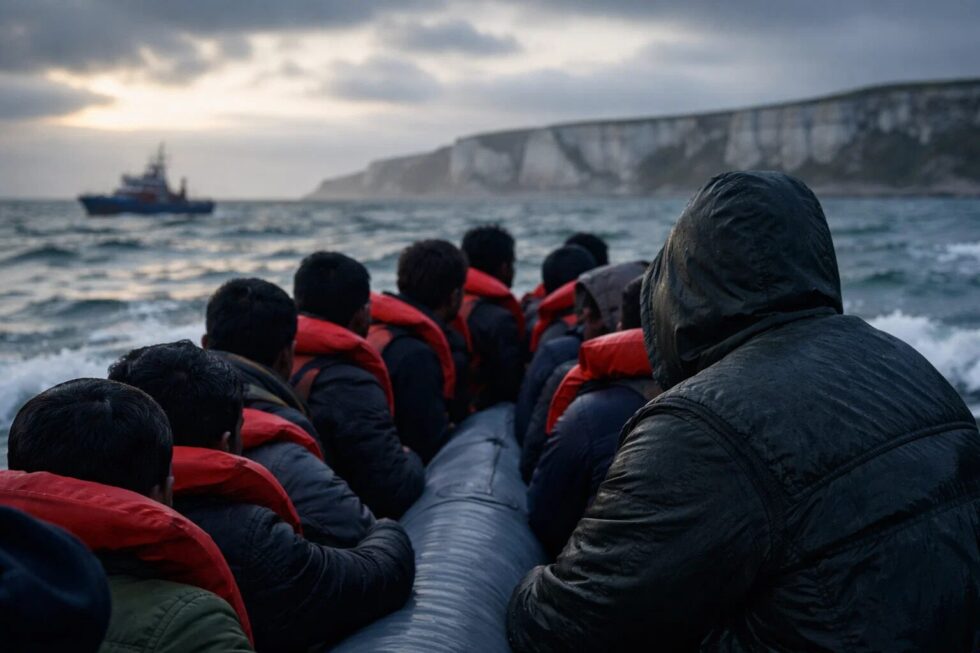
Crossings themselves remain dangerous, with overcrowded inflatable boats frequently used. Yet the persistence of these journeys underscores the limited deterrent effect of current policies.
Primary pull factors toward the UK:
- English language accessibility
- Informal job market opportunities
- Established migrant networks
- Perceived asylum advantages
- Media and peer influence
Policy gaps between Belgium and France
The migration flow highlights structural weaknesses in coordination between Belgium and France. While both countries formally cooperate on migration control, operational inconsistencies allow migrants to transit relatively easily.
Belgium’s internal focus on processing asylum claims contrasts with France’s external border challenges along the Channel coast. This division creates a grey zone where responsibility becomes blurred.
Critics argue that without unified enforcement or shared accountability, migrants will continue to exploit these gaps.
Key policy issues:
- Lack of joint border enforcement mechanisms
- Differing asylum system pressures
- Limited cross-border intelligence sharing
- Political reluctance to escalate controls
- Humanitarian constraints on enforcement
Historical context: Belgium’s coastal legacy and present reality
Belgium’s coastline has long been a site of strategic importance, particularly during both World Wars when thousands of British soldiers lost their lives in the region. Today, that same coastline is again linked to Britain—this time through migration routes rather than military alliances.
The contrast is stark: from a symbol of shared sacrifice to a transit point in a modern migration crisis. While the scale and context differ, the geopolitical connection between Belgium and Britain remains significant.
Contextual contrasts:
- Historical military cooperation vs modern migration tension
- Fixed alliances vs fluid migration routes
- State-controlled movement vs informal networks
- Strategic coastline then and now
Enforcement reality: small boats and operational challenges
Stopping small boat crossings remains a logistical challenge. Smugglers adapt quickly, launching boats from less monitored areas or during favourable weather windows. Even when interceptions occur, they often happen after migrants have already entered UK waters.
Belgium’s indirect role complicates enforcement further. As a transit country, it bears less immediate pressure than France, yet its policies still influence overall migration flows.
Operational challenges:
- Rapidly changing launch locations
- Limited surveillance coverage
- Legal constraints on interception
- Smuggling network adaptability
- Weather-dependent crossings
Outlook: will Belgium become a permanent transit hub
If current trends persist, Belgium risks becoming a stable transit hub within the broader migration network to the UK. Without policy adjustments or stronger bilateral coordination, the flow of migrants through Flanders toward France is likely to continue.
For policymakers, the issue is no longer isolated to one country. It represents a regional system failure requiring coordinated solutions across borders.
Possible future scenarios:
- Increased EU-level coordination
- Stricter internal controls in Belgium
- Expanded UK-France enforcement agreements
- Continued growth in crossings if unchanged
- Humanitarian system strain across all three countries
Belgium to UK migrant boats: smuggling networks and logistics behind crossings
The operational backbone of Belgium to UK migrant boats lies in increasingly sophisticated smuggling networks that coordinate movement across multiple jurisdictions. These networks are not static; they function as fluid, decentralised systems linking recruiters, transport facilitators and maritime operators.
Migrants in Flanders are often approached within days of arrival, either directly or via intermediaries, and offered structured “packages” covering transport to France and a place on a boat.
Payments vary depending on nationality, urgency and perceived risk, with some migrants paying in stages while others rely on family transfers from abroad. Digital communication tools—encrypted messaging apps in particular—have become essential for coordination, allowing smugglers to rapidly adapt routes and timings. This flexibility makes enforcement significantly more complex, as networks can dissolve and reassemble across borders within hours.
Despite crackdowns, the profit margins remain high, ensuring continued supply of facilitators willing to operate in legal grey zones.
Structure of smuggling operations:
- Local recruiters in reception centres or urban hubs
- Transport coordinators arranging cross-border movement
- Safe houses in Belgium and northern France
- Maritime teams handling boat launches
- Financial channels via cash, crypto or remittances
Belgium to UK migrant boats: UK domestic pressure and policy response
The increase in Belgium to UK migrant boats is intensifying political and operational pressure within Britain, where migration has become a central policy issue. Authorities face the dual challenge of managing arrivals while attempting to deter future crossings, a balance that has proven difficult to achieve.
Reception systems in the UK are under strain, with temporary accommodation—often hotels—being used to manage overflow. This has financial and political implications, fuelling debate over the sustainability of current approaches. At the same time, legislative efforts aimed at tightening asylum rules and accelerating removals have faced legal and logistical hurdles.
Crucially, enforcement at sea addresses only the final stage of the journey. Without upstream disruption—particularly in Belgium and France—the overall flow remains resilient.
UK response measures:
| Measure | Description |
|---|---|
| Increased patrols | Expanded maritime surveillance in Channel |
| Bilateral agreements | Cooperation frameworks with France |
| Asylum policy reforms | Attempts to accelerate processing/removals |
| Accommodation expansion | होटल and temporary housing usage |
| Intelligence operations | Targeting smuggling networks |
Read about the life of Westminster and Pimlico district, London and the world. 24/7 news with fresh and useful updates on culture, business, technology and city life: What does the EU Entry Exit System mean for UK travellers, biometrics, fingerprints and Schengen rules in 2026