
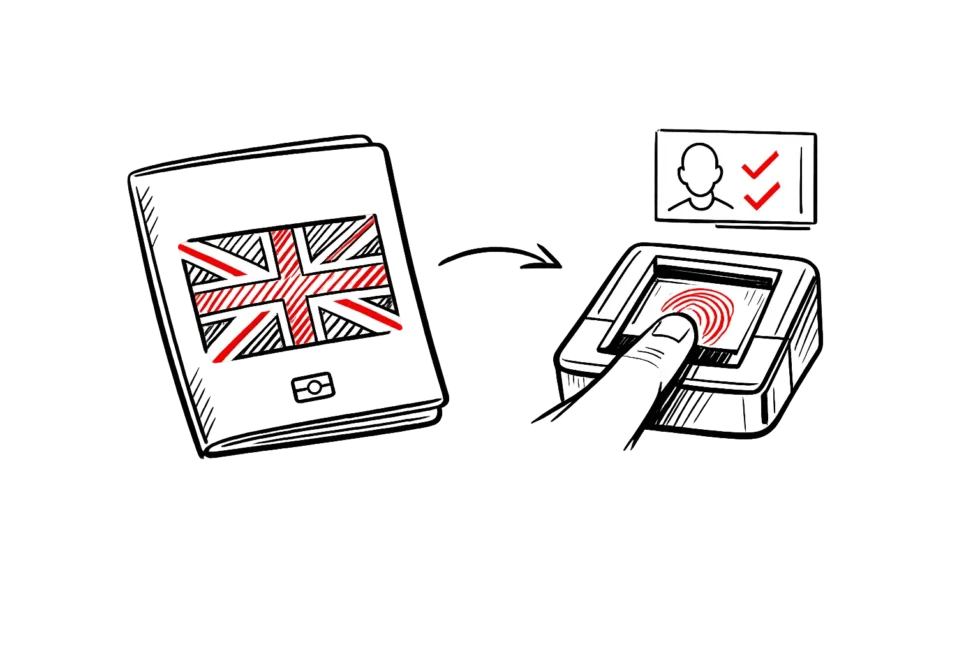
EU Entry Exit System (EES) is being rolled out across the Schengen area, requiring UK travellers to submit fingerprints and facial biometrics at external EU borders, fundamentally changing how entry and exit are recorded, how long visitors can stay, and how compliance is enforced. The system, designed to replace passport stamping with a centralised digital database, applies to all visa-free “third-country nationals,” including British passport holders, and has faced delays, operational inconsistencies and partial suspensions across multiple EU states as rollout targets slipped beyond April 2026, reported in analysis by travel correspondent Simon Calder for The WP Times via Independent.
The policy shift follows Brexit-era agreements that reclassified UK citizens as third-country travellers, meaning they are now subject to strict 90/180-day limits, biometric registration and, eventually, the ETIAS travel authorisation scheme.
While the European Commission describes EES as the most advanced digital border system globally, early implementation has exposed infrastructure gaps, queue risks and uneven enforcement across airports, ports and rail terminals.
EES explained: what the system is and how it replaces passport stamps
The Entry Exit System is an automated IT infrastructure designed to log the movements of non-EU travellers entering and leaving the Schengen zone. It eliminates manual passport stamping and replaces it with biometric identification and a centralised database tracking each individual’s travel history.
At its core, EES records the time and place of entry and exit, linking this data to a traveller’s biometric profile rather than relying on physical documents alone. This structural shift addresses long-standing issues with inconsistent border enforcement and overstays that were previously difficult to track.
The system applies only at external Schengen borders, meaning internal travel between member states remains unaffected. However, the first point of entry becomes critical, as that is where biometric registration occurs.
Importantly, the system is person-based rather than passport-based, allowing authorities to track individuals even if they present different travel documents over time. This directly targets loopholes previously exploited by frequent travellers using multiple passports.
Core functions of EES:
- Replace manual passport stamping
- Record entry and exit data centrally
- Collect biometric identifiers (fingerprints, facial scans)
- Detect overstays automatically
- Strengthen identity verification and fraud prevention

Biometric data requirements: fingerprints and facial recognition rules
Under EES, biometric data collection is mandatory for most UK travellers entering the Schengen zone. This includes fingerprint scans and facial image capture during the first interaction with the system.
Children under 12 are exempt from fingerprinting, but facial biometrics still apply. For subsequent trips, travellers are expected to undergo only facial recognition checks, although in practice multiple reports indicate repeated fingerprint requests at some borders.
The European Union has quietly relaxed strict requirements for biometric capture at every crossing, allowing flexibility where infrastructure or queues create operational pressure. In extreme cases, biometric checks may be temporarily suspended.
This inconsistency has led to confusion among travellers, with experiences varying significantly between countries such as Spain, Greece, Belgium and Switzerland.
Biometric process:
| Stage | Requirement |
|---|---|
| First entry | Fingerprints + facial scan |
| Subsequent entries | Facial recognition only |
| Children under 12 | No fingerprints |
| System validity | 3 years per registration |
Where checks happen: airports, ports and UK juxtaposed controls
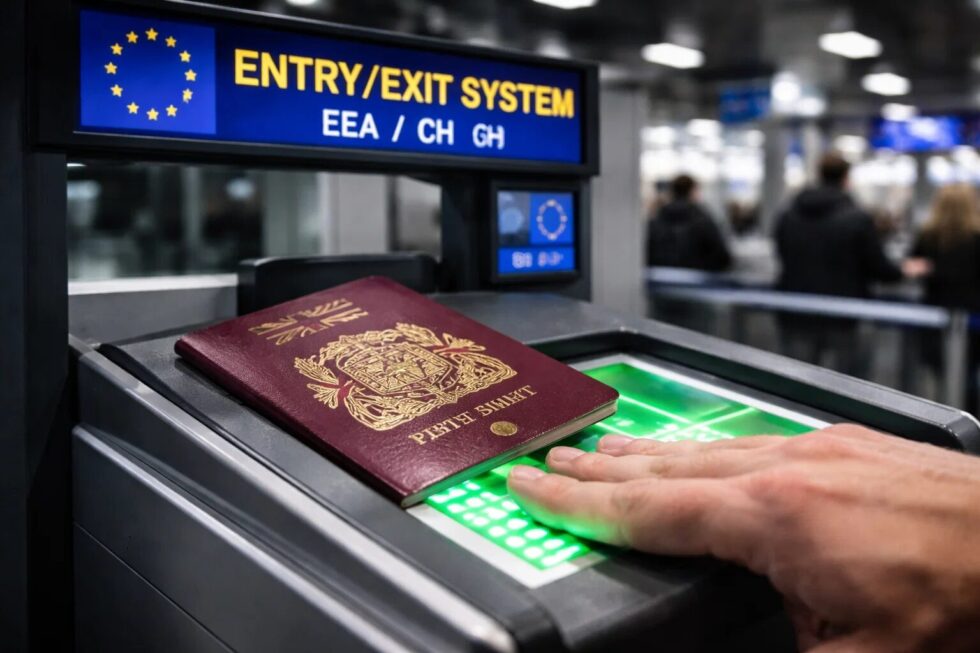
EES applies at all external Schengen entry points, including airports, seaports and land borders. For UK travellers, this includes unique “juxtaposed controls” where French border police operate on British soil.
Key locations include Dover port, Eurotunnel terminals in Folkestone and the Eurostar hub at London St Pancras. These sites are expected to handle biometric registration before departure from the UK.
Despite significant investment, infrastructure readiness varies. For example, registration kiosks installed at St Pancras have reportedly not been fully operational. In contrast, manual processing remains the fallback method in many locations.
Operators estimate that EES could add approximately two minutes per passenger during peak processing, though real-world delays may be higher depending on demand and system stability.
Key UK departure points with EES checks:
- Dover port
- Eurotunnel (Folkestone–Calais)
- London St Pancras (Eurostar)
The 90/180-day rule: stricter enforcement under EES
The Schengen rule limiting stays to 90 days within any rolling 180-day period remains unchanged but will now be strictly enforced through automated tracking.
Previously, compliance depended on passport stamps, which were inconsistently checked and easily manipulated. EES eliminates ambiguity by calculating stays digitally and flagging overstays in real time. This has major implications for frequent travellers, second-home owners and remote workers who previously relied on informal interpretations of the rule.
The system also prevents abuse through dual passports, as biometric identification ties all travel activity to a single individual.
90/180 rule basics:
- Maximum stay: 90 days
- Reference period: rolling 180 days
- Applies to all Schengen countries collectively
- Automatically enforced via EES database
Transit passengers: when EES applies and when it does not
Not all travellers passing through EU airports will be subject to EES. The determining factor is whether the passenger formally enters the Schengen area. Passengers on through-tickets connecting outside Schengen—such as UK to Asia via a major EU hub—generally avoid EES checks if they remain in transit zones. However, the system applies if the journey includes entry into Schengen territory, a domestic Schengen flight segment, or a self-transfer requiring re-check-in.
This distinction is operationally critical and may affect route planning for travellers seeking to avoid additional border procedures.
EES applies if:
- Final destination is within Schengen
- Journey includes intra-Schengen flight segment
- Traveller exits transit zone (self-transfer)
ETIAS: the next layer of control and when it starts
The European Travel Information and Authorisation System (ETIAS) is the next phase of border control, requiring visa-exempt travellers to obtain pre-authorisation before entering Schengen.
Costing €20 and valid for three years, ETIAS functions similarly to the US ESTA system. It requires applicants to submit personal, professional and travel information, along with security disclosures.
However, ETIAS cannot launch fully until EES is operational and stable. Current timelines suggest at least a six-month delay after full EES deployment, with a grace period extending practical implementation into 2027. While not officially a visa, ETIAS introduces a pre-screening layer that effectively acts as one in practice.
ETIAS key facts:
| Feature | Detail |
|---|---|
| Cost | €20 |
| Validity | 3 years |
| Processing time | Minutes to 4 days |
| Launch | After full EES rollout |
| Requirement | Mandatory for visa-free travellers |
Operational challenges: delays, exemptions and real-world gaps
The rollout of EES has been repeatedly delayed since its original 2021 target, with the latest full implementation deadline now pushed to late 2026.
Infrastructure readiness varies widely, and some countries have introduced temporary exemptions to manage congestion. Greece, for example, has suspended biometric requirements for UK travellers at certain entry points to reduce waiting times.
Airports, ports and rail hubs have invested heavily in equipment that is not yet fully utilised, raising concerns about efficiency and cost.
These inconsistencies highlight the gap between policy design and operational reality, particularly during the transition phase.
Key issues reported:
- Repeated delays in system launch
- Partial suspension of biometric checks
- Inconsistent enforcement across countries
- Underused infrastructure at major hubs
What happens to your data: security and monitoring systems
All biometric and personal data collected through EES and future ETIAS applications will be cross-checked against EU databases and international systems, including Interpol.
The system is designed to detect individuals linked to serious crimes such as terrorism, human trafficking, cybercrime and financial fraud. Authorities will also maintain a dedicated watchlist to flag high-risk individuals during the application or entry process.
Concerns remain about data privacy and the risk of fraudulent third-party websites exploiting travellers during ETIAS rollout.
Data checks include:
- EU security databases
- Interpol systems
- ETIAS watchlist
- Criminal and migration records
Bottom line: what UK travellers must expect in 2026–2027
EES marks a structural transformation of European border management, shifting from manual checks to a data-driven, biometric system that tightly controls entry, exit and length of stay.
For UK travellers, this means longer processing times initially, stricter enforcement of stay limits and the need to adapt to digital pre-authorisation systems like ETIAS.
While the long-term goal is efficiency and security, the short-term reality is fragmentation, delays and evolving procedures that travellers must navigate carefully.
Understanding how and when these systems apply is now essential for anyone travelling between the UK and the Schengen zone.
Read about the life of Westminster and Pimlico district, London and the world. 24/7 news with fresh and useful updates on culture, business, technology and city life: London Southend Airport EasyJet plane too heavy for take-off: why passengers left Málaga flight