
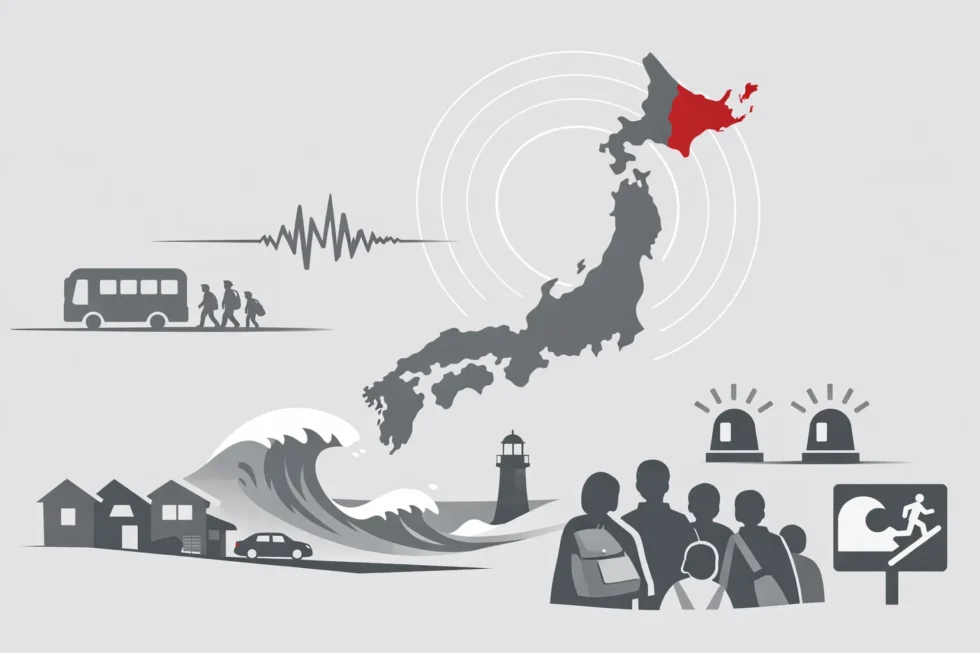
On 20 April 2026 at 16:52 JST, a powerful Japan earthquake struck offshore along the Pacific margin near the Sanrikucoast, prompting an immediate tsunami warning across parts of Hokkaido and north-east Honshu, with the magnitude revised to 7.7–8.0 and more than 170,000 people advised to evacuate coastal zones, The WP Times reports, citing The Guardian. The Japan earthquake today occurred at a depth of roughly 10–20 km near the Japan Trench, a high-risk subduction zone, triggering automated alerts and early projections of tsunami Japan waves of up to three metres, depending on seabed displacement and coastal amplification.
Within hours, the Japan tsunami warning was downgraded to an advisory after observed wave heights remained below critical thresholds, including readings of around 80cm at coastal monitoring points. However, officials warned that the Japan earthquakes sequence remains active, with aftershocks already recorded and a short-term rise in the probability of a larger event. Authorities continue to restrict access to coastal areas, stressing that even moderate tsunami activity can generate dangerous currents, particularly along the indented Sanriku coastline.
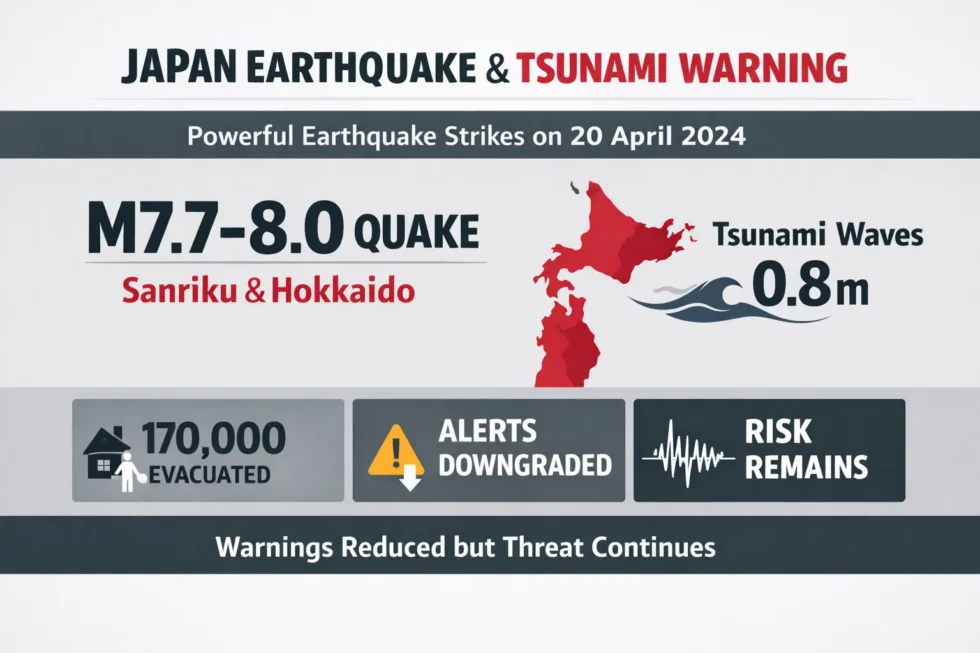
Japan earthquake today: verified timeline, scale and operational response
The earthquake Japan event began offshore in the Pacific, east of northern Honshu, along the boundary where the Pacific Plate subducts beneath the Okhotsk Plate — a zone capable of producing rapid seabed displacement and triggering tsunami activity even without extreme magnitudes. According to the Japan Meteorological Agency, the quake struck at 16:52 JST at a depth of roughly 10–20 km, a range associated with stronger surface shaking and higher tsunami-generation potential due to vertical movement of the ocean floor.
Confirmed sequence of events
- 16:52 JST — primary Japan earthquake recorded offshore near the Japan Trench
- Within minutes — nationwide tsunami warning issued for northern coastal regions
- ~17:30 JST — first wave activity detected along Sanriku coast (~80 cm at monitoring points)
- Evening (18:00–20:00 JST) — evacuation advisories extended across five prefectures
- Late evening (~21:00–22:00 JST) — Japan tsunami warning downgraded to advisory
The timeline reflects the speed of Japan’s early-warning infrastructure, which is designed to issue alerts before full modelling is complete, prioritising immediate evacuation over delayed accuracy.
Impact and system response
| Parameter | Data |
|---|---|
| Magnitude | 7.7–8.0 (revised upward) |
| Depth | ~10–20 km |
| Epicentre | Offshore Pacific, near Japan Trench |
| Affected regions | Hokkaido, Aomori, Iwate, Miyagi, Fukushima |
| Evacuation advisory | ~170,000–182,000 residents |
| Recorded tsunami height | ~0.8 m (Kuji port and nearby points) |
| Transport impact | Shinkansen suspended; airport and road monitoring |
| Power and nuclear | No abnormalities reported by regulators |
| Injuries | Limited; isolated incidents reported |
Operationally, the response followed Japan’s highest precautionary framework: transport systems were halted, coastal municipalities activated evacuation routes, and real-time monitoring networks tracked sea-level changes and aftershocks. Footage broadcast on NHK showed visible ground movement in urban areas, including swaying structures and people taking protective positions (Tokyo/Aomori, 20 April 2026), illustrating the intensity felt even at distance from the epicentre.
“The likelihood of a new, large earthquake is higher than during normal times,” said the Japan Meteorological Agency (Tokyo, 20 April 2026).
Officials stressed that this advisory reflects an elevated statistical probability rather than a specific forecast, a standard post-event assessment following major Japan earthquakes.
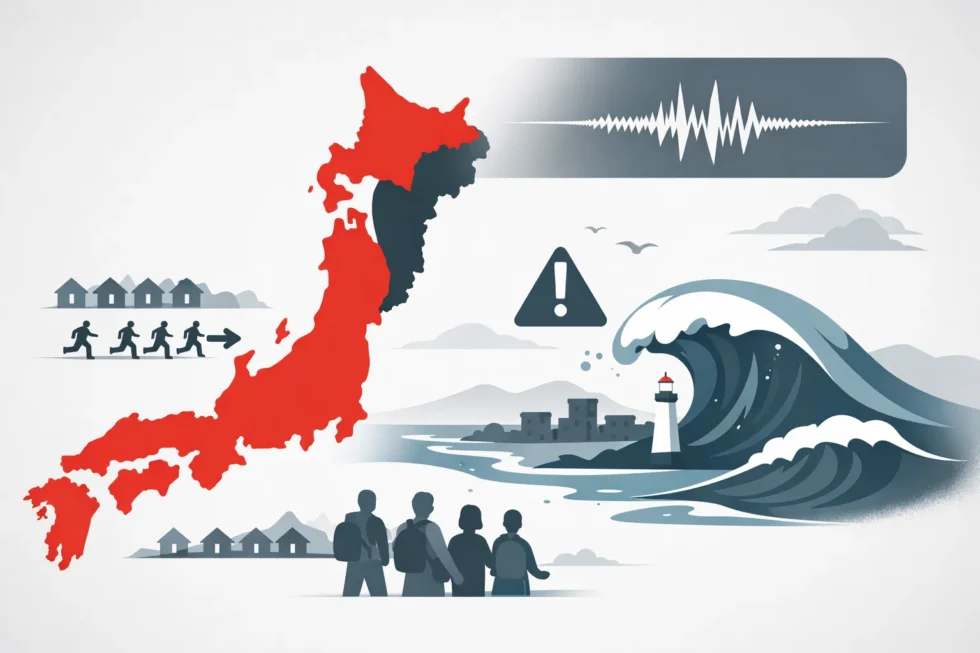
Short-term seismic risk outlook
| Scenario | Probability |
|---|---|
| Baseline conditions | ~0.1% |
| Post-event (current) | ~1% |
| Mega-quake classification | Magnitude 8+ |
This tenfold increase in probability — while still low in absolute terms — is sufficient to trigger heightened national preparedness. Authorities have advised residents in affected coastal zones to maintain readiness for at least one week, reflecting the known pattern of aftershock clusters and potential cascading seismic events. The structure of the response highlights a defining feature of Japan’s disaster management model: rapid escalation based on risk thresholds, followed by gradual de-escalation as real-world data confirms or reduces projected impact.
Tsunami warning downgraded: coastal dynamics and why risk persists
The downgrade from tsunami warning to advisory signals that large-scale inundation is no longer expected, but it does not remove the underlying hazard. Along the Sanriku coast — a deeply indented shoreline with narrow bays and steep inlets — wave energy can be concentrated and redirected, producing strong local currents even when offshore measurements appear modest. Data from the Japan Meteorological Agency showed observed wave heights of around 0.8 metres at monitoring points, but officials stress that these readings do not fully capture conditions inside harbours, river mouths and enclosed coastal zones.
Operational guidance remains in force
Authorities have maintained strict instructions for residents in affected areas, reflecting the continuing uncertainty of tsunami Japan behaviour:
- Stay away from coastlines and river mouths where surges can intensify
- Remain in evacuation zones until all advisories are formally lifted
- Expect repeated or delayed wave activity over several hours
- Monitor official alerts and local authority instructions continuously
Why even small tsunami waves are treated as high risk
The risk from a tsunami is determined less by wave height and more by hydrodynamic force and flow patterns at the coast:
- Water velocity and surge force can destabilise people, vehicles and vessels
- Coastal geometry, particularly along Sanriku, amplifies currents in confined areas
- Secondary and later waves may exceed the first recorded surge
- River systems can channel water inland beyond initial coastal impact zones
“What matters is not whether the wave looks dramatic, but what the water does when it reaches the coast,” said Dr Ioannis Karmpadakis (Imperial College London, London, April 2026).
“Even relatively small waves can generate powerful currents capable of damaging infrastructure and moving vessels within harbours and coastal channels.”
Why Japan’s warning system acts before full confirmation
Japan’s Japan tsunami warning framework is designed around speed rather than complete data, reflecting lessons from previous disasters:
- Early alerts are issued before full seismic and ocean modelling is completed
- Offshore sensor networks detect pressure changes and transmit data in seconds
- Evacuation decisions are based on risk thresholds, not confirmed impact
- Coastal amplification effects are assumed in early-stage warnings
Officials say this approach is critical in a country where seismic events can evolve rapidly.
Preparedness guidance following Japan earthquake today
Authorities have instructed residents to maintain heightened readiness for at least seven days following the Japan earthquake today, citing an increased probability of aftershocks and potential follow-up events.
- Keep emergency supplies accessible for at least one week
- Confirm evacuation routes and designated shelters
- Stay prepared for rapid movement if alerts escalate again
“Please maintain readiness for immediate evacuation and carry emergency supplies,” said Prime Minister Sanae Takaichi (Tokyo, 20 April 2026).
While the immediate tsunami warning phase has eased, Japan’s operational posture remains elevated. The response reflects a system built on precaution under uncertainty, where even downgraded alerts are treated as active risk scenarios until all seismic and oceanic indicators stabilise.
Read about the life of Westminster and Pimlico district, London and the world. 24/7 news with fresh and useful updates on culture, business, technology and city life: What airlines in the UK and worldwide are cancelling flights amid jet fuel shortages and raising fares in 2026