
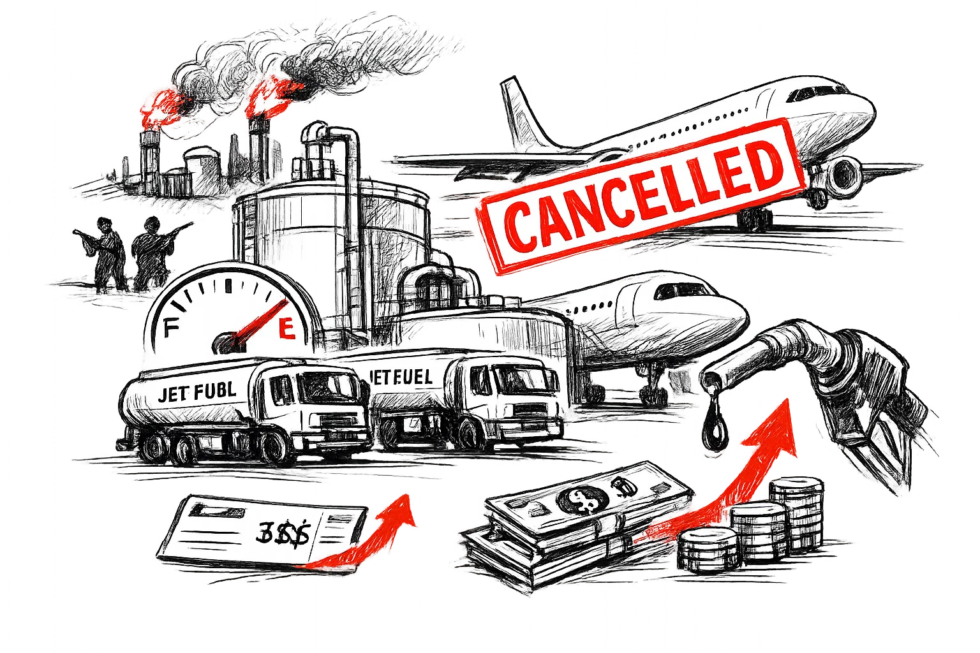
Jet fuel shortages are triggering a global aviation disruption as oil prices surge to $150–$200 per barrel following the US–Israel conflict with Iran, forcing airlines across Europe, Asia and North America to cancel flights, cut capacity and introduce widespread surcharges while warning of deeper instability if supply routes remain blocked. Europe alone may have as little as six weeks of jet fuel reserves, with industry leaders cautioning that closures of key transit corridors such as the Strait of Hormuz could rapidly escalate cancellations and push ticket prices sharply higher into the summer season, reported The WP Times via independent.
Fuel now accounts for up to a quarter of airline operating costs, and with supply constraints intensifying rather than easing, carriers are restructuring schedules, grounding aircraft and shifting financial pressure directly onto passengers through higher fares and ancillary charges.
What governments and energy agencies say about jet fuel shortages
The scale of the jet fuel shortages crisis is being confirmed by official institutions, with the International Energy Agency warning that Europe could face physical shortages within weeks if disrupted Middle East supplies are not restored. According to its April market assessments, Europe has been able to replace only around half of lost jet fuel imports from the Gulf, leaving the region structurally exposed ahead of the peak summer season.
The agency’s executive director, Fatih Birol, stated that Europe has “maybe six weeks” of jet fuel remaining under current conditions, and warned that flight cancellations could begin soon if the Strait of Hormuz remains constrained.
At the infrastructure level, official aviation bodies including Airports Council International Europe have also flagged imminent risk, indicating that some airports could begin experiencing shortages within three weeks if tanker flows are not restored. The disruption is directly linked to reduced throughput via the Strait of Hormuz, a critical chokepoint through which roughly 20% of global oil supply normally passes, with shipments dropping dramatically since the escalation of the Iran conflict.
Meanwhile, the European Commission has taken a more cautious position, stating that there is no immediate shortage inside the EU, but acknowledging that risks remain high and the situation is being monitored as a priority due to potential supply shocks.
Across the Atlantic, US officials have also confirmed that the crisis is global in nature: former energy adviser Amos Hochstein warned that some countries have already run out of jet fuel, with shortages beginning to affect flight operations in parts of Asia and potentially spreading further.
Taken together, official data shows that jet fuel shortages are not speculative but emerging as a near-term supply crisis, driven by constrained logistics, heavy European dependence on Middle Eastern fuel (around 75% of imports), and limited short-term alternatives in refining and transport capacity.
Greece — Aegean Airlines
Aegean Airlines is facing direct exposure to jet fuel shortages due to its geographic proximity to disrupted Middle Eastern routes and reliance on regional connectivity. The airline has already signalled that suspended routes to the Middle East and rising fuel costs will materially affect its first-quarter financial results.
The carrier is not yet implementing large-scale cancellations but is preparing for capacity adjustments if supply tightens further.
Operationally, the airline is prioritising profitable routes while monitoring fuel availability and pricing volatility. The company’s forward guidance indicates that even without full cancellations, margins are being eroded significantly. This reflects a broader trend among Southern European carriers heavily dependent on short-haul traffic.
Key measures:
- Monitoring Middle East route suspensions
- Financial impact flagged in Q1 results
- Potential capacity adjustments pending fuel availability
Malaysia — AirAsia X
AirAsia X has implemented one of the most aggressive responses to jet fuel shortages, cutting 10% of its total flights across the group. The airline has also introduced a fuel surcharge of approximately 20%, directly passing cost increases to passengers.
This dual strategy reflects the airline’s low-cost model, where margins are particularly sensitive to fuel price volatility. Executives have confirmed that further adjustments may follow if oil prices remain elevated. The airline is also reassessing route profitability, particularly long-haul operations.
Key measures:
- 10% reduction in flight capacity
- ~20% fuel surcharge added
- Ongoing network optimisation
France / Netherlands — Air France-KLM
Air France-KLM is combining fare increases with targeted cancellations to manage jet fuel shortages. The group has confirmed that long-haul ticket prices will rise by €50 per round trip.
Its Dutch subsidiary KLM is cancelling 160 European flights, citing unsustainable fuel costs. These cancellations represent a shift toward eliminating marginal routes rather than maintaining network breadth at a loss. The group is also adjusting capacity planning across hubs.
Key measures:
- €50 increase on long-haul fares
- 160 European flights cancelled (KLM)
- Network restructuring to protect margins
India — Air India, IndiGo, Akasa Air
Indian carriers are rapidly expanding fuel surcharge mechanisms as jet fuel shortages intensify.
Air India is transitioning to a distance-based surcharge model, replacing flat pricing to better reflect cost exposure. IndiGo has introduced charges ranging from ₹900 (Middle East routes) to ₹2,300 (Europe), while Akasa Air is applying surcharges between ₹199 and ₹1,300.
These changes reflect both rising fuel costs and structural tax pressures in India’s aviation market.
Key measures:
- Distance-based surcharge model (Air India)
- ₹900–₹2,300 surcharge (IndiGo)
- ₹199–₹1,300 surcharge (Akasa Air)
Nigeria — Airline Operators crisis
Nigeria represents one of the most acute cases of jet fuel shortages, where airlines nearly suspended all operations nationwide. The Airline Operators of Nigeria announced a planned shutdown from April 20, citing unsustainable fuel prices.
Government intervention temporarily halted the shutdown, but the situation remains unresolved pending negotiations. Airlines argue that upfront payment requirements and pricing structures are exacerbating the crisis.
Key measures:
- Planned nationwide shutdown (paused)
- Government mediation underway
- Industry warning of unsustainable operations
New Zealand — Air New Zealand
Air New Zealand has cut flights through May and June and increased ticket prices, becoming one of the first airlines to react structurally to the crisis. The airline has also suspended its full-year earnings forecast due to fuel market volatility.
This reflects both immediate cost pressures and uncertainty about future supply. The airline is prioritising financial stability over expansion.
Key measures:
- Flight reductions (May–June)
- Fare increases across network
- Earnings forecast suspended
United States — Major carriers
US airlines are focusing heavily on ancillary revenue and selective capacity cuts rather than broad cancellations.
American Airlines expects a $400m increase in fuel costs and has raised baggage fees significantly. Delta Air Lines is cutting planned capacity growth by 3.5% and increasing fees, while United Airlines is removing unprofitable routes and preparing for prolonged high oil prices.
These carriers are leveraging strong demand to maintain revenue while adjusting cost structures.
Key measures:
- Baggage fee increases across major airlines
- Capacity reductions (Delta, United)
- $400m cost increase (American Airlines)
Germany — Lufthansa Group
Lufthansa is implementing structural fleet reductions in response to jet fuel shortages. The airline is grounding 27 aircraft in its CityLine subsidiary and accelerating the retirement of older Airbus A340-600 planes.
The group is also reducing short- and medium-haul capacity for upcoming seasons, signalling a longer-term adjustment rather than a temporary response.
Key measures:
- 27 aircraft grounded
- Early retirement of long-haul jets
- Capacity cuts for winter 2026/27
Scandinavia — SAS
SAS has announced one of the largest cancellation programmes in Europe, cutting 1,000 flights in April alone after earlier reductions.
The airline has already increased ticket prices but acknowledged that absorbing fuel costs is no longer viable. The scale of cancellations reflects both cost pressure and limited fuel availability in the region.
Key measures:
- 1,000 flights cancelled in April
- Prior price increases already implemented
- Continued exposure to fuel volatility
Hong Kong / Asia — Cathay Pacific, HK Express
Cathay Pacific is reducing passenger flights by 2% and cutting 6% of operations at its low-cost subsidiary HK Express. The airline has also increased fuel surcharges by 34%, with regular reviews every two weeks.
This reflects a flexible pricing strategy tied directly to fuel market movements.
Key measures:
- 2% reduction in mainline flights
- 6% reduction in budget subsidiary
- 34% surcharge increase
China — China Eastern Airlines, Spring Airlines
Chinese carriers are implementing structured surcharge systems rather than large-scale cancellations.
China Eastern Airlines has introduced surcharges of ¥60 for flights under 800km and ¥120 for longer routes. Spring Airlines is also raising surcharges across domestic routes.
Key measures:
- ¥60–¥120 surcharge (China Eastern)
- Nationwide surcharge adjustments (Spring Airlines)
Canada — WestJet
WestJet is adding a C$60 fuel surcharge on selected bookings while combining flights to optimise load factors.
This approach allows the airline to maintain network coverage while reducing fuel consumption per passenger.
Key measures:
- C$60 surcharge introduced
- Flight consolidation strategy
Australia — Qantas, Virgin Australia
Australian airlines are facing significant cost escalation due to reliance on imported fuel.
Qantas has increased its projected fuel bill to A$3.1–3.3bn and delayed a planned A$150m share buyback. Virgin Australia expects an additional A$30–40m in fuel costs and is reducing capacity.
Key measures:
- Qantas fuel bill sharply revised
- Share buyback delayed
- Capacity reduction (Virgin Australia)
Southeast Asia — Vietjet, Vietnam Airlines
Vietnamese carriers are cutting capacity due to both cost pressures and supply concerns.
Vietnam Airlines plans to cancel 23 domestic flights weekly, while Vietjet is adjusting flight frequencies across selected routes.
Key measures:
- 23 weekly cancellations (Vietnam Airlines)
- Frequency adjustments (Vietjet)
United Kingdom — EasyJet, British Airways
EasyJet is forecasting a £540m–£560m half-year loss, including £25m in additional fuel costs. The airline warns that ticket prices will rise further as fuel hedging expires.
British Airways (IAG) has so far avoided immediate price increases due to hedging but is expected to face similar pressures if the crisis persists.
Key measures:
- £540m–£560m projected loss (EasyJet)
- Future fare increases expected
- Hedging delaying impact (British Airways)
Jet fuel shortages are no longer a projected risk but an active global disruption, with airlines across every major market implementing cancellations, capacity cuts and price increases simultaneously. The crisis is structurally driven by supply constraints linked to geopolitical conflict, and unless key routes such as the Strait of Hormuz reopen fully, further escalation—including widespread summer travel disruption—remains highly likely.
Read about the life of Westminster and Pimlico district, London and the world. 24/7 news with fresh and useful updates on culture, business, technology and city life: London Southend Airport EasyJet plane too heavy for take-off: why passengers left Málaga flight