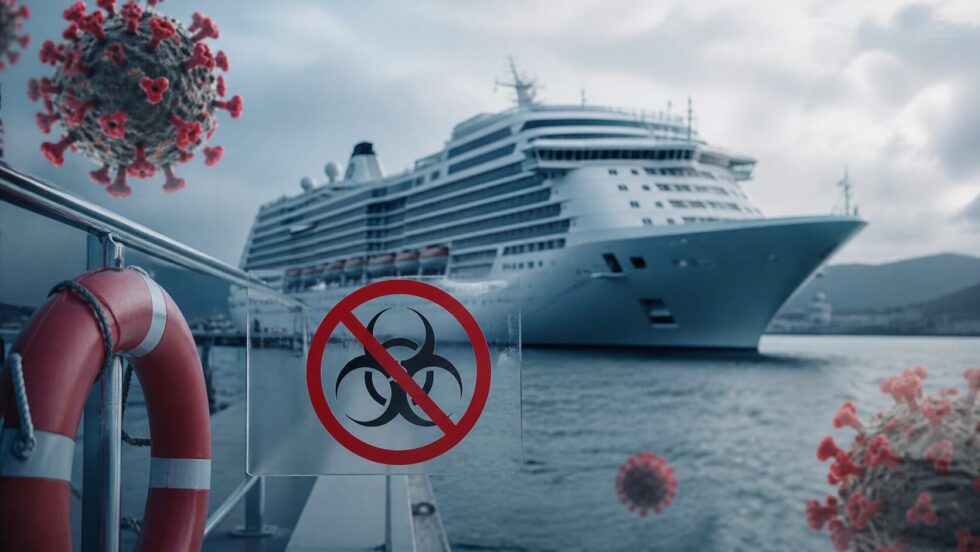
Three people have died and several others have fallen ill after a suspected hantavirus outbreak aboard the expedition cruise ship MV Hondius during a remote Atlantic voyage from Argentina towards Cape Verde. A 69-year-old British tourist is being treated in intensive care in Johannesburg after testing positive for the rare rodent-borne infection, as health authorities in South Africa, Cape Verde, the Netherlands and the World Health Organization investigate how passengers and crew may have been exposed, The WP Times reports.
The vessel, operated by Dutch expedition company Oceanwide Expeditions, was carrying around 150 passengers and about 70 crew members when the medical emergency escalated during the final stages of a long-distance polar-style itinerary. According to international reports, one hantavirus infection has been laboratory confirmed, while five further cases are being treated as suspected. Of the six people affected, three have died and one remains in intensive care in South Africa.
How the MV Hondius voyage became an international health emergency
The MV Hondius departed Ushuaia, Argentina, on 20 March 2026, following an expedition route through remote southern waters before heading across the Atlantic. Reports say the itinerary included Antarctica, the Falkland Islands, South Georgia and St Helena before the ship continued towards Cape Verde. The first serious case involved a 70-year-old Dutch passenger who developed symptoms including fever, headache, abdominal pain and diarrhoea. He died after the vessel reached St Helena, a British overseas territory in the South Atlantic. His 69-year-old wife was later evacuated to South Africa, where she died in hospital. A third death was subsequently reported among those affected during the voyage.
The case of the British passenger has drawn particular attention because he tested positive for hantavirus and remains in intensive care in Johannesburg. South African health officials have been involved in contact tracing, while WHO has said further laboratory testing and epidemiological analysis are under way.
Why hantavirus on a cruise ship is unusual
Hantavirus is not the type of infection usually associated with cruise ships. Most cruise ship outbreaks involve viruses such as norovirus, which spread rapidly between people in enclosed spaces. Hantavirus is different: it is usually linked to environmental exposure, especially contact with urine, droppings or saliva from infected rodents.
That distinction matters. The investigation is not only looking at who became ill onboard, but also where exposure may have happened during the journey. Expedition cruises often involve remote landings, wildlife-rich environments, old storage areas, ports with limited infrastructure and ecological zones where rodent exposure can be harder to rule out. Health authorities have not publicly identified the exact source of exposure. WHO is supporting virus sequencing and epidemiological tracing, which should help determine whether infection occurred during a shore stop, through contaminated material brought onboard, or through another environmental route.
What is hantavirus
Hantavirus refers to a group of viruses carried by rodents. Humans usually become infected by breathing in particles contaminated with rodent urine, faeces or saliva. Infection can cause severe illness, including hantavirus pulmonary syndrome, which affects the lungs, or haemorrhagic fever with renal syndrome, which affects the kidneys. Early symptoms may resemble many other infections: fever, tiredness, muscle pain, headache, abdominal discomfort, nausea or diarrhoea. In severe cases, patients can deteriorate rapidly, developing breathing problems, shock or organ complications. There is no specific antiviral cure for hantavirus infection, so treatment is mainly supportive and depends on early recognition, intensive monitoring and hospital care.
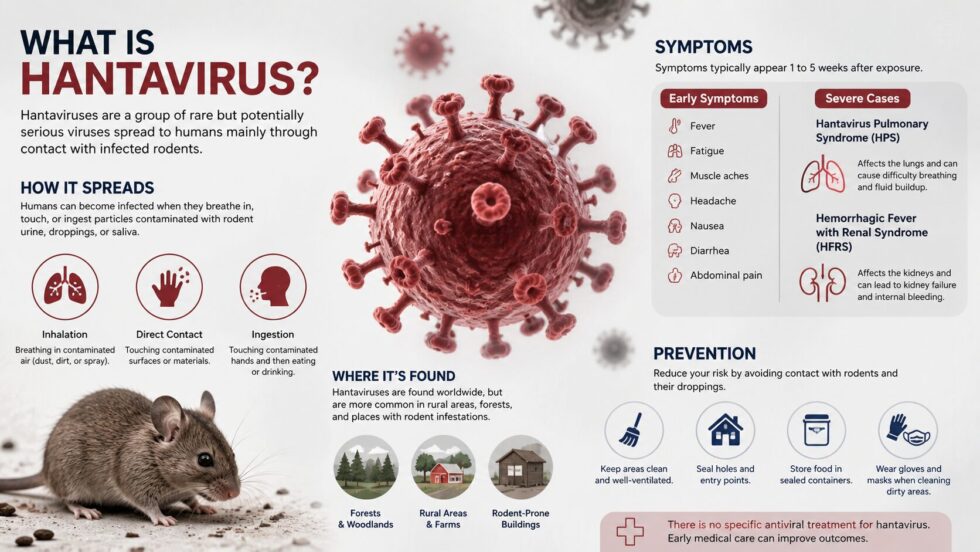
Human-to-human transmission is considered rare and has only been documented with some strains. That is why investigators are treating the MV Hondius incident primarily as an environmental exposure event rather than a conventional person-to-person cruise outbreak.
Timeline of the suspected outbreak
| Date / stage | What happened |
|---|---|
| 20 March 2026 | MV Hondius departed Ushuaia, Argentina |
| Expedition phase | Ship travelled through remote southern Atlantic and polar regions |
| During voyage | Several passengers or crew developed symptoms |
| St Helena | First Dutch passenger died after becoming acutely ill |
| South Africa | Second Dutch passenger died after evacuation; British patient admitted to ICU |
| Early May 2026 | Ship was near Cape Verde as authorities worked on medical evacuation and investigation |
Response from WHO, Oceanwide Expeditions and national authorities
The World Health Organization has confirmed that it is working with national authorities on the response. The priorities are medical evacuation, laboratory testing, tracing possible exposure and assessing whether anyone else onboard or on land may be at risk. Oceanwide Expeditions has said it is managing a serious medical situation and working with authorities. Reports indicate that two symptomatic crew members remained onboard and required urgent medical care, while disembarkation and evacuation depended on clearance from Cape Verdean authorities. The UK Foreign Office said it was monitoring reports and remained in contact with the cruise company and local authorities to support British nationals if required. Dutch authorities are also involved in repatriation and support for affected citizens.
Why this matters for expedition cruising
The MV Hondius case highlights a different kind of travel risk. Traditional cruise health protocols often focus on hygiene, food safety and respiratory infections in crowded indoor spaces. Expedition cruising adds another layer: passengers may visit remote islands, landing sites, wildlife areas and ports where environmental health risks are harder to predict. That does not mean expedition cruising is unsafe. Hantavirus infections remain rare, and most travellers will never encounter the virus. But the incident shows why remote itineraries require strong medical planning, rapid evacuation protocols and clear communication between ship operators and public health authorities.
For travellers, the practical lesson is not panic but awareness. Anyone returning from a remote expedition who develops fever, severe fatigue, abdominal symptoms or breathing difficulty should seek medical advice and mention recent travel history. That detail can be critical because early hantavirus symptoms can look similar to flu, food poisoning or other common infections.
Key questions travellers are asking
Can hantavirus spread between passengers on a cruise ship?
Usually, no. Hantavirus is mainly transmitted through exposure to infected rodents or contaminated environments. Person-to-person spread is rare and linked only to certain strains.
Is this like norovirus on cruise ships?
No. Norovirus spreads easily between people and through contaminated surfaces. Hantavirus is generally an environmental infection, which makes this outbreak medically unusual.
Should passengers cancel expedition cruises?
There is no general reason to cancel travel based on this single incident. However, passengers should follow operator guidance, check health advisories and take symptoms seriously after remote travel.
What symptoms matter most after travel?
Fever, strong fatigue, muscle pain, abdominal pain, diarrhoea and especially breathing difficulty should be assessed quickly, particularly after travel to remote or wildlife-rich locations.
What happens next?
Authorities will continue testing, sequencing and tracing possible exposure points. The findings may influence future safety procedures for expedition vessels operating in remote regions.
The central unanswered question is where exposure occurred. Investigators will need to assess the ship, shore excursions, storage areas, supplies, ports and environmental conditions along the route. Because hantavirus incubation can last several weeks, identifying the exact exposure point may be difficult. The investigation will also need to clarify whether all suspected cases are truly linked to hantavirus or whether some illnesses had another cause. At this stage, WHO has confirmed one laboratory case and five suspected cases, meaning the final classification could change as more test results become available. For now, the MV Hondius outbreak stands as a rare and serious maritime health incident: three deaths, one confirmed hantavirus infection, several suspected cases and an international response stretching across the Atlantic.
Read about the life of Westminster and Pimlico district, London and the world. 24/7 news with fresh and useful updates on culture, business, technology and city life: London Underground strike May 2026: what is happening, when and why
Sources used: Associated Press, The Independent, The Guardian, World Health Organization