
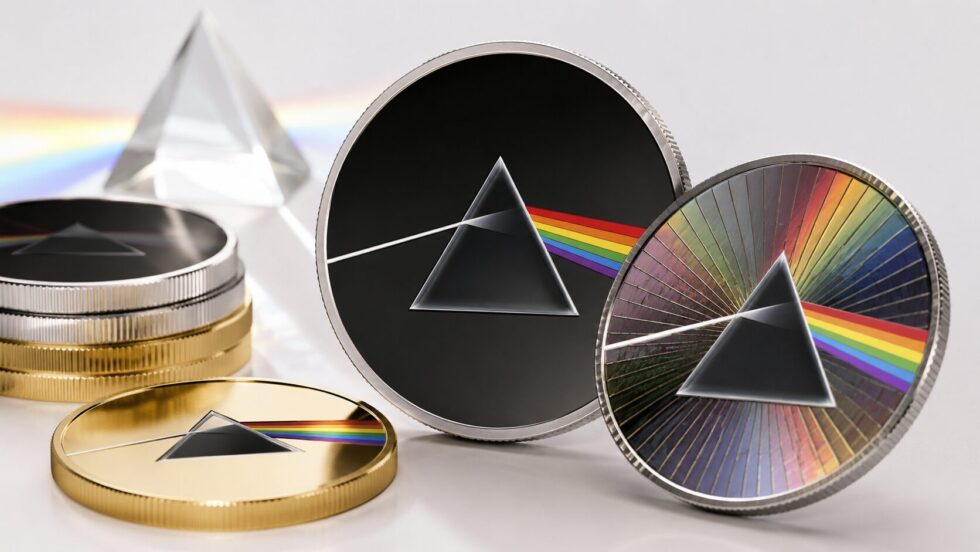
The Pink Floyd coin has officially entered the UK market as The Royal Mint today unveils an official UK commemorative coin celebrating the band's extraordinary and enduring legacy, with sales opening from 9am on Thursday May 14, with prices starting from £18.50 for a £5 denomination brilliant uncirculated coin. The release positions the launch as both a cultural milestone and a commercial strategy within the fast-growing collectibles sector. The coin centres on the instantly recognisable prism artwork from The Dark Side of the Moon and is expected to attract global demand from collectors, investors and music fans, with early signals pointing to strong international interest, The WP Times reports. The Royal MintRadionewshub
The coin's reverse design, created by Henry Gray, places the iconic prism from The Dark Side of the Moon at its heart, one of the most recognisable images in music history and a symbol of the band's visionary approach to art, sound and experimentation. The obverse carries the official portrait of His Majesty King Charles III, anchoring the issue within the current UK numismatic cycle.
The release places the Pink Floyd coin within the Royal Mint's Music Legends series, aligning the band with previously honoured British icons including David Bowie, Freddie Mercury, George Michael, Shirley Bassey and Sir Paul McCartney. The series has delivered nearly half a million coins to collectors and music fans in 108 countries around the world, underlining the scale and global reach of this initiative.
Design strategy: why the prism defines the entire release
The central design decision behind the Pink Floyd coin is the use of the prism motif, widely regarded as one of the most recognisable visual identities in modern music history. The iconic sleeve, which depicts a prism spectrum, was designed by Storm Thorgerson of Hipgnosis and drawn by George Hardie for the 1973 album, symbolising the transformation of light into a spectrum — a metaphor for experimentation, complexity and layered sound. From a journalistic and market standpoint, this is not a decorative choice but a strategic one. The design works across multiple levels:
- it ensures immediate recognition without requiring text
- it connects directly to one of the best-selling albums of all time — The Dark Side of the Moon has sold over 50 million copies worldwide The Royal Mint
- it bridges visual art and music, increasing cross-category appeal
- it strengthens resale narratives through symbolic storytelling
A selection of coins will also feature a rainbow prism effect, bringing the iconic design to life in full colour, which enhances the visual impact and aligns closely with collector demand for distinctive and premium finishes. These versions are already expected to outperform standard editions due to scarcity and visual differentiation.
Pricing and editions: full breakdown of what is on sale
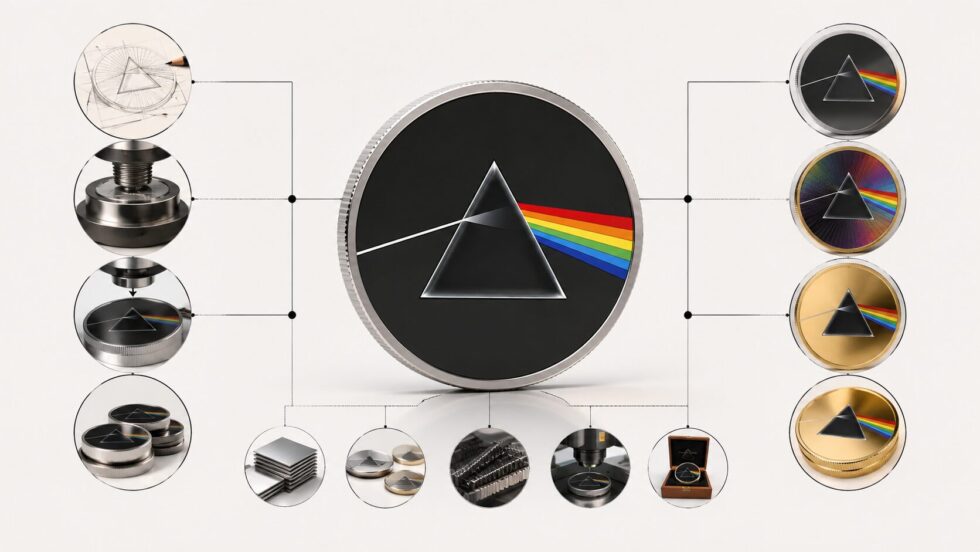
The Royal Mint has structured the release to cover multiple segments of the market, from entry-level collectors to high-value investors. This multi-tier pricing approach is consistent with previous successful launches in the Music Legends series. Main versions available:
- £5 brilliant uncirculated coin starting at £18.50
- Colour versions of the coin are available for £29.50 for a £5 denomination coin Radionewshub
- silver proof editions at mid-tier pricing depending on finish
- A £200 denomination gold coin is available for £10,535, with other versions in gold and silver also available Radionewshub
This tiered structure allows the Mint to capture different types of demand simultaneously. Lower-priced coins are designed for accessibility and volume sales, while gold editions function as prestige assets combining precious metal value with cultural branding.
Pink Floyd plectrum: the limited-edition companion piece
Beyond the coin itself, the Royal Mint has extended the release with a separate collector's object. Alongside the coin, The Royal Mint will also be offering Pink Floyd fans the chance to purchase an exclusive plectrum, available in limited numbers and crafted in gold, silver and dark chrome. Designed by Royal Mint designer Daniel Thorne, the piece is instantly recognisable as Pink Floyd through its striking connection to the iconic album The Dark Side of the Moon. The plectrum carries a deliberate narrative weight: the guitar pick holds a special place in the band's story, and nowhere is this better demonstrated than in David Gilmour's legendary solo on Time, one of the most celebrated moments on the album and among the most iconic in rock history. For collectors, this creates a two-object ecosystem — coin plus plectrum — that increases total spend per buyer and rewards completists.
Commercial logic: why the Royal Mint is focusing on music
The expansion into music-themed coinage reflects a broader shift within the Royal Mint. Traditionally associated with national symbols and royal figures, the institution has increasingly moved toward cultural subjects with global recognition.
Key drivers behind this shift:
- increasing demand for lifestyle collectibles
- competition with alternative investment assets
- globalisation of British cultural exports
- stronger engagement with younger demographics
Music legends provide a unique advantage because they combine emotional attachment with global brand recognition. In the case of Pink Floyd, this is amplified by decades of influence across music, film and visual culture.
Band legacy: why Pink Floyd remains a high-value brand
Pink Floyd's inclusion in the series is grounded in their enduring commercial and cultural impact. Formed in London in 1965 by Syd Barrett, Roger Waters, Nick Mason and Richard Wright with David Gilmour joining in 1968, Pink Floyd went on to define the progressive rock genre and produce some of the most celebrated albums ever recorded.
Their major catalogue continues to generate sales and streaming activity decades after release. The Dark Side of the Moon (1973), Wish You Were Here (1975), Animals (1977) and The Wall (1979) together cemented their place as one of the most innovative and influential bands of all time. This longevity translates directly into market value for commemorative products. Factors sustaining their relevance:
- consistent presence in global music charts and reissues
- iconic album artwork recognised across generations
- influence on contemporary artists and producers
- integration into film, advertising and digital media
These elements collectively support the long-term positioning of the Pink Floyd coin as both a collectible item and a cultural artefact.
Official positioning: what the Royal Mint is signalling
Rebecca Morgan, director of commemorative coin at The Royal Mint, said: "Pink Floyd are one of those truly rare bands whose music and imagery have transcended generations and the moment you see this coin, you know exactly who it celebrates." She also credited the designer directly, noting that Henry Gray has done a remarkable job of bringing it to life with the craft and detail this band deserves.
From an editorial perspective, this reflects a shift in messaging. The Mint is no longer simply producing currency-related items; it is curating cultural icons in physical form.
Global demand: early indicators and market behaviour
Initial reactions from collectors and industry observers suggest that demand for the Pink Floyd coin is likely to follow the trajectory of previous Music Legends releases, with strong early sales followed by active secondary market trading.
Geographic demand patterns:
- UK remains the core market
- US buyers dominate high-value purchases
- Asia shows increasing appetite for Western cultural assets
Key demand drivers:
- limited production runs
- emotional connection to the band
- crossover between music fandom and investment
- perceived long-term value
The international reach of the series — already spanning 108 countries — indicates that distribution infrastructure is well established.
Comparison with earlier releases in the series
The Music Legends series has already demonstrated its commercial viability through previous releases.
Comparative analysis:
- David Bowie coin leveraged narrative through a space launch event
- Freddie Mercury coin focused on performance imagery
- George Michael coin appealed to pop culture nostalgia
- Shirley Bassey and Paul McCartney coins broadened the demographic base
- Pink Floyd coin emphasises visual symbolism and artistic identity
Each release uses a different storytelling mechanism. In the case of the Pink Floyd coin, the prism functions as both a design element and a narrative anchor.
Collector strategy: how buyers are approaching the launch
For those entering the market, strategy is increasingly important. The range of editions creates both opportunities and risks.
Recommended approach:
- prioritise limited or colour editions for higher potential value
- monitor initial sales to gauge scarcity
- track resale platforms for early pricing signals
- consider long-term cultural relevance rather than short-term hype
Potential risks:
- oversupply in entry-level editions
- fluctuations in precious metal markets
- changing trends in collectibles
Despite these risks, the strength of the Pink Floyd brand significantly reduces uncertainty compared to lesser-known subjects.
Broader trend: culture as a financial asset
The launch of the Pink Floyd coin reflects a wider transformation in how cultural products are monetised. Music is increasingly treated as an asset class, extending beyond streaming and licensing into physical collectibles.
Emerging patterns:
- nostalgia-driven purchasing behaviour
- blending of emotional and financial value
- global fan communities acting as markets
- institutional involvement in cultural monetisation
The Royal Mint's role in this ecosystem is particularly notable, as it combines state-backed credibility with commercial innovation.
What happens next: projections for the market
Based on previous releases and current demand signals, several developments are likely:
- rapid sell-out of premium editions
- increased activity on secondary markets within weeks
- potential price appreciation for rare variants
- continued expansion of the Music Legends series
For the Pink Floyd coin specifically, the combination of strong design, global recognition and limited availability suggests sustained interest beyond the initial launch window.
FAQ: key questions buyers are asking
Is the Pink Floyd coin a good investment? It can retain or increase value, particularly limited colour and gold editions, but remains subject to market conditions and precious metal price movements.
Which version is most desirable? Gold and rainbow-prism colour editions are typically favoured due to scarcity and visual appeal. The £200 gold coin at £10,535 sits at the top of the range.
Where can the Pink Floyd coin be purchased? Officially through The Royal Mint at royalmint.com/pinkfloyd from 9am UK time on 14 May 2026, with resale markets emerging shortly after launch.
Who designed the Pink Floyd coin? The reverse was designed by Royal Mint artist Henry Gray. The accompanying limited-edition plectrum was designed by Royal Mint designer Daniel Thorne.
Why is the prism design central? It directly references The Dark Side of the Moon (1973), one of the most recognisable visual identities in music history, originally created by Storm Thorgerson of Hipgnosis with artwork by George Hardie.
How much did The Dark Side of the Moon sell? More than 50 million copies worldwide, making it one of the best-selling albums of all time.
The introduction of the Pink Floyd coin is not simply a commemorative gesture. It represents a calculated intersection of culture, commerce and collectability. By leveraging one of the most iconic images in music history — engineered by Henry Gray for the Royal Mint and rooted in Storm Thorgerson's original prism — the institution has created a product that operates simultaneously as a tribute, a collectible and a potential investment.
Read about the life of Westminster and Pimlico district, London and the world. 24/7 news with fresh and useful updates on culture, business, technology and city life: How did annabel yates lloyds cheque deposit row expose UK banking gaps for rural customers