
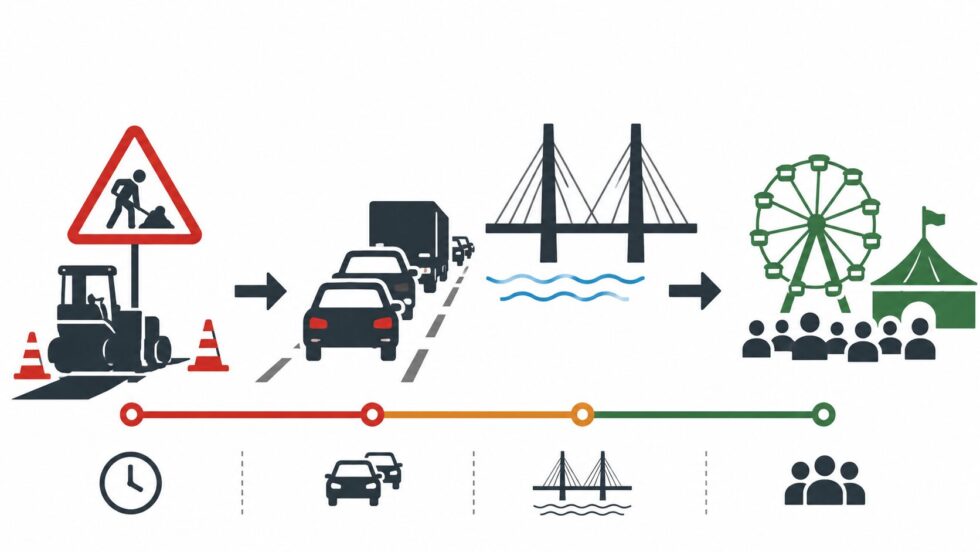
A14 traffic disruption around Ipswich and the Orwell Bridge became one of the dominant transport stories across eastern England on Thursday as tens of thousands travelled toward Suffolk Show 2026 at Trinity Park while emergency resurfacing work, lane restrictions and freight congestion combined to create severe delays across parts of Suffolk. Drivers heading toward the county showgrounds faced long queues near junctions linked to the Orwell Bridge corridor, while National Highways confirmed that overnight repair work connected to heat-damaged road surfacing forced traffic management measures into the morning peak period, The WP Times reports as Suffolk’s largest annual agricultural and public event returned under warm late-May conditions.
A14 traffic conditions improved gradually through Thursday afternoon after earlier warnings that the eastbound carriageway closure between junction 57 near Nacton and junction 58 at Seven Hills could continue beyond the morning rush hour. Authorities confirmed the resurfacing project had been affected by unusually warm temperatures overnight, preventing the newly repaired road surface from cooling fast enough for full reopening. The disruption coincided with the second and final major public day of Suffolk Show 2026, an event expected to attract approximately 45,000 visitors alongside continuous heavy container transport movements connected to the nearby Port of Felixstowe — Britain’s busiest container port corridor.
Why A14 traffic became a major Suffolk Show 2026 issue
Traffic pressure surrounding the Suffolk Show is not unusual, but the scale of disruption on the A14 this year reflected a combination of infrastructure pressure, weather-related road complications and unusually high simultaneous vehicle demand. The Orwell Bridge corridor already represents one of eastern England’s most sensitive freight bottlenecks because it links Felixstowe shipping traffic with regional commuter flows, tourism traffic and local Ipswich movement patterns. Once lane restrictions were introduced following overnight resurfacing work, congestion escalated rapidly.
National Highways confirmed that emergency road resurfacing became necessary after defects reportedly appeared in the carriageway during the period of elevated temperatures affecting parts of the UK earlier in the week. Contractors worked overnight in an attempt to complete repairs before the morning traffic surge linked to Suffolk Show visitors. However, engineers later stated that warm conditions slowed cooling on the newly resurfaced road, forcing a lane closure to remain active into the daytime period.
The timing proved particularly problematic because Suffolk Show visitor arrivals traditionally peak during the early morning and mid-morning hours. Trinity Park, located close to Felixstowe Road east of Ipswich, becomes heavily dependent on A14 access routes during major events. Simultaneously, freight traffic linked to Felixstowe continued operating normally, placing additional pressure on already restricted carriageways.
Transport authorities later stated that conditions gradually improved by lunchtime as reopening operations progressed. Nonetheless, delays continued across surrounding local roads for much of the morning period.
Key transport factors behind the disruption
| Factor | Impact on traffic |
|---|---|
| A14 resurfacing works | Reduced eastbound lane capacity |
| High temperatures | Delayed road cooling and reopening |
| Suffolk Show visitor traffic | Tens of thousands travelling simultaneously |
| Port of Felixstowe freight | Heavy HGV flow across Orwell Bridge |
| Ipswich local congestion | Secondary delays on feeder roads |
| Emergency incidents elsewhere | Additional strain on Suffolk network |
Suffolk Show 2026 draws major crowds despite delays
Despite the transport disruption, Suffolk Show 2026 continued attracting large crowds to Trinity Park as visitors arrived for agricultural demonstrations, food experiences, animal displays, entertainment and regional exhibitions. The event remains one of the most important annual county shows in eastern England and combines farming, regional business, local tourism and family entertainment into a large-scale two-day programme.
Reporter Fin Brown described the atmosphere as overwhelmingly positive despite difficult early travel conditions, highlighting the scale of the venue, the strong visitor turnout and the diversity of attractions available throughout the site. Organisers continued operating full programming across both public days while visitors navigated periodic traffic difficulties outside the grounds.
One of the most discussed attractions involved livestock and agricultural demonstrations, including a historic sheep shearing appearance by the first woman ever to shear at the Suffolk Show. Food and drink exhibitions also remained among the busiest sections of Trinity Park, particularly regional produce stands and the Adnams Food and Drink Experience.
Local vendors benefited from large visitor numbers throughout the event, with food sampling, regional product showcases and family-focused experiences attracting constant queues during the afternoon periods. Visitors also praised the balance between commercial attractions and educational rural activities.
The event additionally highlighted the importance of Suffolk’s agricultural economy and regional tourism sector at a time when county shows across Britain increasingly compete for attendance against rising travel costs and changing consumer entertainment habits.
Orwell Bridge pressure again raises long-term infrastructure concerns
The Orwell Bridge corridor once again became central to wider political and transport debates across Suffolk after the latest A14 disruption renewed scrutiny over regional infrastructure resilience. Traffic congestion linked to the bridge has remained a recurring issue for years because even relatively small incidents can trigger major delays across eastern England logistics networks.
The A14 functions not only as a regional commuter route but also as a nationally important freight artery linking Felixstowe with the Midlands and wider UK distribution systems. Because of that strategic importance, any disruption near Ipswich quickly affects both local drivers and commercial supply chains.
Questions surrounding Orwell Bridge resilience have intensified repeatedly during election campaigns, infrastructure reviews and freight discussions. Critics argue that current traffic capacity remains vulnerable during periods of roadworks, extreme weather, crashes or strong winds affecting bridge operations. Businesses connected to logistics and shipping have frequently called for further investment, improved contingency planning and additional transport solutions.
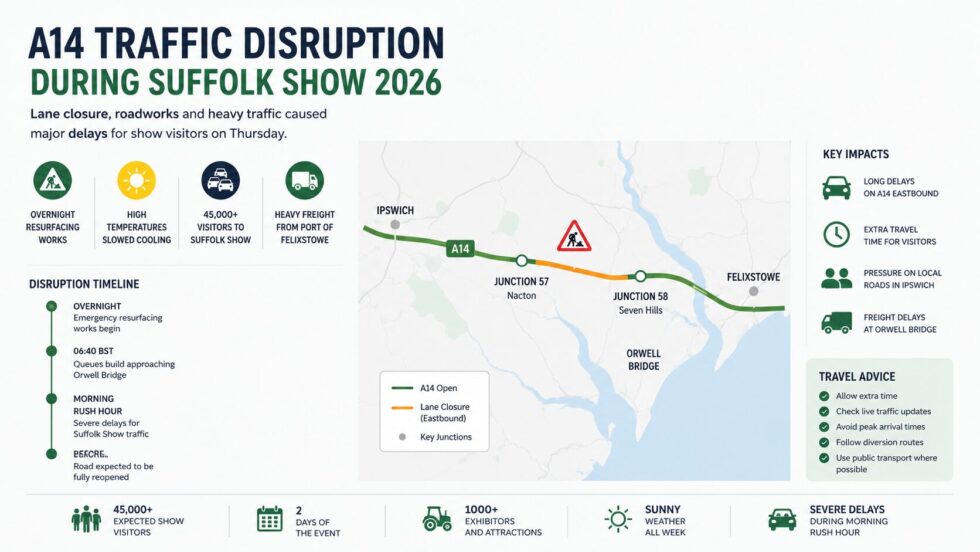
Thursday’s congestion therefore became more than a temporary inconvenience for visitors attending a county event. For many commuters and freight operators, it represented another example of how sensitive the regional transport system remains under pressure.
Main locations affected during the disruption
- Orwell Bridge eastbound carriageway
- Junction 57 near Nacton
- Junction 58 at Seven Hills
- Felixstowe Road approaching Trinity Park
- Ipswich urban feeder roads
- A12 northbound approaching Suffolk
- Foxhall Road diversion area
- Cambridge-Newmarket A14 section after lorry blaze
Suffolk Show visitors describe atmosphere despite travel disruption
Visitors arriving later in the day reported significantly improved conditions compared with the severe queues experienced during Wednesday morning’s peak disruption. Traffic cameras later showed clearer movement near the River Orwell while congestion reduced gradually approaching the afternoon period.
Many attendees nevertheless acknowledged the difficult journey conditions earlier in the morning, particularly for those travelling from Essex, Colchester and southern Suffolk. Some commuters reportedly spent close to two hours travelling routes that would normally take substantially less time under standard weekday conditions.
Inside Trinity Park, however, the atmosphere remained largely upbeat. Families, agricultural exhibitors and local businesses continued participating across the extensive event programme despite earlier access frustrations. Attractions ranged from livestock demonstrations and mascot races to craft exhibitions, educational activities and regional food stalls.
The scale of Suffolk Show 2026 also surprised some returning visitors who had not attended for several years. Expansions in exhibition zones, family activity areas and commercial displays reflected how county shows increasingly blend agriculture with tourism, retail and regional branding strategies.
Food remained one of the most heavily discussed elements of the event. Local produce stands, confectionery exhibitors and drink experiences drew sustained crowds throughout the day, while organisers also distributed maps and promotional materials to help visitors navigate the large venue more efficiently.
National Highways explains resurfacing delay
National Highways later confirmed that engineers worked overnight in an attempt to complete emergency resurfacing operations before morning traffic volumes increased. Officials explained that the issue originated after a defect appeared on the eastbound carriageway surface earlier in the week.
According to transport authorities, elevated road temperatures complicated repair operations because the resurfaced material required longer cooling periods before reopening safely to normal traffic speeds. The situation forced one lane to remain closed during the morning period even after overnight work had officially concluded.
A spokesperson stated that road crews remained “out in force” throughout the night while thanking motorists for patience during the disruption. The agency later confirmed expectations that the route would reopen fully before lunchtime as cooling conditions improved.
The incident also demonstrated how infrastructure maintenance challenges increasingly intersect with warmer weather conditions across Britain. Transport authorities in several regions have recently faced complications linked to high surface temperatures affecting roads, rail lines and construction materials during late spring and summer periods.
Timeline of the A14 disruption
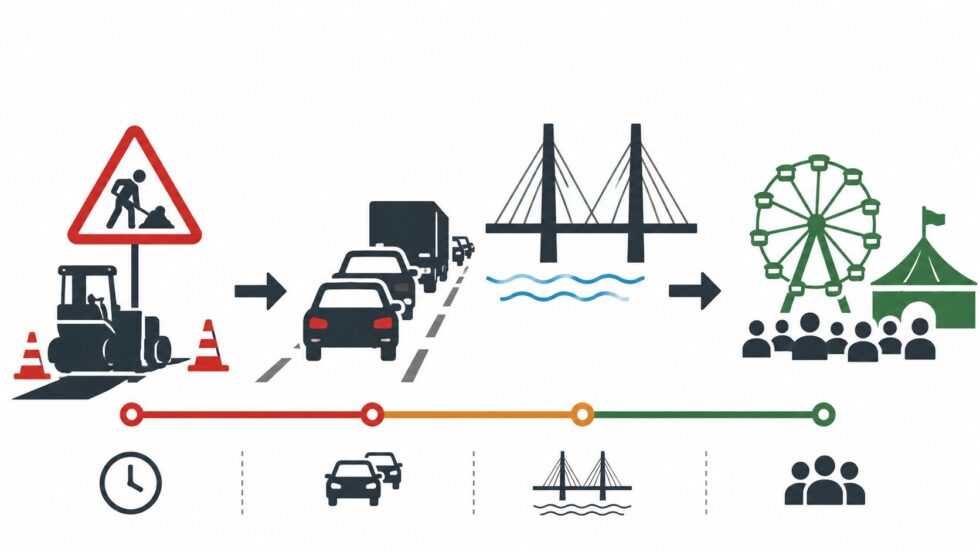
| Time | Development |
|---|---|
| Overnight Tuesday | Emergency resurfacing work begins |
| Early Wednesday | Lane closures continue after repairs |
| Around 06:40 BST | Queues rapidly build approaching Orwell Bridge |
| Morning rush hour | Severe delays affect Suffolk Show traffic |
| Mid-morning Thursday | Congestion gradually improves |
| Before lunchtime | Authorities expect full reopening |
Suffolk Show reflects wider importance of regional British events
Beyond the transport difficulties, Suffolk Show 2026 highlighted the continuing cultural and economic importance of county events across Britain. Agricultural shows remain deeply connected to regional identity, rural business networks and tourism activity, particularly across counties where farming continues playing a central economic role. Modern county shows increasingly operate as hybrid public festivals that combine agriculture, retail, education, entertainment and local economic promotion. Suffolk Show has grown into one of the largest examples in eastern England, attracting families, agricultural professionals, schools, food producers and tourism operators.
The strong attendance despite significant road disruption illustrated the resilience of public demand for major regional outdoor events during periods of favourable weather. Warm conditions and sunshine throughout much of the event also helped sustain visitor numbers after concerns earlier in the week regarding possible travel complications. For local businesses, exhibitors and producers, the event additionally provides a major annual commercial opportunity. Regional food companies, agricultural suppliers, craftspeople and tourism operators use the show to reach large public audiences over a concentrated period.Transport disruptions, however, once again demonstrated how dependent such events remain on efficient infrastructure planning and reliable regional mobility systems.
What drivers were told during Thursday traffic updates
Authorities and local live traffic services repeatedly advised motorists to allow extra travel time throughout Thursday morning. Traffic updates warned drivers heading toward Trinity Park that conditions remained unpredictable due to the combination of show traffic, freight movement and ongoing lane restrictions. Additional incidents elsewhere across Suffolk added further complications during the day. These included emergency gas works on Foxhall Road, delays linked to a separate lorry blaze near Newmarket and a crash involving a car and van on the A143 near Ixworth. Drivers approaching Suffolk from Essex also experienced congestion on the A12 northbound corridor near Stanway and Ipswich approaches. Traffic conditions eventually eased later in the afternoon after lane restrictions near the Orwell Bridge reduced and visitor arrival flows stabilised. For many local residents, however, the disruption again reinforced concerns surrounding how fragile major transport corridors remain during simultaneous infrastructure work and high public event attendance.
Most important advice issued to motorists
- Allow significantly longer travel times
- Use live traffic updates before departure
- Expect congestion near Trinity Park
- Avoid peak arrival periods where possible
- Monitor Orwell Bridge lane changes
- Prepare for diversions near Ipswich
- Anticipate freight-related slowdowns
- Check weather-related road alerts
The Suffolk Show ultimately continued successfully despite the traffic disruption, but the A14 delays once again exposed the continuing infrastructure pressures facing eastern England’s transport network as major public events, freight movement and seasonal travel converge around the Orwell Bridge corridor.
Read about the life of Westminster and Pimlico district, London and the world. 24/7 news with fresh and useful updates on culture, business, technology and city life: London festivals June 2026 — line-ups, dates and tickets for SXSW London, Lido and West End Live Festival season