House of the Dragon season 3 arrives on HBO on Sunday, 21 June 2026, at 9pm ET/PT, with an eight-episode run that will continue weekly until the finale on 9 August, and the central question is no longer whether Rhaenyra Targaryen wants the Iron Throne but whether the series can turn two seasons of court tension into a war story with real emotional weight. HBO confirms that the new season is based on George R.R. Martin’s Fire & Blood, is set 200 years before Game of Thrones, and brings back Emma D’Arcy, Matt Smith, Olivia Cooke, Steve Toussaint, Ewan Mitchell, Tom Glynn-Carney, Sonoya Mizuno, Phoebe Campbell and James Norton among a large ensemble, The WP Times reports.
The third season begins with unusually high pressure for HBO: season two ended with armies moving, dragons claimed, alliances broken and viewers waiting two years for the promised Dance of the Dragons to stop feeling like a threat and become the main event. Early critic material describes the new episodes as bigger, bloodier and more politically crowded, with the Battle of the Gullet positioned as a major opening spectacle and later episodes shifting toward a more intimate look at power, rule, money, fear and the ordinary people trapped beneath noble ambition.
House of the Dragon season 3 release date, cast and HBO schedule
House of the Dragon season 3 premieres on HBO and HBO Max on 21 June 2026, with eight episodes released weekly. The official HBO/WBD release lists the finale for 9 August, making this a compact summer run rather than a long prestige-season rollout. The cast list confirms the return of the central Blacks and Greens, including Emma D’Arcy as Rhaenyra, Matt Smith as Daemon, Olivia Cooke as Alicent, Ewan Mitchell as Aemond and Tom Glynn-Carney as Aegon. It also confirms James Norton among the new or expanded season-three names, a significant addition because Ormund Hightower pulls the Hightower political machine more visibly into the war.
For UK readers, the key point is that this is not being sold as a soft reset. It is the continuation of the civil war that season two arranged on the board: Rhaenyra holds dragon power, naval support and new riders, while the Greens remain dangerous because Aemond is unstable, Aegon is wounded but ambitious, and the Hightower-Lannister side still has institutional force. The result is a season built around military escalation, but also around the cost of making a realm live under permanent dynastic crisis.
Useful facts for readers:
| Detail | What is confirmed |
|---|---|
| Premiere | 21 June 2026 |
| HBO time | 9pm ET/PT |
| Episodes | Eight |
| Finale | 9 August 2026 |
| Source material | George R.R. Martin’s Fire & Blood |
| Timeline | Around 200 years before Game of Thrones |
| Main conflict | Targaryen civil war for the Iron Throne |
House of the Dragon season 3 review: spectacle is back, but the real test is focus
House of the Dragon has always had the ingredients of a major HBO drama: dynastic collapse, family betrayal, religious pressure, bloodline politics, succession law, public fear and dragons as both weapons and symbols. The problem has been rhythm. Season one moved across time quickly, season two spent much of its run preparing the war, and the long gaps between seasons weakened the momentum that a story this dense badly needs. Early reviews suggest season three tries to correct that by opening with scale, blood and direct conflict, but the same danger remains: too many characters, too many dragons and too little space for consequences to breathe.
That is why the third and fourth episodes matter in the first critical response. The review material provided to critics argues that those episodes work better because they become smaller, sharper and more interested in institutions than spectacle. Instead of treating Westeros only as a fantasy battlefield, they ask what happens when rulers finally get close to power and discover that ruling is not the same as claiming. That is a more mature question for the series, because Rhaenyra’s claim has always been emotionally clear, but her governing agenda has been much less clear.
The strongest dramatic line is this: House of the Dragon season 3 appears to understand that dragons alone cannot carry the show. The audience can admire dragon fire once, twice, even ten times, but a battle only matters when the viewer understands who is losing more than a fleet or a castle. The better parts of the season, according to early reviews, are not only about who wins the next clash but about who pays for the aristocratic game when the ruling class calls disaster strategy.
Why Rhaenyra, Alicent, Daemon and Aemond define season 3
Rhaenyra enters season three with the strongest claim, the clearest grievance and the most complicated moral position. She is not merely a wronged heir now; she is a would-be ruler surrounded by military advisers, dragons, vengeance and the expectations of followers who want a clean victory. Emma D’Arcy’s performance is central because the character must move from wounded legitimacy into the colder space of leadership. Early critical reaction points to D’Arcy as one of the season’s most important strengths, especially when the writing allows Rhaenyra to become less mythic and more unpredictable.
Alicent remains just as important, but in a different way. She is no longer only the political mother defending her children inside the Red Keep. She is also a figure whose past choices have helped build a system she can no longer fully control. Aegon’s injuries and ambition, Aemond’s violence and Daemon’s appetite for power create a world where private family decisions become public catastrophe. That is the real subject of House of the Dragon: not simply dragons, but the moment a ruling family’s private dysfunction becomes national policy.
Key character stakes:
- Rhaenyra must prove whether she can rule, not only claim.
- Alicent must face the consequences of a faction she helped legitimise.
- Daemon must decide whether loyalty is stronger than ambition.
- Aemond remains the most dangerous military actor because he has power without restraint.
- Aegon is physically damaged but politically unfinished.
- The smallfolk become more important because war turns elite conflict into public suffering.
House of the Dragon season 3 and the Battle of the Gullet
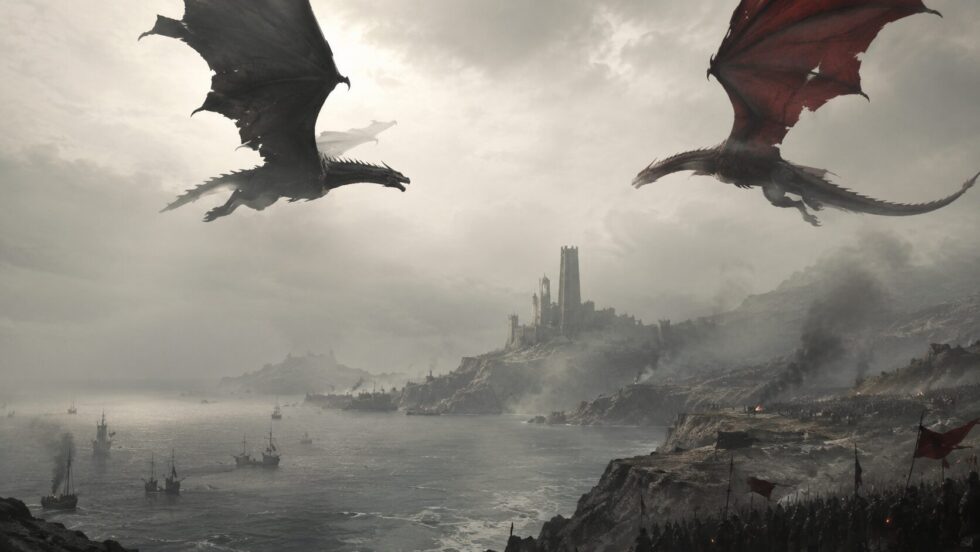
The Battle of the Gullet is expected to be one of the season’s defining early events, and early reviews describe the opening as a huge naval-and-dragon set piece. That matters because fans have waited since the end of season two for the Dance of the Dragons to become visible rather than theoretical. The risk is that spectacle becomes weightless if it feels too digital, too fast or too disconnected from character. One critical reading of the first episodes says the battle is huge and bloody, but not always emotionally convincing; another finds the season’s action a major improvement after the slower second season.
For HBO, the Battle of the Gullet is not just a plot point. It is a statement of budget, ambition and brand identity. House of the Dragon is now the flagship Game of Thrones prequel, and it has to show why the Targaryen civil war matters beyond family trees and dragon names. If the battle works, it can give the season the momentum that earlier runs sometimes lost. If it feels like expensive noise, the show risks repeating its most familiar problem: impressive scale without enough narrative intimacy.
What viewers should watch for:
| Story element | Why it matters |
|---|---|
| Naval warfare | Expands the war beyond castles and councils |
| Dragon combat | Shows the military cost of Targaryen power |
| Rhaenyra’s decisions | Tests whether she is ready to govern |
| Aemond’s role | Keeps the Greens unpredictable |
| Civilian impact | Gives the war moral weight |
| Political aftermath | Determines whether spectacle changes the story |
House of the Dragon season 3 is also about power, money and broken institutions
The most interesting reading of House of the Dragon season 3 is not that it becomes bigger, but that it may become more political. Early review material notes that the third and fourth episodes move into questions of budget, bureaucracy, speech, public order and the weakness of institutions under oligarchic rule. That is exactly where the series can separate itself from ordinary fantasy. Westeros is not only a place of swords and dragons; it is a state with food problems, money problems, military pressure, religious influence and rulers who treat the population as collateral damage.
This is where the show can become more relevant for a British audience. The central conflict is medieval fantasy, but the mechanisms are recognisable: elites argue over legitimacy, institutions bend to factional power, public services collapse under political ambition, and ordinary people become statistics in a conflict they did not choose. The Targaryen war is not simply glamorous family tragedy. It is a study of how states fail when power is inherited, personalised and defended by violence.
That political layer is also useful for viewers who felt season two spent too long waiting for war. If season three connects every dragon attack to shortages, fear, public anger and institutional decay, then the show becomes more than a battle calendar. It becomes a story about government under crisis. That is where Rhaenyra’s arc can become most compelling: she may be the rightful claimant, but rightful claim does not automatically create good rule.
House of the Dragon season 3 early reviews: divided, but more alive
The early critical picture is not uniform. Some reviews describe season three as faster, more violent and more satisfying than season two, with major action and improved energy. Others argue that the show remains overloaded, with too many names, too many moving pieces and a spectacle-first approach that can weaken emotional engagement. The Times review, for example, is notably harsher, calling the series increasingly stale and confusing, while other US reviews frame the new episodes as a stronger and more entertaining return.
That divide is important because it explains the real position of the show in 2026. House of the Dragon is not fighting for basic attention; it already has that. It is fighting for trust. Viewers want to know whether the long wait has produced a season that moves the story forward, pays off the civil-war promise and gives its characters sharper interior lives. The early answer appears mixed but more hopeful than before: season three may still be crowded, but it also seems more willing to be funny, intimate, brutal and politically specific when it steps away from pure dragon spectacle.
What House of the Dragon season 3 means for HBO
For HBO, House of the Dragon season 3 is bigger than one returning drama. It is part of the long-term survival of the Game of Thrones universe on television. The official release places Ryan Condal as co-creator, showrunner and executive producer, with George R.R. Martin also credited as co-creator and executive producer. That matters because HBO needs the prequel brand to feel stable, premium and narratively controlled after years of spin-off development, audience scepticism and comparison with the original series.
The challenge is clear. Game of Thrones became a global phenomenon because the politics felt personal and the deaths felt irreversible. House of the Dragon has inherited the world, the houses, the violence and the dragons, but it still has to earn the same emotional danger. Season three can do that only if the war changes people, not just maps. Rhaenyra cannot remain only a claimant, Alicent cannot remain only conflicted, Daemon cannot remain only charismatic, and Aemond cannot remain only terrifying. They all need to become consequences.
FAQ: House of the Dragon season 3
When does House of the Dragon season 3 premiere?
House of the Dragon season 3 premieres on HBO on Sunday, 21 June 2026, at 9pm ET/PT. HBO says the season has eight episodes and will run weekly until 9 August 2026.
How many episodes are in House of the Dragon season 3?
There are eight episodes in House of the Dragon season 3. This matches season two’s shorter format rather than the ten-episode structure of the first season.
Who is in the House of the Dragon season 3 cast?
The cast includes Emma D’Arcy, Matt Smith, Olivia Cooke, Steve Toussaint, Rhys Ifans, Fabien Frankel, Ewan Mitchell, Tom Glynn-Carney, Sonoya Mizuno, Harry Collett, Phoebe Campbell, James Norton, Tom Bennett, Kieran Bew, Clinton Liberty and others.
What is House of the Dragon season 3 about?
Season three continues the Targaryen civil war known as the Dance of the Dragons. Rhaenyra pushes her claim to the Iron Throne while the Greens remain fractured but dangerous, especially through Aemond, Aegon and their military alliances.
Is House of the Dragon season 3 getting good reviews?
Early reviews are mixed but energetic. Some critics say the season is more action-driven and entertaining than season two, while others argue that it remains overcrowded and sometimes emotionally thin. The clearest point of agreement is that season three is bigger, more violent and more directly focused on war.
Read about the life of Westminster and Pimlico district, London and the world. 24/7 news with fresh and useful updates on culture, business, technology and city life: What time is Eddie Hall vs Tommy Fury? UK ring walks, DAZN start time and full Manchester fight guide