
Ruthin School, one of Britain’s oldest independent schools, is to close at the end of the 2025/26 academic year, ending a teaching history in Denbighshire that dates back to 1284, reports The WP Times. Staff and pupils were told on Wednesday afternoon, 1 July 2026, that the North Wales day and boarding school was no longer financially sustainable and would shut at the end of term.
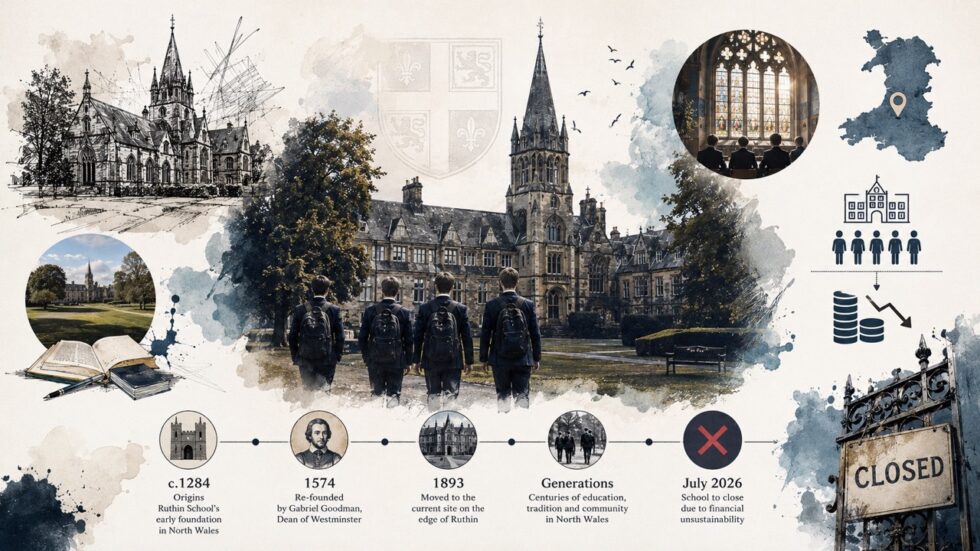
The closure brings to an end 742 years of education linked to the Ruthin site. The school was first founded in the medieval period and later re-founded in 1574 by Gabriel Goodman, Dean of Westminster. In 1893, it moved from its original position near St Peter’s Church to a new building on the edge of the town, designed by John Douglas. The decision comes as independent schools face higher costs from VAT on fees, increased employer National Insurance contributions, rising wage bills and the loss of business rates relief in Wales. Rydal Penrhos School said it was aware of the announced closure, adding: “Our thoughts and sympathies are with every family affected.”
Why is Ruthin School closing
Ruthin School has not yet issued a detailed public statement setting out the full reasons for the closure. However, the announcement comes amid wider financial pressure on independent schools in Wales and across the UK. Recent changes affecting the sector include VAT on private school fees, higher employer National Insurance contributions, rising wage costs and the removal of some business rates relief. Ruthin School itself said earlier this year that it was freezing fees for 2026/27 despite “considerable pressures”, including VAT on school fees, higher National Insurance costs and the removal of business rates relief.
The closure also follows the recent announcement that St Gerard’s School in Bangor would shut. Llandovery College, one of Wales’s best-known independent schools, has also warned of serious financial pressure and asked the UK Government for emergency support.
What happened on 1 July 2026
Staff and pupils at Ruthin School were told on Wednesday afternoon, 1 July 2026, that the Denbighshire independent school would close at the end of the current academic year. The decision leaves only a short period before the summer break for families to secure alternative places, with the pressure likely to be greatest for boarders, international pupils and students already on GCSE or A-level pathways. WalesOnline reported that it had tried to contact the school for comment, but the phone line was not connecting to the school office. Rydal Penrhos School responded to the announcement by saying: “We are aware of the announced closure of Ruthin School. Our thoughts and sympathies are with every family affected. Our priority is to support those affected by the news.”
Why does Ruthin School matter historically
Few British schools can trace their origins as far back as Ruthin School. Founded in 1284, it ranks among the oldest independent schools in the United Kingdom and has educated pupils through the reigns of Plantagenet, Tudor, Stuart, Georgian and modern British monarchs. After an early period of decline, the school was re-founded in 1574 by Gabriel Goodman, Dean of Westminster and a native of Ruthin, who secured its future through a new royal charter and financial endowment, establishing an institution that would become a permanent part of Welsh educational life.
For more than six centuries the school was closely linked with St Peter's Church in Ruthin before relocating in 1893 to a purpose-built campus on Mold Road, designed by renowned Victorian architect John Douglas. The move reflected the expansion of Victorian education and allowed the school to develop into a modern boarding institution while retaining its historic identity.
During the 20th and early 21st centuries, Ruthin School evolved from a traditional Welsh grammar school into an international independent day and boarding school. Pupils came not only from North Wales and across Britain but also from Europe, Asia and other overseas markets, with boarding becoming central to its educational model. The school built a reputation for small class sizes, university preparation, music, sport and international recruitment, making it one of the best-known independent schools in North Wales. Its closure therefore represents not simply the loss of another private school, but the end of a 742-year educational institution that has been part of the history of Ruthin since the medieval period.
What is the wider pressure on private schools
The closure comes during one of the most significant periods of financial change for Britain's independent school sector in decades. Since 1 January 2025, most private school fees have become subject to 20% VAT, increasing costs for many families. Schools have also faced higher employer National Insurance contributions from April 2025, rising National Living Wage costs and, in Wales, the removal of business rates relief previously available to charitable independent schools.
In a letter to families earlier this year, Ruthin School said it had attempted to absorb rising costs and even froze fees for the 2026/27 academic year, despite mounting financial pressures. However, governors ultimately concluded that the combined effect of government policy changes and increasing operating costs had made the school financially unsustainable.
The issue extends beyond a single institution. St Gerard's School in Bangor has also announced its closure, while Llandovery College, one of Wales' best-known independent schools, has warned that its financial future is under severe pressure and has sought emergency government support. Sector bodies say smaller regional boarding schools with historic estates face particularly high fixed costs, leaving them more vulnerable than larger institutions with greater financial reserves.
What happens next for pupils and staff
Attention is now turning to the practical consequences of the closure. Families must secure new school places before the start of the 2026/27 academic year, while pupils approaching GCSEs, A-levels and university applications will require continuity in teaching and examination arrangements. The situation is particularly complex for boarders and overseas students. Many will need alternative boarding accommodation, new guardianship arrangements and, where applicable, updated immigration or visa documentation linked to a different educational sponsor.
The closure also affects teachers and support staff across the school. Academic, pastoral, boarding, administrative, catering, estates and maintenance employees now face uncertainty over future employment after the end of the summer term, bringing to a close hundreds of years of continuous educational activity on the site.
Background: from medieval foundation to an international boarding school
The origins of Ruthin School date back to the years immediately following Edward I's conquest of Wales, when education became closely associated with the collegiate church established in the town. Although the institution changed over the centuries, its formal re-foundation in 1574 by Gabriel Goodman, Dean of Westminster, secured its long-term future and established the legal and financial basis on which the school continued to operate for generations.
The relocation to Mold Road in 1893, into buildings designed by John Douglas, marked the beginning of its modern era. Throughout the 20th century the school expanded its academic curriculum, boarding provision and extracurricular programmes while preserving its historic traditions. By the 21st century it had become a co-educational independent day and boarding school educating pupils from Wales, the wider UK and dozens of countries overseas, reflecting the increasingly international nature of British independent education. Its closure in July 2026 therefore marks more than the end of a single school year. It brings to a close 742 years of educational history connected with Ruthin and highlights the financial pressures confronting historic independent schools across Britain, particularly those operating outside the largest and wealthiest metropolitan markets.
Read about the life of Westminster and Pimlico district, London and the world. 24/7 news with fresh and useful updates on culture, business, technology and city life: What TfL lines are shut in London in July 2026