
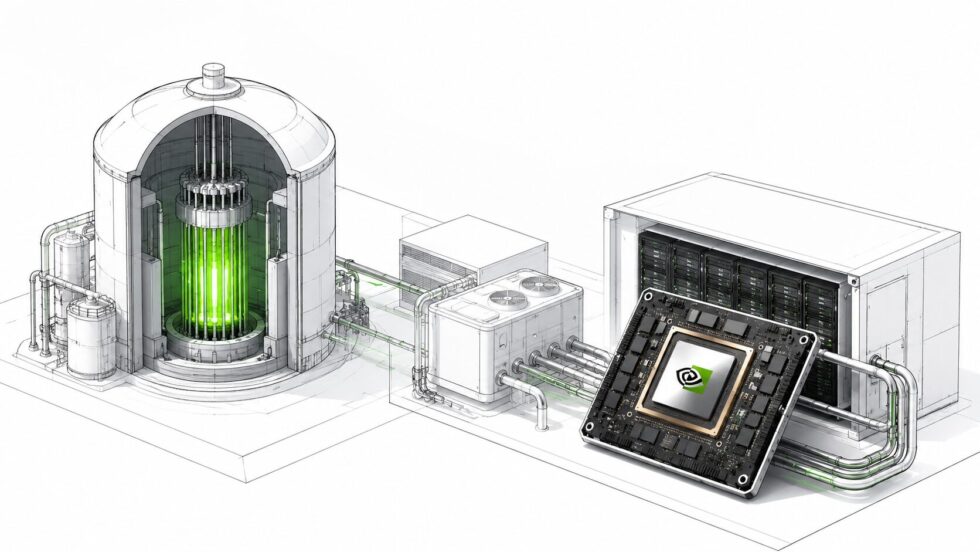
A California nuclear startup has done something no next-generation reactor firm in the United States had managed before,The WP Times reported: it generated electricity and used it to run an Nvidia artificial intelligence chip. Valar Atomics connected its Ward 250 test reactor to an Nvidia RTX Spark desktop machine — built on the chipmaker’s Blackwell architecture — during a live demonstration on Wednesday, 1 July 2026, at the San Rafael Energy Research Center in Emery County, Utah.
The output was modest: roughly 100 kilowatts of thermal energy converted through a thermoelectric generator. The electricity was used to host a website, nuclearwebsite.com, which stays online only while the reactor is running. Yet the symbolism was anything but modest. Alongside the demonstration, Valar and Nvidia announced a joint feasibility study for a 30-megawatt, entirely water-free AI computing facility — a signal that the world’s most valuable chipmaker is now looking beyond the public grid altogether.
For Britain, where roughly 50 gigawatts of data-centre demand is queuing for grid connections and Rolls-Royce is racing to build the country’s first small modular reactors, the Utah demonstration is less a curiosity than a preview.
What Exactly Did Valar Atomics Demonstrate in Utah
The set-piece was theatrical by nuclear industry standards. During a live event streamed in part on the company's LinkedIn page, a Valar team member plugged an Nvidia RTX Spark desktop unit — a compact PC running on Blackwell silicon — into a circuit fed by the Ward 250 reactor. Operators then ramped the reactor to 37 per cent of its full power, and the machine flickered into life on nuclear electricity.
Company founder and chief executive Isaiah Taylor walked the audience through the physics on stage, explaining that the chip was wired into a circuit running straight into the reactor hall, where he said quadrillions of uranium atoms were "fissioning every second, producing 100 kilowatts of thermal energy".
The proof-of-concept payload was deliberately cheeky: a temporary web server hosting nuclearwebsite.com, which the firm says anyone can visit for as long as the reactor is operating. In a media release, the company declared that "Valar Atomics became the first nuclear startup to make electricity".
Bloomberg, which reported the demonstration alongside Tom's Hardware and the American Nuclear Society, was careful to note the scale: only a trickle of electricity was actually produced. Nobody is powering a hyperscale campus off Ward 250 this year. But in an industry where progress is normally measured in decade-long licensing sagas, a startup taking a reactor from first criticality to usable electric output in a fortnight is genuinely rapid.
The Timeline: From Criticality to Current in 13 Days
The Ward 250 reached criticality — the point at which a nuclear chain reaction becomes self-sustaining — on 18 June 2026. Thirteen days later, it was pushing electrons through an AI chip. That pace owes a great deal to groundwork laid over the previous 18 months.
| Milestone | Date | Detail |
|---|---|---|
| Ward Zero validation | 2025 | Non-nuclear mock-up tested with silicon carbide heating elements to simulate peak core temperatures |
| Reactor construction | 2025–early 2026 | Built in California, then disassembled into eight modules |
| Transport to Utah | February 2026 | Airlifted by the US Air Force to the test site |
| First criticality | 18 June 2026 | Self-sustaining fission achieved at San Rafael Energy Research Center |
| Electricity demonstration | 1 July 2026 | ~100 kW thermal output; Nvidia Blackwell chip powered; nuclearwebsite.com hosted |
| Nvidia partnership announced | 1 July 2026 | Joint feasibility study for a 30 MW water-free AI computing facility |
The Ward Zero step is worth dwelling on. Before any nuclear fuel went near the primary unit, engineers built a full non-nuclear replica and installed silicon carbide heaters inside its core, cooking the structure to peak operating temperatures to verify every component could take the thermal punishment. It is the sort of de-risking discipline regulators like to see — and a hint that Valar is playing a longer game than the demo-day theatrics suggest.
Inside the Ward 250: How the Reactor Actually Works
The Ward 250 is a high-temperature gas-cooled reactor, or HTGR, a design lineage with decades of research pedigree but very few commercial deployments. Its headline specifications read like a checklist of what the advanced nuclear sector has been promising for years.
| Specification | Ward 250 |
|---|---|
| Reactor type | High-Temperature Gas-Cooled Reactor (HTGR) |
| Thermal capacity | 5 megawatts |
| Fuel | TRISO (Tristructural-Isotropic) particles |
| Uranium type | HALEU (High-Assay Low-Enriched Uranium) |
| Operating temperature | 750°C |
| Coolant | Helium gas |
| Water requirement | None |
| Form factor | Modular — shipped in eight sections |
TRISO Fuel: The "Meltdown-Proof" Pellets
TRISO fuel is the design's quiet star. Each particle is a poppy-seed-sized kernel of high-assay low-enriched uranium wrapped in successive layers of carbon and ceramic — in effect, every speck of fuel carries its own miniature containment vessel. The layers trap fission products even at temperatures well beyond normal operating conditions, which is why TRISO is frequently described in the industry as the most robust nuclear fuel ever engineered. HALEU, enriched to between 5 and 20 per cent, packs more energy into a smaller core than the fuel used in conventional power stations, making genuinely compact reactors feasible.
Why Helium and 750 Degrees Matter
Cooling with helium rather than water does two things. First, it removes the need for the vast water draw that defines conventional nuclear plants — and, crucially, conventional data centres. Second, running hot at 750°C makes the electricity conversion more efficient and opens the door to industrial heat applications, from hydrogen production to synthetic fuels, which is where Valar's longer-term ambitions reportedly lie.
That water-free characteristic is precisely what caught Nvidia's eye. As Valar put it, the pairing works because both halves of the system dispense with water entirely — nuclear generation on one side, chip cooling on the other.
The Nvidia Partnership: A 30 MW "AI Factory" Without a Drop of Water
The demonstration would have been a footnote without the deal announced alongside it. Valar Atomics and Nvidia unveiled a joint feasibility study to design a 30-megawatt computing facility powered by Valar reactors and cooled by a closed-loop system that draws nothing from municipal water supplies.
Nvidia's global vice president John Josephakis framed the ambition in a statement, saying the company is examining how "behind-the-meter, waterless advanced nuclear systems could support future AI factories". Two phrases in that sentence deserve unpacking for anyone watching Britain's own energy debate.
Behind the meter means generation that sits on-site and never touches the public grid. The world's dominant AI chipmaker is openly exploring a future in which its most demanding customers simply bypass utilities — no interconnection queue, no transmission constraints, no waiting for the grid operator.
Waterless addresses the second great complaint about data centres. Nvidia simultaneously announced its DSX data centre design, using closed-loop liquid cooling the company says can push facility water consumption towards zero. Pair that with a helium-cooled reactor and you have, at least on paper, a compute campus that needs neither a grid connection nor a river.
If the 30 MW project proceeds, industry observers note it could become the first commercial instance of advanced nuclear directly powering an AI data centre anywhere in the world.
Why This Matters: AI's Voracious Appetite for Power
The context is an arms race measured in gigawatts. Data centres already consume electricity on the scale of mid-sized nations, and the generative AI boom has turned the constraint on AI expansion from silicon supply into energy supply. As one analysis of the Utah demonstration put it bluntly, AI capital expenditure is no longer chip-constrained — it is energy-constrained.
That is why the tech giants have gone nuclear-shopping. Google has partnered with Kairos Power to bring a small modular reactor online by 2030. Microsoft has contracted to restart capacity at Three Mile Island. Meta and Amazon have signed their own nuclear arrangements. Valar Atomics is one of roughly a dozen American startups chasing the same prize: compact, factory-built reactors that can be dropped next to a data centre and switched on years faster than a conventional plant.
The regulatory road remains long. Commercial deployment in the United States requires licensing from the Nuclear Regulatory Commission, a process famous for its rigour and its timescales. Valar's Utah test unit operates under research arrangements; a fleet of commercial units serving AI campuses is a different regulatory beast entirely. Sceptics also point out that a 100-kilowatt trickle running a single desktop PC sits several orders of magnitude below the hundreds of megawatts a frontier AI training cluster devours.
Still, first is first. Every subsequent milestone — sustained grid-quality output, NRC licensing, a commercial power purchase agreement — now has a proof point behind it.
The British Angle: 50 GW Queuing for the Grid and a £2.5bn Bet on SMRs
Readers in Westminster might reasonably ask what a reactor in the Utah desert has to do with Britain. Rather a lot, as it happens — because the UK is wrestling with exactly the problem Valar and Nvidia claim to have cracked.
Around 50 gigawatts of data centre demand is currently queuing for access to the UK grid, according to reporting by The Register, at the very moment the Government wants mass adoption of electric vehicles and has designated AI infrastructure a national growth priority. Something has to give, and ministers have decided that something is nuclear.
Rolls-Royce and the Great British Energy Programme
The centrepiece is Rolls-Royce SMR, selected under the Great British Energy programme to build three small modular reactors, backed by £2.5 billion of public money. Each 470-megawatt unit — assembled from roughly 1,500 factory-built, transportable modules and occupying about three football pitches once installed — is designed to power around a million homes for at least 60 years. Wylfa on Anglesey has been confirmed as the site of the UK's first SMR, and in June 2026 Rolls-Royce SMR announced its Pioneer Works manufacturing development centre in Derby to de-risk fleet delivery across the UK, Czechia and Sweden.
Rolls-Royce chief executive Tufan Erginbilgic has been characteristically bullish about the company's position, telling the BBC: "There is no private company in the world with the nuclear capability we have." The firm has explicitly positioned itself to become the first UK company to power AI operations with nuclear energy — the same race Valar just took an early lead in across the Atlantic, albeit at wildly different scales.
The US–UK Nuclear Deals Already Signed
The transatlantic traffic runs both ways. A package of UK–US civil nuclear commitments announced by the Government includes several projects that rhyme almost exactly with the Utah demonstration:
| Project | Partners | Location | Scope |
|---|---|---|---|
| Hartlepool AMR fleet | X-Energy & Centrica | Hartlepool, then UK-wide | Up to 12 advanced modular reactors, targeting a 6 GW national fleet; up to 1.5 million homes powered and 2,500 jobs; estimated £40bn economic value, £12bn in the North East |
| Nuclear-powered data centres | Holtec, EDF & Tritax | Former Cottam coal station, Nottinghamshire | Advanced data centres powered directly by small modular reactors |
| SMR fleet delivery | Rolls-Royce SMR | Wylfa (first site); Derby manufacturing | Three 470 MW SMRs under Great British Energy, £2.5bn public backing |
Note the Cottam project in particular: SMR-powered data centres on the site of a retired coal station. It is, in outline, the same behind-the-meter logic Nvidia and Valar sketched out in Utah — decommissioned fossil infrastructure reborn as nuclear-fed compute. X-Energy, the American firm partnering with Centrica in Hartlepool, builds high-temperature gas-cooled reactors running on TRISO fuel: technologically a close cousin of the Ward 250, simply at commercial scale.
Britain's Office for Nuclear Regulation, alongside the NRC and Canada's CNSC, is among the handful of regulators globally now processing SMR licensing pathways in earnest, with deployment case studies running through 2035 across the UK, US, Canada, Poland and Romania. The Government is also funding research into advanced modular microreactors — precisely the Ward 250 class of machine — with feasibility demonstrations targeted for the early 2030s, aimed at off-grid sites such as mines and, tellingly, data centres.
The Sceptics' Corner: What the Demo Did Not Prove
Balanced reporting demands the cold water, even if the reactor doesn't need any. The Utah event proved that a small HTGR can reach criticality and convert heat to usable electricity. It did not prove commercial economics, licensing viability, or scale.
The numbers gap is stark. The demo produced roughly 100 kilowatts of thermal output, feeding a desktop PC via a thermo-electric generator. A single frontier AI training run consumes tens to hundreds of megawatts continuously. Bridging that gap requires fleets of reactors, sustained high-capacity operation, and turbine-grade power conversion rather than a thermo-electric proof of concept.
Cost is the second question mark. Analysis of the first wave of Western SMR projects has been described as cautionary, with levelised costs estimated between $60 and $120 per megawatt-hour and first-of-a-kind builds routinely blowing past vendor targets. Factory fabrication promises capital costs of $4,000–7,000 per kilowatt once designs mature, against $8,000–12,000 for recent large reactor builds — but those mature-fleet figures remain vendor aspirations, not audited reality.
And then there is licensing. The NRC's requirements for commercial deployment remain stringent, and no amount of LinkedIn showmanship shortens a safety case. Valar's achievement is real; the road from a 5 MW test article in the desert to certified commercial fleets is measured in years and regulatory reams. Nuclear power itself remains contested terrain, with long-standing debates over waste, cost overruns and proliferation running alongside its renaissance. What has changed is the demand side: AI has given the industry its most motivated — and deepest-pocketed — customer base in a generation. Three threads are worth watching through the remainder of 2026. First, the Valar–Nvidia feasibility study: if the 30 MW water-free facility moves from paper to planning, it becomes the template every hyperscaler will study. Second, US regulatory signals: any indication of an accelerated NRC pathway for microreactors would compress the entire sector's timelines. Third, the British response: with Wylfa confirmed, Derby's Pioneer Works announced, and the Cottam and Hartlepool projects in motion, the UK has assembled the pieces for its own nuclear-compute play — the question is whether it can bolt them together before the demand queue turns into an economic bottleneck.
A startup in the Utah desert ran a desktop computer off a reactor the size of a few shipping containers. On its own, a party trick. As a preview of how the next decade of energy and computing intertwine — from Emery County to Anglesey — it may prove rather more than that.
FAQ
What is Valar Atomics?
Valar Atomics is a California-based nuclear startup founded by Isaiah Taylor. On 1 July 2026 it became the first US nuclear startup to generate electricity from an advanced reactor, using its Ward 250 test unit in Emery County, Utah, to power an Nvidia Blackwell AI chip.
What is the Ward 250 reactor?
The Ward 250 is a 5-megawatt high-temperature gas-cooled reactor (HTGR). It runs on TRISO fuel containing high-assay low-enriched uranium (HALEU), operates at 750°C, is cooled by helium gas and requires no water. It was built in California, split into eight modules, and flown to Utah by the US Air Force in February 2026.
What did the demonstration actually power?
Roughly 100 kilowatts of thermal output, converted via a thermo-electric generator, ran an Nvidia RTX Spark desktop PC built on Blackwell architecture. The machine hosted a live website, nuclearwebsite.com, which remains online only while the reactor operates.
What is the Nvidia partnership about?
Valar Atomics and Nvidia announced a joint feasibility study for a 30-megawatt AI computing facility powered by nuclear reactors and cooled by a closed-loop, water-free system — potentially the first commercial advanced-nuclear-powered AI data centre in the world.
Why does this matter for the UK?
Around 50 GW of data centre demand is queuing for UK grid access. Rolls-Royce SMR is building Britain's first small modular reactors under a £2.5bn government programme, with Wylfa confirmed as the first site, while X-Energy/Centrica plan up to 12 advanced reactors in Hartlepool and Holtec/EDF/Tritax plan SMR-powered data centres at the former Cottam coal station in Nottinghamshire.
Is nuclear-powered AI commercially viable yet?
Not yet. The demonstration was a proof of concept, not commercial deployment. Licensing from regulators such as the US NRC and the UK's ONR, sustained high-capacity output and competitive costs (current SMR estimates run $60–120/MWh) all remain to be proven through the early 2030s.
Read about the life of Westminster and Pimlico district, London and the world. 24/7 news with fresh and useful updates on culture, business, technology and city life: Why could PlayStation 6 cost more in Britain as Sony rules out deep console losses