
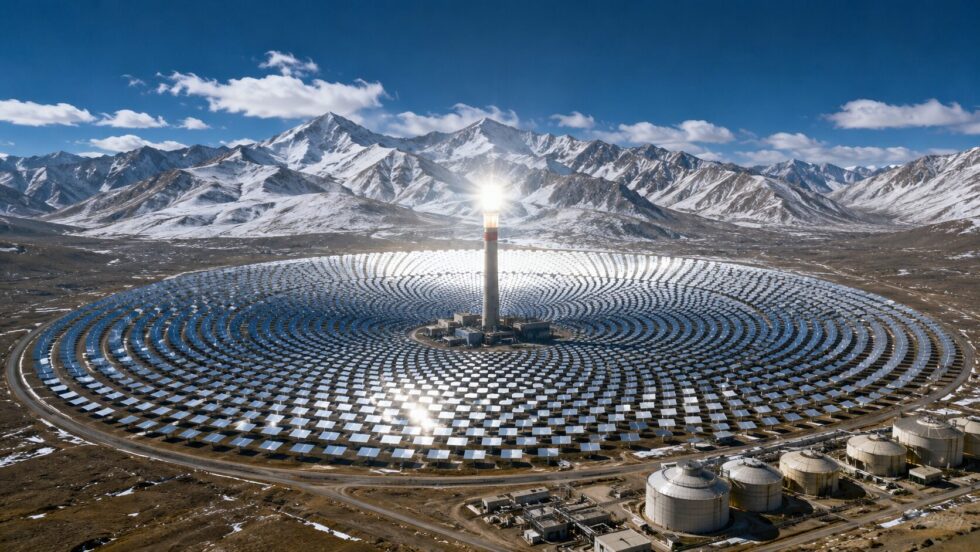
China has reached another milestone in its renewable energy expansion. In Amdo County in the Nagqu region, at 4,645 to 4,657 metres above sea level in the Tanggula mountain range of the Tibetan Plateau, installation work on the world's highest tower-type solar thermal power plant has been completed. All 15,927 heliostat mirrors of the Anduo Tushuo project are in place, the 185-metre receiver tower is finished, and the core equipment has been installed. The official commissioning of the 100-megawatt facility is scheduled for October. What makes it remarkable: thanks to a vast molten salt storage system, the plant can deliver electricity even after sunset — solving one of solar energy's greatest problems, The WP Times desk reports.
The project is far more than a technical showpiece. It is a test case for whether solar thermal power with heat storage can be operated economically under the harshest conditions on Earth — and a signal to the global energy industry that China is scaling concentrated solar power technology on an industrial level, while it has largely ground to a halt in Europe and the United States.
What Is Anduo Tushuo? The Project at a Glance
Anduo Tushuo — also rendered in Chinese sources as Amdo Tushuo or Tuosuo — lies in Amdo County of the prefecture-level city of Nagqu in northern Tibet. The area ranks among the most inhospitable inhabited places on the planet: thin air, extreme cold, powerful winds and some of the most intense solar radiation on Earth. It is precisely this combination that makes the site attractive for solar thermal power. The 100-megawatt solar thermal plant is the centrepiece of a much larger integrated complex: together with an 800-megawatt photovoltaic field, a combined project totalling 900 megawatts is being built here. The pairing is deliberate: the photovoltaic array delivers cheap electricity in bulk during the day, while the thermal plant with its heat storage smooths out the fluctuations and feeds the grid at night and under overcast skies.
The scheme also forms part of a regional programme under which Tibet intends to build 750 megawatts of solar thermal capacity in total. It is the region's first demonstration project for the technology — meant to prove such plants can run reliably on the "roof of the world".
The developer and owner is the state-run Xizang Development Investment Group, the investment vehicle of the autonomous region. General contracting lies with subsidiaries of the state-owned giant PowerChina: the Northwest Survey and Design Institute is responsible for planning and the EPC contract, while Shandong Electric Power Construction No. 1 Company (SEPCO1) is carrying out the construction work. The heat-collection technology — the crown jewel at the top of the tower — is supplied by boiler manufacturer Dongfang Boiler, with the control systems provided by automation specialist Nanjing SciYon.
How Does a Solar Thermal Plant With Salt Storage Work?
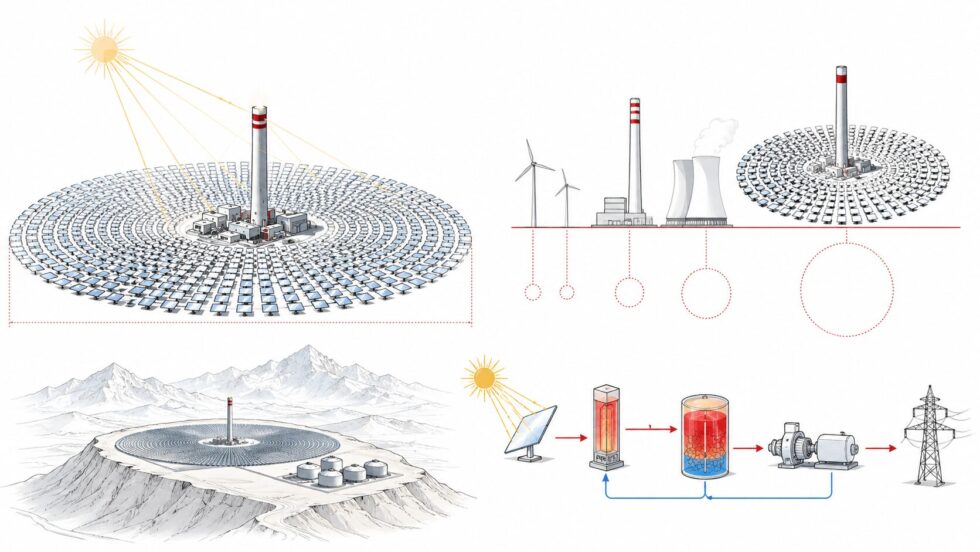
Unlike a conventional solar farm, Anduo Tushuo does not generate electricity directly through solar cells. The facility operates on the principle of concentrated solar power, known internationally as CSP. The process can be described in four steps.
First: thousands of movable mirrors, known as heliostats, precisely track the sun's path throughout the day, each positioned by motors to reflect sunlight onto exactly one point — the receiver at the top of the central tower. Viewed from the air, the field resembles a vast bed of sunflowers, all turning towards the same light.
Second: at the receiver atop the 185-metre tower, the energy of nearly 16,000 mirrors is concentrated, heating a special salt mixture flowing through it to 565 degrees Celsius. At these temperatures the salt is as fluid as water and can absorb enormous quantities of heat.
Third: the hot molten salt is pumped into well-insulated tanks at the base of the tower. This storage is the decisive difference from photovoltaics: the energy does not have to be consumed immediately but remains available as heat for hours — at Anduo Tushuo, for eight full-load hours. Fourth: when electricity is needed — in the evening, for instance — the hot salt transfers its heat to water via a heat exchanger. The resulting steam drives a conventional turbine and generator of the kind familiar from coal or nuclear stations. The cooled salt flows back into the cold tank, and the cycle begins anew. The result is a solar power plant that behaves like a dispatchable conventional station: it can adjust its output to demand, balance grid fluctuations and, according to those involved in the project, generate electricity continuously for 15 to 16 hours on good days — considerably longer than the sun is in the sky.
The Technology in Detail: Numbers That Impress
The dimensions are staggering. The mirror field comprises 15,927 heliostats with a total surface of around 800,000 square metres — roughly 112 football pitches, or 8.61 million square feet of reflective surface. The mirrors have a distinctive pentagonal shape developed specifically for this project and are arranged in circles around the central tower. The receiver tower rises 185 metres — taller than all but a handful of London's skyscrapers. The concrete work was an engineering feat in itself: in September last year, contractor SEPCO1 announced the structure had passed the 100-metre mark before the shell was completed in the following months and the high-efficiency heat receiver mounted at the top.
For the thermal store alone, 11,850 tonnes of sodium nitrate salt were procured — a major project in its own right, awarded through public tender. The mixture circulates between a cold tank and a hot tank, storing the energy of an entire day of sunshine.
The manufacturing of the mirrors is equally noteworthy. Because hauling delicate large-scale components thousands of kilometres up to the plateau would have been a logistical nightmare, the partners built the world's first fully automated heliostat production line at this altitude directly on site, turning out up to 6,000 square metres of mirror surface per day — enough to populate the entire field within the tight schedule.
| Feature | Detail |
|---|---|
| Location | Amdo County, Nagqu, Tibet Autonomous Region (China) |
| Altitude | 4,645 to 4,657 metres (world record for tower CSP) |
| Number of heliostat mirrors | 15,927 (pentagonal design) |
| Total mirror surface | around 800,000 square metres |
| Receiver tower height | 185 metres |
| Solar thermal capacity | 100 megawatts |
| Thermal storage | molten salt (11,850 t sodium nitrate), 565°C, 8 hours |
| Coupled photovoltaics | 800 megawatts |
| Overall project | 900-megawatt integrated complex |
| Expected annual output (CSP) | around 255 to 260 million kilowatt-hours |
| Households supplied | over 50,000 |
| Annual CO2 savings | 165,000 to 220,000 tonnes (depending on calculation basis) |
| Official launch | October 2026 |
Building at the Limit: Extreme Conditions at 4,650 Metres
Hardly any power plant in the world has been built under harsher conditions. The site sits higher than the summit of the Matterhorn; the air holds only around 60 per cent of the oxygen available at sea level, sapping workers and pushing machinery to its limits. Winter temperatures fall well below minus 30 degrees Celsius, and the effective construction season is restricted to a few months each year.
Engineers had to develop special solutions for practically every trade. The curing of concrete — central to the 185-metre tower — behaves differently in frost and thin air, requiring special procedures. All pipework was fitted with extra-thick insulation to keep the molten salt from solidifying: if it cools below its melting point, it clogs the pipes and can paralyse the entire facility — a problem that has plagued plants in far milder climates.
The mirrors themselves are also bespoke. Storms regularly sweep across the high plateau with a force that would bend conventional heliostat structures or knock them out of alignment. The developers therefore opted for particularly lightweight yet highly rigid support structures and a tracking system with virtually zero-backlash mechanics that keeps the mirrors precisely aligned even in strong winds. Because ultraviolet radiation at this altitude is significantly more aggressive than at lower elevations, special UV-resistant coatings protect electronics, seals and surfaces from premature ageing.
Industry representatives openly concede that these conditions drive up costs: altitude, cold, a short construction season and complex logistics increase both the investment total and the uncertainty of the schedule. That the project has nevertheless remained largely on track is regarded within China's energy sector as evidence of the technology's industrial maturity.
A Record With a Caveat — and an Important Distinction
Anduo Tushuo is the highest-altitude tower-type solar thermal plant in the world. A clarification is worthwhile: the altitude record for photovoltaics is also held by Tibet — the Caipeng plant near Shannan reaches 5,228 metres in its second phase. But photovoltaic modules are simple, passive components. Building and operating a solar thermal plant with hundreds of thousands of moving parts, a high-temperature salt circuit and a conventional power block at this altitude is a challenge of an entirely different order.
Chinese officials therefore speak of a replicable "China solution" for clean energy in high-altitude and extreme regions. The methods developed at Amdo — from high-altitude concrete techniques and wind-resistant mirror supports to automated on-site manufacturing — are intended as a blueprint for further projects, in the Andes, the wider Himalayan region or other sun-rich highlands.
The Investment Side: What the Project Costs and Who Is Behind It
No official total investment figure for Anduo Tushuo has been published. The order of magnitude, however, can be gauged from comparable schemes: a practically identical project in Xinjiang — likewise 100 megawatts of tower CSP with eight hours of salt storage plus 900 megawatts of photovoltaics — was budgeted at 6.5 billion yuan, around 960 million US dollars or roughly £760 million. Given the difficulties on the high plateau, Anduo Tushuo is likely to sit at the upper end of that range or beyond it.
Historical benchmarks add context: China's first large 100-megawatt molten salt tower at Dunhuang, which entered service in 2018 as the "super mirror power station", cost around 3 billion yuan — albeit without a coupled photovoltaic field and under far easier conditions in the Gobi Desert. The cost curve has been falling ever since: mass production of mirrors, component localisation above 95 per cent and a growing project pipeline are pushing prices down.
Anduo Tushuo is financed essentially through the autonomous region's state investment structure. The Xizang Development Investment Group acts as project company, with state-owned groups PowerChina and Dongfang Electric as suppliers and contractors. For the firms involved, the project is also a shop window: Dongfang Boiler is positioning its receiver technology as world-leading in high-temperature solar components, while the builders advertise the credential of "the highest construction site in the power industry".
The Market Context: China's Solar Thermal Offensive
Anduo Tushuo exemplifies a remarkable trend. While concentrated solar power in the United States and Europe has practically ground to a halt after several failed flagships — most prominently the trouble-plagued Crescent Dunes plant in Nevada — China has systematically developed the technology further. Dozens of CSP projects with thermal storage are under construction or in planning across the country, several in Tibet alone: alongside Amdo, plants are rising in Damxung near Lhasa and in the Ngari region, where the filling of the salt tanks has already begun.
Investment bank Citic Securities forecasts that China will install 4 to 5 gigawatts of new solar thermal capacity in the coming years — a construction and equipment market worth 64 to 80 billion yuan, or roughly £7 to £9 billion. The analysts point to the technology's combination of generation and storage in a single facility, delivering precisely the flexibility a power system increasingly shaped by wind and solar requires.
Policy support is building too. In November, China's economic planners and the national energy administration adopted guidelines giving solar thermal power a clear commercial framework at national level for the first time: plants will be able to monetise their balancing capability through ancillary services and capacity payments — a business model beyond simple electricity sales that should markedly improve profitability. Within the industry, the ruling is seen as a turning point, transforming the technology from politically subsidised demonstration into a commercially viable source of dispatchable power.
At the same time, insiders warn against inflated expectations. Initial costs remain high, and for certain key components — high-temperature salt pumps and valves, for instance — Chinese operators still prefer pricier imports to safeguard first-year reliability. A procurement manager at a state-owned enterprise admitted to Chinese business media that for the most critical parts, established foreign brands are still trusted more, even when price and delivery times argue against them.
Voices on the Project: What Officials and Experts Say
The strategic significance of the scheme is repeatedly emphasised by officialdom. A representative of Tibet's energy administration stated publicly that in a region this ecologically fragile, with such a weak grid, stable and storable solar thermal generation holds strategic value for security of supply and for cutting dependence on fossil fuels.
Industry analysts place the construction boom in a wider context. Energy expert Liu Xin of a state-owned utility describes in Chinese media a clear logic behind the acceleration: since last year, recognition of solar thermal power as a building block of the new power system has firmed up at national and regional level, and the new remuneration rules have opened a reliable market to the technology for the first time.
The construction companies, for their part, highlight the pioneering character of the venture. Statements from the PowerChina subsidiaries involved speak of a project that not only sets an altitude world record but closes technological gaps in high-plateau energy engineering. The international CSP trade press, including the SolarPACES network, now lists Anduo Tushuo among the most closely watched reference projects of the year worldwide.
Benefits for the Region: Power, Climate, Grid Stability
For local people, the plant is first and foremost a supply project. Once grid-connected, the solar thermal section alone is expected to generate around 255 to 260 million kilowatt-hours annually — enough for more than 50,000 households in Amdo County and the surrounding areas. With the photovoltaic field, the complex is set to boost the northern Tibet grid's feed-in capacity by 200 megawatts.
That is more than a statistic. Northern Tibet regularly suffers winter power shortages when hydropower and photovoltaics falter at once; outages and load restrictions are part of everyday life in the cold season. Storable solar thermal power is meant to fill precisely this gap — while easing the problem of "wasted" electricity when wind and solar peaks overwhelm the fragile grid.
The climate arithmetic is equally striking: the facility will save around 60,000 tonnes of coal annually and avoid between 165,000 and 220,000 tonnes of CO2, depending on the calculation basis. Longer term, green power from the plateau is to travel thousands of kilometres to southern and eastern China via new ultra-high-voltage lines — positioning Tibet as a clean-energy export region.
Why It Matters for Britain
Why should a power station in Tibet interest readers here? For at least three reasons. First, Anduo Tushuo is a real-world test of a technology that keeps resurfacing in the British and European energy debate: solar thermal power with salt storage is one of the few proven ways of making solar energy available around the clock at scale — without batteries, whose costs escalate rapidly for long-duration storage. If it proves itself on the high plateau, the arguments of its advocates worldwide will be strengthened.
Second, projects like this are redrawing the industrial map. The solar thermal value chain — mirrors, receivers, salt systems, power blocks — now lies almost entirely in Chinese hands, with localisation rates above 95 per cent. European suppliers, who once pioneered the technology, barely feature any more. For future CSP projects in Spain, North Africa or the Middle East, Chinese consortia are likely to set the price benchmark — with consequences for British investors active in those markets.
Third, the project shows the rigour with which China is underpinning its climate targets with industrial policy. The country aims to be carbon neutral by 2060 and is simultaneously building the world's largest photovoltaic parks, its most powerful hydropower stations and now its highest solar thermal plants. For a British energy sector wrestling with winter supply margins and long-duration storage, it is an object lesson in how quickly new technologies can scale when policy, finance and industry pull in the same direction.
Timeline of a Record Build: From Foundations to a Finished Mirror Field
The road to completion was a race against altitude and the calendar. The main construction phase began at the end of April 2025 with the first concrete pour for the receiver tower's foundations. Because the building season on the plateau is short, the trades then proceeded in tight parallel sequence: while the tower climbed skywards, the automated production line was already turning out the first heliostats, and major components — from storage salt and steam generators to control systems — were tendered in rapid succession.
July 2025 brought the tender for the 11,850 tonnes of sodium nitrate for the thermal store; in September, the tower shaft broke through the 100-metre mark — a milestone proudly announced by contractor SEPCO1. In November the control systems contract was awarded. Over the winter, the tower reached its full 185 metres, the heat receiver was installed, and row upon row of mirrors filled the 800,000-square-metre field. By early summer the project reported completion: all 15,927 heliostats installed, core equipment in place — the transition to the grid connection and generation phase could begin.
That a plant of this complexity was built in this environment in roughly eighteen months of main construction is considered exceptional even in China's record-accustomed building industry — made possible by the on-site mirror manufacturing and by the experience of previous demonstration projects, whose construction methods, supply chains and operating data fed directly into the planning at Amdo.
A Technology With a Turbulent History
As a modern power plant technology, concentrated solar power gained momentum in 1980s California, where the first commercial parabolic trough plants came online. The next major push came from Spain in the 2000s with a state-guaranteed feed-in tariff: around 50 plants were built within a few years. Then the technology went on the defensive. Photovoltaic module prices collapsed from 2010 onwards, while solar thermal plants remained expensive and complex. Flagship projects such as America's Crescent Dunes battled technical failures: a leak in the hot salt tank shut the Nevada facility down for months, and the operating company later slid into insolvency. New construction in Europe and the United States effectively ceased; many wrote the technology off.
China drew different conclusions. Rather than abandoning the technology, the country launched a national demonstration programme, learned systematically from the pioneers' mistakes and built a complete domestic supply chain — from mirror manufacturing and salt pumps to power plant control systems. The calculation: it is not the price per kilowatt-hour alone that matters, but the value of dispatchable, storable generation in a grid increasingly shaped by fluctuating wind and solar power. It is precisely in this role that the technology is now enjoying its renaissance in China, whose most spectacular expression to date is the project on the Tibetan Plateau.
Anduo Tushuo in Global Comparison
How does the new record-holder measure up internationally? A look at the world's best-known solar thermal plants shows how dramatically the balance has shifted.
Morocco's Noor complex near Ouarzazate long served as the West's flagship: around 500 megawatts across several phases, financed in part by European development banks. Chile's Cerro Dominador brought tower technology with salt storage to Latin America. And America's Crescent Dunes, with its more than 10,000 heliostats, remains a technical monument — albeit one with a chequered operating history.
China has overtaken these projects in series. The Dunhuang plant in the Gobi Desert became the country's first large 100-megawatt salt tower facility in 2018 and achieved continuous day-and-night generation with record figures in summer operation. Twin-tower plants with around 30,000 mirrors followed, along with hybrid projects combining wind and photovoltaics — and now the leap to above 4,600 metres. No other country is building anywhere near as many solar thermal plants; the trade platform SolarPACES lists dozens of Chinese projects under construction or in advanced planning.
The altitude record at Amdo is more than symbolism, moreover. The thin, clear air of the high plateau lets through far more direct radiation than lower-lying sites — annual solar irradiation there is more than double that of comparable regions in the Chinese lowlands. For a plant that lives on concentrated direct light, that is a tangible economic advantage which recoups part of the higher construction costs.
Salt Storage Versus Batteries: The Core Economic Question
Behind the project also lies a fundamental question of the energy transition: what is the cheapest way to store solar power over many hours? Batteries have seen enormous price falls in recent years and dominate the market for short-duration storage of one to four hours. But the longer the required storage duration, the more heavily the cost per stored kilowatt-hour weighs — for eight, ten or twelve hours of bridging, battery solutions are still considered expensive.
This is exactly where solar thermal power comes in. Its storage medium is plain nitrate salt, a bulk industrial product that can be kept warm in large tanks for hours with almost no losses. Doubling the storage capacity essentially means bigger tanks and more salt — no exotic materials, no degradation as with battery cells. Researchers in American energy laboratories pointed out years ago that a salt tower with eight to ten hours of storage can work out cheaper than a photovoltaic farm with an equivalent battery store.
Solar thermal plants also generate their electricity with classic synchronous generators. These rotating machines stabilise the grid physically — with inertia, reactive power and short-circuit capacity — something inverter-based assets such as photovoltaics and batteries can provide only to a limited extent. In a weak high-altitude grid like northern Tibet's, that is a weighty argument, one the new Chinese remuneration policy explicitly rewards. The sums only add up, of course, if the plants run reliably: the high initial investment amortises over decades, and every outage in the early years hits the economics hard. That is why the industry is watching October so intently.
Tibet's Transformation Into an Energy Export Region
The plant at Amdo is also a building block in a far bigger strategy: Beijing is systematically developing the Tibetan Plateau into one of the country's most important clean-energy regions. The combination of extreme solar radiation, vast open land and enormous hydropower potential makes the region unique from an energy perspective — and the list of major projects under way reads accordingly.
Alongside the solar thermal plants at Amdo, Damxung and Ngari, some of the world's largest photovoltaic parks are being built on the plateau, including schemes with millions of modules for several million households. On the Yarlung Tsangpo river, China has also begun constructing a hydropower complex intended to overtake the Three Gorges Dam as the most powerful facility in the world. Ultra-high-voltage transmission corridors are rising in parallel to carry the energy thousands of kilometres to the population centres in the south and east.
For Amdo County itself, the project brings construction contracts, operating jobs, tax revenues and a more stable power supply. Critics caution that major projects in the ecologically sensitive high-mountain region require careful environmental oversight — from protecting permafrost soils to preserving wildlife migration routes; project officials point to the mirror field's compact land use and the facility's long-term carbon balance.
Outlook: What Happens Between Now and October
Several critical steps remain before commissioning in October. First, the sodium nitrate in the tanks will be melted — a process lasting days to weeks in which thousands of tonnes of salt are brought to operating temperature under controlled conditions. Then come commissioning of the salt circuit, steam blowing and turbine tests, grid synchronisation and finally trial operation with a gradual ramp-up of output.
Experience elsewhere shows this phase is delicate: salt circuits react sensitively to temperature errors, and the first months of operation determine availability for years to come. If the launch goes to plan, Anduo Tushuo will demonstrate this coming winter what the technology promises: reliable solar power in one of the coldest and highest regions on Earth — long after the sun has gone down.
FAQ — The Key Questions and Answers
Where is the world's highest solar power plant? The tower-type solar thermal plant Anduo Tushuo stands in Amdo County in the Nagqu region of China's Tibet Autonomous Region — at 4,645 to 4,657 metres above sea level in the Tanggula mountains. It is the highest-altitude facility of its kind in the world.
How does the plant work? 15,927 movable mirrors concentrate sunlight onto a 185-metre tower, where a salt mixture is heated to 565 degrees and stored. The heat drives a turbine via a steam cycle — even at night, thanks to eight hours of storage capacity.
How much electricity will Anduo Tushuo deliver? The solar thermal section has a capacity of 100 megawatts and is expected to generate around 255 to 260 million kilowatt-hours annually — power for more than 50,000 households. Together with the coupled photovoltaic field, the overall complex totals 900 megawatts.
What does the project cost? No official figure has been published. Comparable 900-megawatt complexes in China cost around 6.5 billion yuan, roughly £760 million; the extreme conditions in Tibet are likely to push costs higher still.
When will the plant come online? Official commissioning is scheduled for October 2026, preceded by the melting of the storage salt, system tests and trial operation.
Why is China building solar thermal rather than just photovoltaics? Because solar thermal with salt storage delivers dispatchable power — at night and under cloud cover too. It complements cheap but variable photovoltaics and stabilises the grid, especially in remote regions with weak infrastructure.
Is Anduo Tushuo really the highest solar power plant in the world? It is the world's highest tower-type solar thermal plant. The altitude record for pure photovoltaics is held by the Caipeng plant, also in Tibet, at up to 5,228 metres — though that is a technically far simpler facility without heat storage or a power block.
Who is building and operating the plant? The developer is the state-run Xizang Development Investment Group. Delivery lies with subsidiaries of the state-owned PowerChina group, including the Northwest Survey and Design Institute and contractor SEPCO1; the heat-collection technology comes from Dongfang Boiler and the control systems from Nanjing SciYon.
What role does the project play in China's climate targets? China aims to be carbon neutral by 2060. Plants like Anduo Tushuo are intended to replace fossil-fuel stations not only in terms of output but also grid stability — a task that variable wind and solar farms cannot perform on their own.
Read about the life of Westminster and Pimlico district, London and the world. 24/7 news with fresh and useful updates on culture, business, technology and city life: Santander 8% savings account: what the new regular saver really means for UK customers