
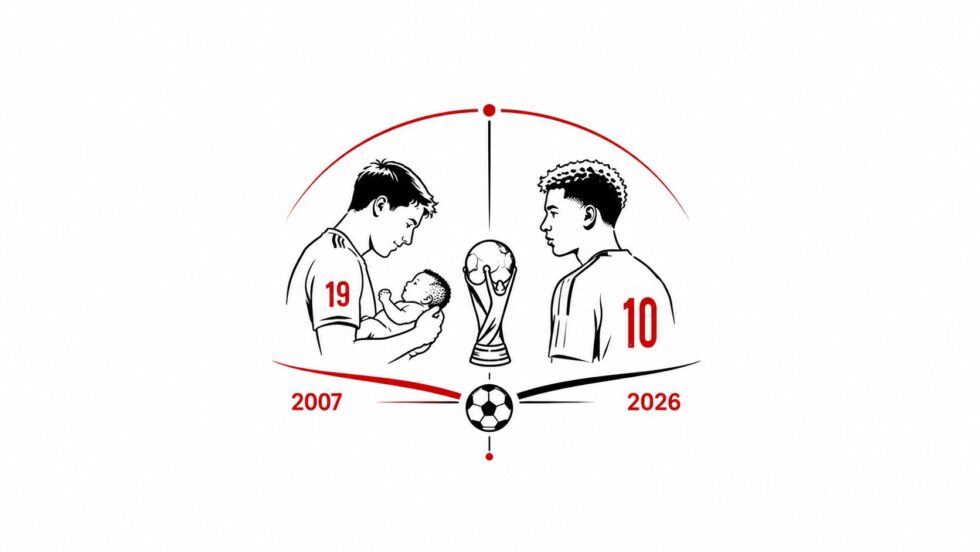
Lamine Yamal and Lionel Messi are meeting on football’s largest stage on Sunday, 19 July 2026, as Spain face defending champions Argentina in the World Cup final at New York New Jersey Stadium. Yet their shared history began almost 19 years earlier, inside an away dressing room at Barcelona’s Camp Nou, where a 20-year-old Messi was photographed holding and gently bathing the five-month-old future Spain international during a charity calendar shoot.
The remarkable Messi and Yamal baby photo was not arranged as a prediction, a publicity campaign or an early meeting between two recognised talents. Yamal’s family had entered a competition connected to Barcelona, Catalan newspaper Sport and Unicef, and were randomly paired with Messi after being selected. Photographer Joan Monfort captured the encounter without knowing that the baby would eventually inherit Messi’s Barcelona number 10 shirt and oppose him in a World Cup final, The WP Times reports.
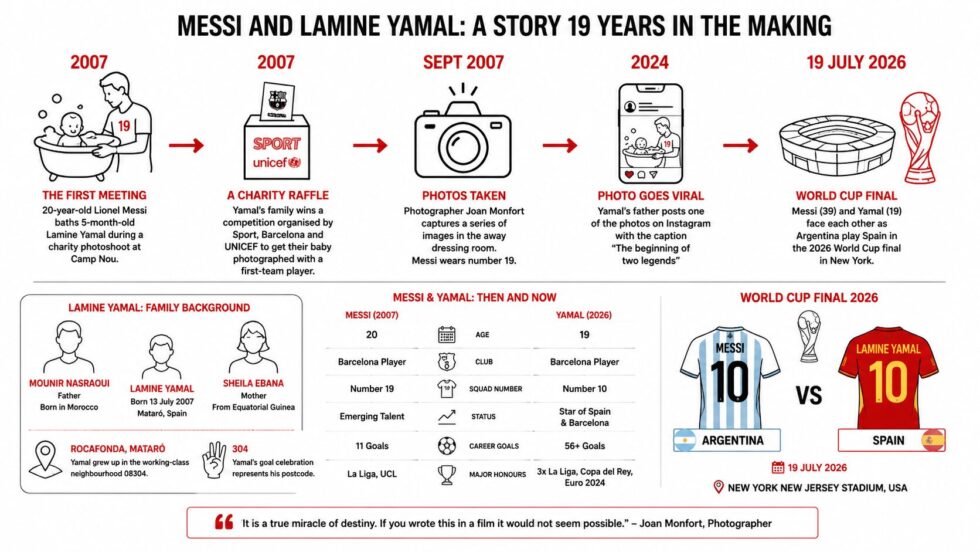
The photographs show Messi holding Lamine Yamal in a small plastic bath, helping to wash him and posing beside the baby’s mother, Sheila Ebana. At the time, Messi was an emerging Barcelona first-team player still wearing number 19. Yamal was an infant from a working-class family living in Catalonia, almost 16 years away from making his senior Barcelona debut. Their reunion in the 2026 World Cup final has transformed the photographs from an unusual piece of Barcelona history into one of football’s most powerful images of generational change. Messi, now 39, leads Argentina in pursuit of another world title. Yamal, who turned 19 shortly before the final, represents a Spain side attempting to add the World Cup to its European Championship success.
Why was Messi bathing Lamine Yamal in the 2007 photograph
Lionel Messi was bathing Lamine Yamal because both were taking part in a charitable photoshoot organised for a calendar associated with Barcelona, Sport and Unicef. It was not a private family occasion, a Barcelona academy ceremony or evidence that Messi had identified Yamal as a future footballer.
Families entered a raffle offering selected babies the opportunity to be photographed with a member of Barcelona’s first team. Lamine Yamal’s family was chosen, and the baby was paired with Messi by chance when the participants arrived at Camp Nou. The photographs were taken in September 2007 in the away dressing room rather than on the pitch or inside Barcelona’s usual first-team facilities. Monfort arranged a bathing scene involving Messi, Yamal and Sheila Ebana, creating pictures intended for the charity project. The photographer later recalled that Messi initially appeared uncertain about handling such a young baby. The Argentine was still only 20 and was known as a quiet, reserved figure away from football. Yamal, however, was relaxed during the session, while his mother helped Messi become comfortable with the unusual assignment. Monfort said he did not discover the baby’s identity until 2024, when a friend contacted him after Yamal’s father published one of the photographs online. The photographer described the eventual connection between the two players as an extraordinary coincidence that would have seemed unrealistic had it been written into a film.
What happened during the Messi and Lamine Yamal photoshoot
The surviving images document several stages of the session:
- Messi holds the baby carefully while looking towards the camera.
- Yamal sits in a small bath as Messi helps wash him.
- Sheila Ebana stands beside Messi and supports her son.
- Messi gradually appears more relaxed as the shoot continues.
- The Barcelona player wears the club’s number 19 shirt rather than the number 10 he later made famous.
The setting helps explain why searches such as Messi bathing Yamal, Messi holding Yamal and Messi Yamal baby photo produce genuine photographs rather than digitally created images. The pictures were taken professionally by Monfort and preserved as part of the original charity project.
How old is Lamine Yamal and how old was he in the Messi photo
Lamine Yamal was born on 13 July 2007 and turned 19 six days before the 2026 World Cup final. He was approximately five months old when the photographs with Messi were taken in September 2007.
Messi was 20 at the time. He had already established himself in Barcelona’s senior side but had not yet reached the period in which he would dominate European football, win multiple Ballon d’Or awards and become the club’s record goalscorer.
The age difference between Messi and Yamal is almost exactly 20 years. That gap makes their appearance in the same World Cup final particularly unusual: one player is approaching the end of an exceptional international career, while the other has completed only the opening years of his.
By the age of 19, Yamal had already developed a senior career that would be exceptional even without the comparison to Messi. He made his Barcelona debut in 2023 at 15, became a key Spain international and helped his country win Euro 2024 before taking the number 10 shirt at his club. Messi had also won major trophies before turning 20, although his most dominant individual seasons came later. The comparison therefore concerns career timing and Barcelona symbolism rather than two identical footballers following precisely the same path.
When did the Messi and Yamal baby photo become famous
The Messi Yamal photo existed for nearly 17 years without becoming a major international story. It resurfaced during Euro 2024, when Yamal’s father, Mounir Nasraoui, shared an image on Instagram with a caption describing it as the beginning of two legends. Yamal was then playing a central role in Spain’s European Championship campaign. His performances had already generated comparisons with Messi because of his Barcelona education, left-footed attacking style and preference for operating from the right side.
The photograph spread rapidly because it appeared to connect the two careers long before anyone could have known what Yamal would become. Supporters initially questioned whether the image was authentic, but Monfort subsequently confirmed its origin and described how the shoot had been organised.
It returned to global attention before the 2026 World Cup final, when Argentina and Spain qualified to meet in East Rutherford, New Jersey. The final provided a competitive conclusion to a story that had previously been treated mainly as an extraordinary Barcelona coincidence. Messi himself called the photograph incredible and said it was “crazy” that both he and Yamal had reached the same World Cup. He also described the young Spaniard as one of the world’s leading players while making clear that Argentina intended to prevent him from becoming champion.
Who are Lamine Yamal’s parents
Lamine Yamal’s parents are Mounir Nasraoui and Sheila Ebana. His father was born in Morocco, while his mother comes from Equatorial Guinea. Both settled in Catalonia with their families when they were young. Sheila appeared alongside Messi and her baby son in the 2007 photoshoot. Her presence was practical as well as photographic: Yamal was still an infant, and she helped Messi hold and interact with him safely during the session.
Yamal spent much of his childhood in Rocafonda, a working-class neighbourhood in Mataró, approximately 20 miles north-east of Barcelona. The district has remained an important part of his public identity despite his rapid rise in professional football.
His familiar 304 goal celebration refers to the final digits of Rocafonda’s postcode, 08304. By forming the numbers with his fingers, Yamal acknowledges the community in which he grew up and the people who supported his development. He has also spoken publicly about the financial and personal sacrifices made by his parents. Developing a child within elite football requires transport, time and consistent family support, particularly before an academy player earns professional income.
Yamal has said that he cannot fully repay what his mother and father did to give him the opportunity to play. That background gives the 2007 photographs an additional significance: they show the family before Barcelona football became the centre of their lives.
What is Lamine Yamal’s ethnicity and nationality
Lamine Yamal is Spanish and represents Spain at international level. His family background includes Moroccan heritage through his father and Equatoguinean heritage through his mother. He was born in Esplugues de Llobregat, near Barcelona, and grew up in Catalonia. His upbringing reflects the multicultural communities around Barcelona and Mataró rather than a simple football narrative confined to the club’s academy.
Questions about Lamine Yamal’s ethnicity sometimes arise because he was eligible through his family background to represent more than one country. He ultimately chose Spain and progressed rapidly from youth international football into the senior national team. His identity is visible in the different parts of his public life. He represents Spain, plays for Barcelona, celebrates Rocafonda and openly recognises the origins of both sides of his family.
Is Yamal really Lamine Yamal’s surname
Yamal is not his family surname. His full name is Lamine Yamal Nasraoui Ebana, combining his two given names with the family names of his father and mother. Barcelona and Spain use Lamine Yamal on the back of his shirt because those are the names by which he has chosen to be identified professionally. References to Yamal Lamine or Lamin Yamal are common search variations, but Lamine Yamal is the correct familiar form.
Reports in Spain have said that his first names recognise two people who assisted his parents financially around the time of his birth. Lamine is an Arabic name commonly associated with honesty or trustworthiness, while Yamal is related to Jamal, a name associated with beauty. His name has consequently become globally recognised despite not following the usual pattern in which footballers compete under a surname.
How do Messi and Lamine Yamal compare at Barcelona
The connection between Messi and Yamal extends beyond the baby photograph, but it should not be overstated. They developed at different times, played in different Barcelona teams and did not share the senior dressing room. Messi left Barcelona for Paris Saint-Germain in 2021. Yamal made his first-team debut in April 2023, becoming one of the youngest senior players in the club’s history. Their Barcelona careers therefore did not overlap.
Both emerged from the club’s development structure as left-footed attackers capable of beginning on the right and moving towards central areas. Both also reached senior football unusually early and became important international players as teenagers. However, Yamal is not simply a replacement version of Messi. His physical profile, crossing, movement and decision-making have developed within a different tactical era. Barcelona’s financial and sporting circumstances during Yamal’s emergence were also very different from those surrounding Messi’s rise. The strongest symbolic link arrived when Yamal inherited Barcelona’s number 10 shirt in 2025. Messi had worn the number from 2008 until leaving the club, turning it into one of the most commercially and emotionally significant shirts in world football. Wearing the same number inevitably produces comparisons, but Yamal has repeatedly been encouraged to establish his own career rather than reproduce Messi’s achievements.
Messi and Yamal reach the World Cup final from opposite ends of their careers
Argentina entered the final as defending champions, with Messi attempting to lift the trophy for a second consecutive tournament. Spain arrived as the reigning European champions and with Yamal among the central figures in a young, technically accomplished side. The match at New York New Jersey Stadium is the 104th and final fixture of the expanded 48-team World Cup. Spain reached the final after defeating France, while Argentina advanced after overcoming England in their semi-final.
Messi’s importance to Argentina remains based on more than reputation. He continues to influence matches through his passing, awareness around the penalty area and ability to control the pace of attacks, even though his movement and physical workload have changed with age. Yamal offers a different threat. He can isolate defenders near the touchline, move inside to combine with midfielders and create chances from apparently static positions. His confidence in possession has made him one of Spain’s principal attacking outlets. The individual contest cannot determine the final on its own. Spain possess a structured midfield and coordinated pressing system, while Argentina have the experience, defensive resilience and emotional control developed through recent international tournaments. Nevertheless, Messi and Yamal provide the final with its clearest human story: Barcelona’s most celebrated player facing the teenager who now wears his former shirt.
Did Messi’s bath give Lamine Yamal his football talent
There is no credible suggestion that the photoshoot influenced Yamal’s ability or future career. The idea that Messi somehow transferred his talent to the baby is an internet joke built around the extraordinary coincidence. Yamal’s development came through years of family support, organised youth football, Barcelona’s academy and his own technical and psychological qualities. Messi’s involvement lasted for a brief photography session when Yamal was too young to remember it. The photograph has survived because it offers an unusually precise image of two careers before either had reached its present meaning. Messi was not yet the dominant player of his generation, and Yamal was not yet a footballer at all.
Its importance is therefore symbolic rather than supernatural. It captures how quickly sporting eras can turn: the young player being asked to pose with a baby eventually becomes the veteran attempting to stop that child from winning the World Cup.
Why the Lamine Yamal and Messi photo matters before the World Cup final
Football history is often reconstructed after success, with childhood moments presented as evidence that greatness had always been inevitable. The Messi and Lamine Yamal baby photographs are different because the original meeting was entirely random. Neither the organisers nor the photographer selected Yamal because of footballing ability. He was five months old. Messi was assigned to the family through the mechanics of a charity competition, not because Barcelona had designed a symbolic meeting between generations. That randomness is what gives the story its power. The image would have remained an obscure calendar photograph had Yamal become anything other than an elite footballer. Instead, he progressed from Rocafonda to Barcelona, Spain, a European title and eventually the World Cup final.
For Monfort, the final represents the closing of a circle that began accidentally in his Camp Nou photoshoot. The photographer supports Barcelona and has expressed divided loyalties between the club’s greatest former player and the teenager now carrying its number 10.
The outcome of Argentina against Spain will not settle debates about whether Yamal can emulate Messi’s career. A single match cannot bridge the distance between an emerging 19-year-old and a player whose achievements span more than two decades. It can, however, add one final image to a story that began in a plastic bath in 2007: Messi and Lamine Yamal no longer appearing as a shy young footballer and an anonymous baby, but standing on opposing sides of a World Cup final.
Read about the life of Westminster and Pimlico district, London and the world. 24/7 news with fresh and useful updates on culture, business, technology and city life: Why was flight FR4007 diverted to Paris, and what has Ryanair confirmed
Sources: FIFA, Associated Press, ITV News, Sky Sports, MLS Soccer, and reporting and photographs by Joan Monfort.