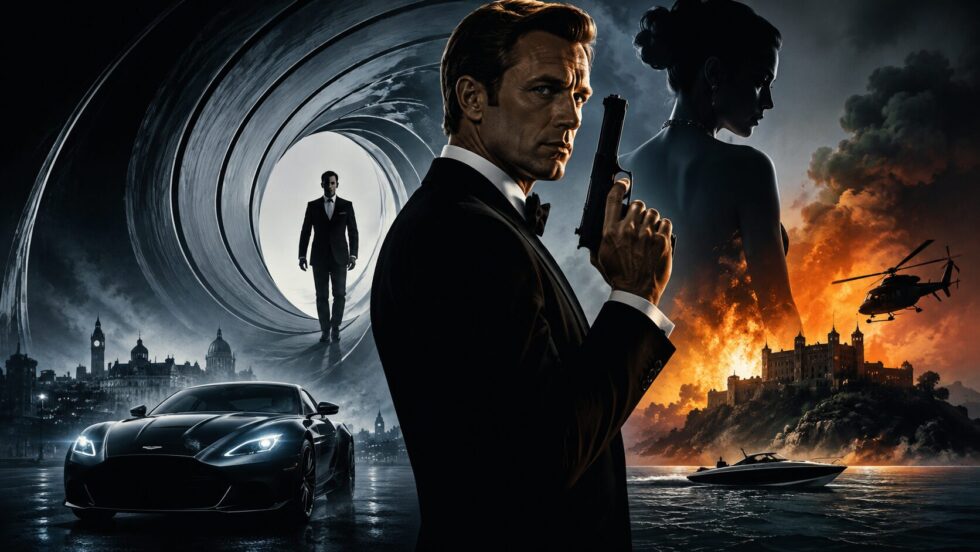
Casino Royale writers Neal Purvis and Robert Wade have set out what the next James Bond film must do to escape Daniel Craig’s shadow, arguing that Bond 26 needs a genuinely different leading man, a lighter sense of entertainment and the confidence to rebuild 007 rather than imitate the previous era. Their intervention comes almost 20 years after Casino Royale introduced Craig as a younger, physically dangerous and emotionally exposed Bond, and as Amazon MGM Studios develops the first film under its new creative control with Denis Villeneuve directing, Steven Knight writing and Amy Pascal and David Heyman producing, The WP Times reports.
The central challenge is not simply choosing another British actor and placing him in a dinner jacket. Bond 26 must establish why James Bond still matters, what distinguishes him from modern screen spies and how the series can recover humour, glamour and standalone adventure without discarding the dramatic credibility achieved during Craig’s five-film run. No new Bond actor, official title, production start or release date had been announced by Amazon MGM Studios by 2 August 2026, leaving casting reports and projected schedules unconfirmed.
Casino Royale Writers Say Bond 26 Cannot Simply Replace Daniel Craig
Purvis and Wade helped write seven James Bond films, beginning with The World Is Not Enough in 1999 and continuing through Die Another Day, Casino Royale, Quantum of Solace, Skyfall, Spectre and No Time to Die. That record gives them an unusually broad view of how the series changes between actors, political periods and audience expectations. Their first recommendation for Bond 26 is straightforward: the producers should not search for a younger or cosmetically different version of Daniel Craig.
“You don’t want to just swap like for like,” Purvis told The Times while discussing the franchise’s next reinvention.
Craig was 38 when Casino Royale reached UK cinemas in November 2006. His casting replaced Pierce Brosnan’s polished, knowingly sophisticated Bond with a more muscular and confrontational agent who had only recently earned 00 status. The film showed him making mistakes, ignoring instructions and forming an attachment to Vesper Lynd that permanently altered his character.
The strategy worked because Craig was not presented as an imitation of Brosnan, Sean Connery or Roger Moore. His Bond had the essential professional abilities associated with 007, but his temperament, physical presence and emotional vulnerability immediately signalled that the franchise had entered a different period.
Bond 26 therefore needs more than a recognisable face. The new actor must be credible as an intelligence officer, carry action without appearing interchangeable with Craig and sustain the mixture of danger, charm, arrogance and self-control that distinguishes Bond from a conventional action hero. No candidate has been officially confirmed. Amazon MGM’s May 2026 update stated only that the search for the next James Bond was continuing while repeating the confirmed creative team. Any report naming a frontrunner should consequently be treated as speculation unless supported by a formal studio announcement.
Why Casino Royale Remains the Model for Rebuilding James Bond
Casino Royale succeeded because it returned to fundamentals without becoming a museum piece. Adapted from Ian Fleming’s first Bond novel, the film introduced an inexperienced 007, gave him a defined mission and built its main conflict around money, intelligence work and personal judgement rather than an escalating collection of gadgets.
Bond’s operation begins with the pursuit of a bomb-maker in Madagascar and develops into an attempt to bankrupt Le Chiffre, a financier serving terrorist clients. After Bond prevents the destruction of a prototype aircraft, Le Chiffre must recover the lost funds through a high-stakes poker game in Montenegro. The British government sends Treasury representative Vesper Lynd to control the money used by Bond at the table.
The structure gives the action a clear purpose. The airport sequence is not an isolated spectacle; it creates the financial crisis that forces Le Chiffre into the casino. The poker game is not decorative luxury; it is the operational mechanism through which British intelligence intends to destroy him. The film’s official production record identifies Martin Campbell as director, Michael G Wilson and Barbara Broccoli as producers, and Daniel Craig, Eva Green and Mads Mikkelsen as the principal cast. Casino Royale received its world premiere at London’s Odeon Leicester Square on 14 November 2006 before its UK release on 16 November.
Its approach also made action reveal character. Purvis has explained that the Madagascar construction-site chase was designed to establish Craig’s Bond as “gadget free, raw, slightly crazy, very physical and incredibly brave”. The sequence contrasts Bond’s brute determination with the fluid parkour movements of Mollaka, showing the audience who the new 007 is before the story pauses to explain him.
What Bond 26 Can Learn from Casino Royale
| Casino Royale decision | Why it worked | Possible lesson for Bond 26 |
|---|---|---|
| Introduced Bond early in his 00 career | Allowed familiar traits to be rediscovered naturally | Give the new actor a clear starting position |
| Reduced dependence on fantasy gadgets | Made Bond’s judgement and physical ability central | Use technology to support the story, not replace it |
| Built action around one connected operation | Prevented the film from feeling like unrelated set pieces | Give the mission a simple strategic objective |
| Made Vesper essential to the plot | Created emotional and professional conflict | Write major supporting characters with independent authority |
| Changed the tone from the previous era | Gave Craig his own identity immediately | Avoid reproducing Craig’s performance or visual style |
| Used humour selectively | Preserved wit without weakening danger | Restore entertainment without turning Bond into parody |
Bond 26 Needs More Humour Without Returning to Parody
Wade believes the next film should permit itself to be more entertaining. He said that, even before he and Purvis stopped working on the series, they had concluded: “It needs to lighten up. It needs to be entertaining.”
That does not necessarily mean a return to disposable jokes, improbable disguises or self-conscious references to earlier films. The strongest Bond humour usually comes from character: his composure under pressure, his competitive exchanges with colleagues, his irritation with authority and the contrast between elegant surroundings and lethal circumstances. Craig’s era began with dry humour but became progressively burdened by personal history. Skyfall connected the mission to M’s past. Spectre linked several former villains to Ernst Stavro Blofeld. No Time to Die gave Bond a child, returned Madeleine Swann and ended with his death during the destruction of Safin’s island base.
Those choices gave the five films an emotional continuity that earlier Bond periods rarely attempted. They also created a difficult inheritance. The next film cannot continue Craig’s biography, yet another origin story could feel repetitive only two decades after Casino Royale.
A practical alternative would be to introduce the new Bond as an established but not fully explained agent. The audience does not need to see him receive his licence to kill again. A mission can reveal his personality, methods and professional relationships while leaving enough of his background undisclosed to preserve mystery. The lighter approach proposed by Wade should therefore concern rhythm as much as dialogue. Bond 26 needs moments of anticipation, seduction, travel, competitive pleasure and controlled absurdity between scenes of violence. Entertainment in a Bond film comes from the combination of danger and access: 007 enters places, conversations and conflicts closed to ordinary people.
How Die Another Day Helped Create the Conditions for Casino Royale
Casino Royale’s disciplined tone becomes clearer when compared with Die Another Day, released four years earlier. Brosnan’s final film included an invisible Aston Martin, a palace constructed from ice and a satellite weapon capable of concentrating solar energy on the Earth.
Wade has acknowledged that the production moved “completely over the top”, although he noted that the invisible-car concept had roots in camouflage technology being investigated for military vehicles.
The lesson is not that Bond must always be realistic. The series has never operated as a documentary portrayal of British intelligence. Its stories depend on heightened villains, luxury settings, extreme risks and unusually capable agents.
The problem arises when every element demands more attention than the character or mission. If the car, headquarters and weapon all exist principally to exceed the previous film, escalation becomes the story.
After Die Another Day, Purvis and Wade developed a spin-off centred on Jinx, the American NSA agent played by Halle Berry. Barbara Broccoli and Michael G Wilson were expected to produce, while Stephen Frears was considered as director. The proposed film was intended to be smaller, darker and grittier than Brosnan’s final Bond adventure.
MGM ultimately declined to proceed after the commercial performance of female-led action sequels including Charlie’s Angels: Full Throttle and Lara Croft: Tomb Raider — The Cradle of Life reportedly made the studio more cautious. When the screen rights to Fleming’s Casino Royale became available, elements of the creative thinking behind the abandoned Jinx project informed the subsequent Bond reboot.
That history matters because successful reinvention rarely begins with a slogan about modernisation. It develops from decisions about scale, character, stakes and what the preceding film has exhausted.
Amazon MGM’s James Bond Takeover Has Ended a 60-Year System
Bond 26 will be the first James Bond film developed after Barbara Broccoli and Michael G Wilson transferred creative control of the franchise to Amazon MGM Studios. Amazon announced the agreement on 20 February 2025 and confirmed that the transaction closed on 24 March. A new joint venture holds the intellectual-property rights, while Amazon MGM has creative authority over future productions. Broccoli and Wilson, whose family had controlled the film series for more than six decades, stepped back from active stewardship.
The change is larger than an ordinary replacement of producers. Under the previous system, the Bond series was tightly controlled by Eon Productions, with major decisions about actors, scripts, directors and release strategy passing through the Broccoli family.
Purvis and Wade said they had expected to be contacted about another Bond film. Instead, Broccoli informed them that creative authority was moving to Amazon and that they would not be required.
“It was sad because it was the end of an era,” Wade said. “We had such a great time doing these films.”
Their departure confirms that Bond 26 is not merely beginning a new acting cycle. The writing, production and approval structure behind the series has also been replaced.
What Is Officially Confirmed About Bond 26?
Amazon MGM announced Amy Pascal and David Heyman as producers in March 2025. Pascal is producing through Pascal Pictures and Heyman through Heyday Films. Their franchise experience includes Spider-Man and Harry Potter respectively, although Bond presents a different challenge because its continuity, tone and British identity have traditionally been guarded by a small central production team.
Denis Villeneuve was officially named director on 25 June 2025, with Tanya Lapointe serving as executive producer. Villeneuve described Bond as “sacred territory” and said he intended to honour the tradition while opening the way for future missions.
Steven Knight was announced as screenwriter on 31 July 2025. The British writer created Peaky Blinders and has also worked on Taboo, SAS Rogue Heroes, A Thousand Blows and other film and television projects. Amazon described his appointment as another key stage in the film’s development. The confirmed production structure is therefore:
- Studio and creative authority: Amazon MGM Studios
- Director: Denis Villeneuve
- Screenwriter: Steven Knight
- Producers: Amy Pascal and David Heyman
- Executive producer: Tanya Lapointe
- James Bond actor: Not announced
- Official title: Not announced
- Principal cast: Not announced
- Filming date: Not announced
- Release date: Not announced
Producer Amy Pascal indicated in March 2026 that the film was expected to shoot in Britain. The UK would be a conventional base: 23 of the first 25 official Bond films used London’s Pinewood Studios, home to the Albert R Broccoli 007 Stage. However, a complete production plan has not been formally published.
Can Denis Villeneuve Combine Spectacle with Classic Bond Entertainment?
Villeneuve brings extensive experience in large-scale filmmaking through Arrival, Blade Runner 2049 and the Dune films. His work is associated with controlled visual composition, immersive environments and characters operating under political, moral or psychological pressure.
Those qualities suit Bond, particularly if the film requires a clear geopolitical world and action that communicates strategic consequences. They could also produce a film that is too solemn if every element is treated with monumental weight. The key question is whether Villeneuve and Knight can combine cinematic scale with the lighter energy recommended by Wade. Bond needs suspense and atmosphere, but he also requires speed, social confidence and the pleasure of watching a highly trained agent improvise.
Villeneuve’s official statement suggests awareness of that responsibility. He did not describe Bond as material to be dismantled or corrected. He promised to honour the tradition while preparing the character for further missions, indicating that Bond 26 is intended as the foundation of a new cycle rather than an isolated experiment. Knight’s task will be to give that visual ambition a disciplined dramatic structure. Casino Royale worked because its central operation could be understood quickly: force a terrorist financier into a poker game and defeat him. Bond 26 will need similar clarity even if its political and technological context is more complex.
Why the Next James Bond Actor Must Remain Partly Mysterious
The prolonged casting debate risks reducing Bond to a checklist of nationality, age, height and franchise availability. Purvis and Wade’s experience suggests that the more important issue is whether an actor can reveal qualities that are difficult to predict from previous roles.
Craig faced substantial hostility when he was announced. His blond hair, appearance and perceived lack of conventional Bond polish were treated by critics as evidence of a casting error. The response changed after Casino Royale premiered on 14 November 2006. Craig became the first performer to receive a BAFTA nomination for playing Bond and continued for four further films.
That example should make audiences cautious about judging candidates from photographs or isolated performances. Bond requires an actor who can hold the screen while doing very little, suggest calculation beneath polite conversation and make violence appear decisive rather than decorative. The role also benefits from mystery. Excessive familiarity can make it harder for an audience to see the character rather than the celebrity. The successful candidate does not need to be unknown, but the producers must believe viewers can accept him as Bond before recalling his previous public identity.
What Bond 26 Must Achieve Before James Bond Can Return
Bond 26 has to solve several problems simultaneously. It must introduce a new actor, define a post-Craig tone, demonstrate the judgement of Amazon MGM’s new production structure and justify the long interval since No Time to Die.
The safest response would be to repeat familiar components: an Aston Martin, an elaborate villain’s base, a global threat, tailored suits and references to earlier adventures. That would produce recognisable marketing but not necessarily a convincing reinvention. Casino Royale demonstrates the stronger approach. Keep the identifiable Bond world, but change the dramatic engine. Give the agent a clear operation, place capable characters around him, allow consequences to emerge from his decisions and ensure that action reveals personality. Purvis and Wade are not demanding that Bond 26 reproduce their 2006 film. Their argument points in the opposite direction. Casino Royale worked because it refused to offer a slightly revised version of what came immediately before it. The new film will succeed only if Villeneuve, Knight, Pascal and Heyman make the same fundamental choice: preserve James Bond, but do not preserve the habits of the last James Bond era.
Read about the life of Westminster and Pimlico district, London and the world. 24/7 news with fresh and useful updates on culture, business, technology and city life: What did Tony Bellew say about Britain’s only two elite boxers and why does his verdict matter now
Materials used: The Times, Amazon MGM Studios, About Amazon, James Bond 007 official website, The Guardian, Screen International, The James Bond Dossier.