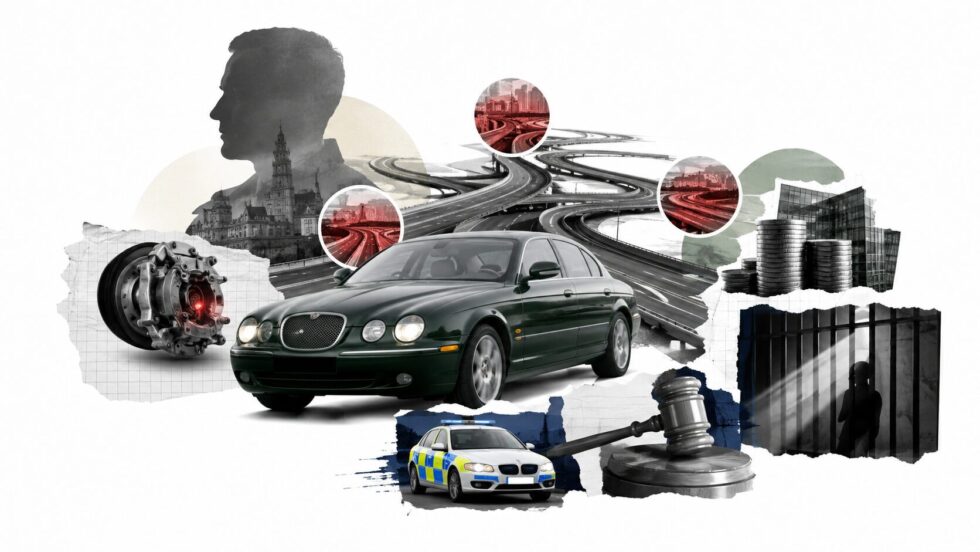
The Nathan Owen M62 Jaguar hoax ended at Liverpool Crown Court on Monday, 3 August 2026, when the 33-year-old motorist was jailed for four years and three months after admitting that a supposed high-speed electric-car malfunction was a carefully constructed lie. Owen falsely told police that his Jaguar I-Pace would not brake as he drove across the M58, M57 and M62 on 6 March 2024, triggering a major motorway operation in which officers placed their own vehicles around the car to protect other road users. Investigators later established that the Jaguar was functioning correctly, that Owen remained in control through the accelerator and that vehicle data showed he had not applied the brakes while claiming repeatedly that they had failed, The WP Times reports.
The episode lasted about 35 minutes and covered approximately 38 miles, with Owen reaching speeds of up to 86mph before the electric Jaguar finally stopped near Junction 12 of the M62 at Birchwood, close to Warrington. Prosecutors said the performance was designed to help him escape a troubled vehicle-finance agreement, while evidence recovered from his phone showed that he had discussed ways of disposing of the car, including having it written off, before the motorway incident. Owen later repeated the false mechanical-failure story to his finance provider and sold accounts of his supposed ordeal to two national newspapers for a combined £800, turning a dangerous deception into both an attempted financial exit and a source of personal profit.
Nathan Owen’s M62 Jaguar hoax began with a 999 call from a stationary car
At about 2.10pm on Wednesday, 6 March 2024, Owen contacted Merseyside Police and claimed his Jaguar I-Pace had malfunctioned and could no longer be stopped. He had been travelling from Ormskirk along the eastbound M58 towards his then home in Bolton, before reaching the Orrell interchange, turning around and heading west towards Liverpool. Police data later showed that during the 30 seconds before his emergency call, the Jaguar was stationary on a roundabout at the end of the M58.
The timing was central to the prosecution case. Liverpool Crown Court heard that Owen had contacted a lender shortly before calling police and had been refused permission to borrow more money on top of an existing loan. Five minutes later, he called 999 and announced that his vehicle was stuck at motorway speed, that the brakes were unresponsive and that he had no control over its acceleration. Prosecutor Eric Lamb told the court that the central claim was already false at the moment it was made because the vehicle was not moving.
During the recorded emergency call, Owen described himself as frightened and shaking. He told the operator that the Jaguar had “gone crazy”, warned that he was approaching a large bend and claimed a similar episode had previously sent the car beyond 100mph. The operator attempted to keep him calm while police motorway units were deployed to intercept what officers reasonably believed was a genuine, potentially fatal technical emergency.
The route then took Owen from the M58 to Switch Island, along the M57 and on to the M62. Officers moved traffic away, positioned police vehicles around the Jaguar and attempted to contain it while the car continued at speeds reaching 86mph. Roads were closed and substantial delays followed as specially trained officers tried to bring the situation under control without causing a more serious collision.
Key facts from the Nathan Owen motorway incident
| Detail | Confirmed information |
|---|---|
| Date of incident | 6 March 2024 |
| Emergency call | About 2.10pm |
| Vehicle | Electric Jaguar I-Pace |
| Roads involved | M58, M57 and M62 |
| Approximate distance | 38 miles |
| Duration | About 35 minutes |
| Highest reported speed | 86mph |
| Final location | Near M62 Junction 12 at Birchwood |
| Sentence | Four years and three months |
| Driving ban | Five years, plus an extended driving test |
| Offences admitted | Dangerous driving and two counts of fraud |
The Jaguar eventually stopped close to Junction 12 at Birchwood. Merseyside Police said the car did not stop because officers had repaired a fault or because Owen had suddenly regained control; it stopped safely only after its battery charge was exhausted. Police dashcam footage showed the vehicle boxed between marked motorway patrol cars, while footage presented in court also showed its brake lights illuminating once it had been brought to a halt.
Jaguar data showed the car was working and Owen never pressed the brakes
The case against Owen was built through a lengthy joint investigation by Merseyside Police and Jaguar Land Rover. Investigators examined the vehicle, its electronic records, Owen’s calls, his financial position and messages recovered from his mobile phone. The technical evidence contradicted his public account: the Jaguar was operating normally, remained under driver control and responded throughout the journey to pressure on the accelerator pedal.
Most damagingly, the data showed that Owen did not press the brakes at any point, despite repeatedly telling the 999 operator that he was attempting to do so. The finding transformed the case from a disputed account of a possible vehicle malfunction into evidence of deliberate driving conduct. It also explained why the car continued at speed and why police were forced to place their vehicles in its path.
The court heard that Owen collided with an assisting police car on numerous occasions during the motorway operation. The Guardian and evidence reported from court put the number of contacts at 31, while dashcam footage showed repeated minor impacts as officers drove in convoy and tried to box the Jaguar safely. Those collisions were not incidental to the deception: they were part of the physical danger created by Owen’s decision to maintain the appearance of an uncontrollable vehicle.
Prosecutors also said Owen drove through red lights before entering the motorway network and sent messages to his girlfriend while supposedly unable to control the Jaguar. The behaviour was inconsistent with the panic he described to the emergency operator and demonstrated, the Crown argued, that he was making active decisions throughout the journey. Workers were present on the motorway hard shoulder, adding another group of people placed at risk by the fabricated emergency.
Detective Constable Michael Doyle, the roads-policing investigator who worked on the case, said the inquiry had conclusively disproved Owen’s claims. Police found that he remained in full control for the duration of the incident and had endangered officers, road workers and members of the public through his reckless actions.
Financial problems and phone messages exposed the motive behind the Jaguar hoax
Owen was arrested on 13 March 2024, one week after the motorway operation, but initially denied inventing the emergency for financial gain. He continued to maintain that the Jaguar had suffered a genuine fault. Investigators therefore examined both the technical condition of the car and the financial circumstances surrounding his finance agreement.
Police found significant personal debt and repeated missed payments connected to the Jaguar. Court reports said Owen had roughly £5,000 remaining on the finance arrangement, although an earlier hearing referred more specifically to £4,426 in payments that prosecutors alleged he hoped to avoid. The figures reflect different stages or descriptions of the outstanding agreement, but both accounts support the prosecution’s central claim that Owen was struggling to meet the cost of the car.
His mobile-phone records provided further evidence of planning. Messages recovered by detectives showed Owen discussing how he might get rid of the Jaguar in the months before the claimed malfunction. One option under discussion was to have the vehicle written off, which would potentially remove or alter his obligations under the finance agreement.
On the day of the incident, Owen contacted a loan provider after already borrowing £3,000 and asked whether further credit was available. The request was refused. Within minutes, he made the false 999 call, and about 40 minutes after the motorway incident ended he contacted the vehicle-finance company again and repeated the allegation that the Jaguar had malfunctioned.
The sequence established by prosecutors was therefore unusually clear:
- Owen was experiencing financial pressure and had missed car payments.
- He had previously discussed ways of getting rid of the Jaguar.
- A request for additional borrowing was rejected.
- Five minutes later, he called 999 from a stationary vehicle.
- He created a motorway emergency by deliberately driving without braking.
- He repeated the mechanical-failure claim to the finance company.
- He then sold the same account to the press.
Prosecutor Eric Lamb told the court that Owen had fabricated the event to dispose of the vehicle and escape the finance agreement. Although the plan was financially motivated, its execution depended on dangerous driving across three busy motorways and on police accepting his account as genuine.
Owen sold his false ‘terror ride’ account to national newspapers
The deception did not end when the Jaguar stopped. The following day, Owen sold versions of the story to the Sun and the Daily Mail, receiving £300 from one newspaper and £500 from the other. His published account described a terrifying and uncontrollable journey, including what was presented as 35 minutes of fear while police vehicles surrounded the car.
Owen compared the motorway scene to the video game Grand Theft Auto and presented himself as the victim of an inexplicable electric-car failure. At that stage, the imagery of the incident appeared to support the story: police cars had genuinely surrounded the Jaguar, motorways had genuinely been disrupted and officers had genuinely acted as though lives were at risk. What was missing from the early public account was that the emergency itself had been manufactured by the person behind the wheel.
The false allegations spread widely. Jaguar Land Rover said they generated approximately 180 pieces of adverse media coverage and forced the company to allocate an additional £50m to marketing intended to counter the reputational damage. That figure was presented to the court in a statement from the manufacturer and became one of the most striking measures of the wider consequences of Owen’s conduct. The £50m was not described as the cost of repairing the individual vehicle or compensating motorists affected by the road closures. It represented Jaguar Land Rover’s assessment of additional promotional spending required to respond to negative attention created by a false claim that one of its electric vehicles had accelerated uncontrollably and could not be stopped.
Owen’s fraud therefore operated on several levels. He sought to influence his finance company, misled emergency services, exposed the manufacturer to financial and reputational harm and received direct payments from newspapers for an account he knew to be untrue. The two fraud charges reflected those dishonest representations, while the dangerous-driving conviction addressed the physical risk created on the motorway.
Liverpool Crown Court heard the plan was ‘frighteningly stupid’
Owen eventually admitted dangerous driving and two counts of fraud at a pre-trial review in June 2026. A further charge of causing a public nuisance was ordered to remain on file rather than forming part of the final sentence. He had previously denied the allegations when he first appeared in court in August 2025.
Daniel Travers, defending, described the scheme as “frighteningly stupid” for someone considered reasonably educated and intelligent. He said Owen had no previous convictions and came from a stable and successful family. His father had described him as a Walter Mitty figure who lived in a fantasy world and developed grand ideas that subsequently went wrong.
The defence also argued that Owen had not anticipated the scale of the damage caused to Jaguar Land Rover by the resulting publicity. That submission did not alter the fact that he had intentionally created the false emergency, maintained the account during the police response and later sought payment from newspapers for retelling it.
Sentencing Owen, Judge Ian Unsworth KC said his actions had set in motion a substantial police traffic operation, caused alarm to the public and created serious loss and disruption. The judge stressed that officers had knowingly placed themselves in danger because they believed they were dealing with a genuine vehicle failure and an apparently helpless driver.
The judge’s central conclusion was that Owen had not merely panicked, exaggerated a minor incident or misunderstood the behaviour of an electric vehicle. He had constructed a lie, driven in a manner designed to make that lie credible and then attempted to benefit financially from the consequences. As Judge Unsworth told him in court: “You, meanwhile, sought to profit from a lie.”
What sentence did Nathan Owen receive for the M62 Jaguar hoax?
Liverpool Crown Court imposed a prison sentence of four years and three months. Owen was also disqualified from driving for five years and will remain disqualified until he has passed an extended driving test. Merseyside Police said the ban followed his convictions for dangerous driving and two counts of fraud.
Some reports described the five-year ban as beginning after Owen’s release from custody, while the police statement said he was disqualified for five years and until an extended test had been completed. The practical effect is that he will not be entitled to resume driving automatically at the end of the stated period; he must also meet the additional testing requirement imposed by the court.
The sentence reflected conduct extending beyond ordinary dangerous driving. Owen created a prolonged emergency response across major roads, repeatedly collided with a police vehicle, exposed motorway personnel and the public to danger, attempted to manipulate a finance agreement and sold the resulting false narrative for money.
Nathan Owen case timeline
| Date | Development |
|---|---|
| September 2023 | Owen entered a finance agreement for the Jaguar I-Pace, according to evidence reported from court |
| 6 March 2024 | He called 999 and falsely claimed the car could not brake |
| 13 March 2024 | Police arrested him after beginning their investigation |
| 7 July 2025 | Merseyside Police announced charges |
| 13 August 2025 | Owen indicated not-guilty pleas at his first court appearance |
| June 2026 | He pleaded guilty to dangerous driving and two fraud counts |
| 3 August 2026 | Liverpool Crown Court jailed him for four years and three months |
The case also offers a clear example of the evidential role played by modern vehicle data. Owen’s story depended on an alleged technical failure that could not easily be assessed by other motorists or officers during the emergency. Once investigators examined the Jaguar’s recorded inputs, however, they could compare his spoken claims with his actual use of the controls. That evidence showed a working vehicle, continued accelerator use and no recorded braking during the supposed failure. Combined with the stationary position of the car before the 999 call, Owen’s financial records and earlier messages about disposing of the Jaguar, it provided a detailed reconstruction of both the deception and its motive.
The Nathan Owen M62 Jaguar hoax began as an apparent emergency involving a supposedly uncontrollable electric car. It ended more than two years later as a fraud and dangerous-driving case in which technical records, financial evidence and Owen’s own communications demonstrated that the threat had not come from the vehicle’s systems, but from the driver’s deliberate decisions.
Materials used: Merseyside Police, Liverpool Crown Court reporting, BBC News, The Guardian, ITV News Granada, The Sun.
Read about the life of Westminster and Pimlico district, London and the world. 24/7 news with fresh and useful updates on culture, business, technology and city life: What is known about the August England bus pass change and who will have to wait longer to qualify