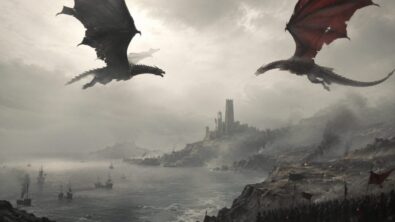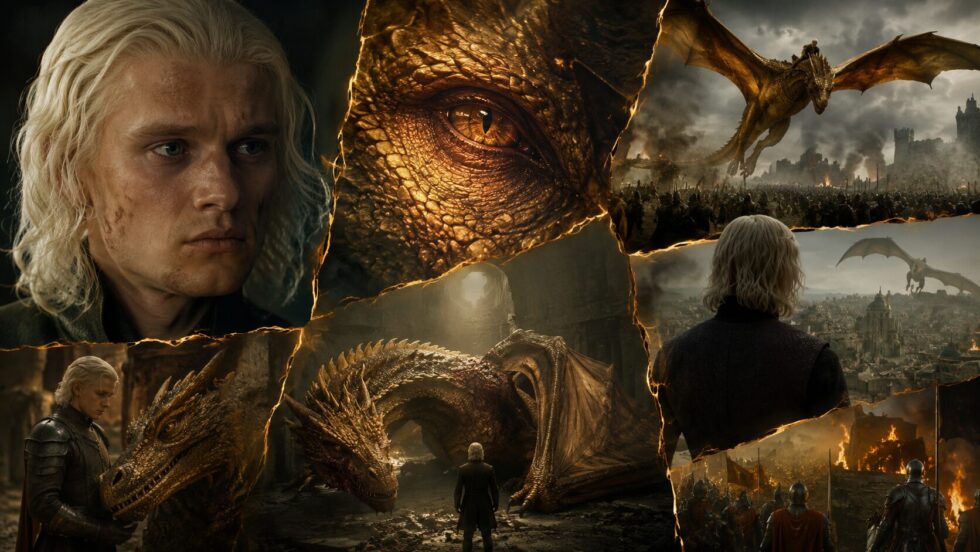
House of the Dragon season 3 episode 7 confirms that Sunfyre survived the catastrophic injuries suffered alongside King Aegon II Targaryen, transforming what appeared to be the death of a dragon into one of the season’s most consequential returns. Scarred, weakened and hidden from the forces fighting across Westeros, Aegon’s golden dragon emerges from the woodland behind his rider and burns through a Rhaenyra-loyal host, proving that the bond between the pair had endured even when almost everyone around Aegon believed Sunfyre was dead. The sequence restores a military weapon to the Greens, gives Aegon his first decisive victory after months of pain and humiliation, and changes the balance of the Dance of the Dragons immediately before the season finale, The WP Times reports.
Sunfyre has not been resurrected by magic and is not an undead dragon comparable with Viserion in Game of Thrones. Episode 7 instead reveals that the animal remained alive after Rook’s Rest, recovering slowly from severe burns, torn wings and facial injuries while Aegon continued to sense that the connection between them had not disappeared. Director Nina Lopez-Corrado has described their reunion as an emotional extension of the unusually close relationship established between rider and dragon, while the episode deliberately presents them as physical reflections of one another: both disfigured, underestimated and newly dangerous. Their return also arrives as Ormund Hightower works to weaken Rhaenyra’s dragonriders and as the armies of Westeros move towards Tumbleton, where another major reversal in the civil war is now being prepared.
How Sunfyre survived the injuries that appeared to kill Aegon’s dragon
Sunfyre survived because the dragon was never conclusively shown to have died. The injuries sustained during the aerial confrontation at Rook’s Rest were devastating, but House of the Dragon repeatedly left a narrow distinction between a mortally wounded creature and a dead one. Sunfyre fell from the sky, was burned by Vhagar and later appeared almost motionless on the ground, yet the series avoided presenting an unmistakable final breath, a corpse being formally identified or the permanent severing of the dragon bond.
That uncertainty became particularly important through Aegon’s insistence that he could not feel Sunfyre’s death. Other characters treated his belief as desperation from a broken king clinging to the last source of affection and power available to him. Episode 7 establishes that his instinct was correct. The dragon had become dormant or almost entirely immobile while its body recovered sufficiently to move, breathe fire and respond to its rider again.
The series does not provide a medical explanation for the dragon’s survival, nor does it suggest that Sunfyre returned to full health. His appearance tells the opposite story. Part of the dragon’s face remains badly damaged, his movement is heavy and his body carries the consequences of the battle. What has returned is therefore not the flawless golden dragon seen earlier in the drama, but a wounded animal capable of one sudden and overwhelming intervention.
Lopez-Corrado said the creative team treated the reunion as a continuation of the emotional exchange previously shown between Aegon and Sunfyre. Her account suggests that the earlier scene was not merely a farewell staged to misdirect viewers. It was intended to establish recognition, communication and a bond strong enough to remain meaningful while the two were physically separated.
Why Sunfyre is not a zombie dragon
The distinction matters because Game of Thrones has already shown a dragon returning after death. Viserion was killed beyond the Wall and raised by the Night King as an undead creature whose body and behaviour were transformed by supernatural power. Nothing comparable happens to Sunfyre.
There is no intervention by the White Walkers, no magical resurrection and no suggestion that the dragon has lost its original identity. Sunfyre recognises Aegon, responds to the danger facing him and uses ordinary dragonfire rather than the blue flame associated with undead Viserion. The damaged appearance is the result of battle wounds rather than decay after death.
The return is therefore closer to the recovery of a creature believed to be beyond saving. House of the Dragon asks viewers to accept that dragons possess an extraordinary capacity to endure trauma, particularly when their connection with a rider remains intact. That explanation belongs to the mythology of the series rather than real-world biology, but it is consistent with the story’s repeated presentation of dragons as ancient, resilient and only partly understood beings.
| Question | Episode 7 answer |
|---|---|
| Did Sunfyre die at Rook’s Rest? | No. The dragon was catastrophically injured but remained alive. |
| Was Sunfyre resurrected by magic? | No magical resurrection is shown or suggested. |
| Why did Aegon believe Sunfyre survived? | He could still sense the connection between rider and dragon. |
| Is Sunfyre fully recovered? | No. The dragon remains visibly scarred and physically damaged. |
| Can Sunfyre still fight? | Yes, although the full extent of his strength and endurance is unknown. |
What happens when Sunfyre returns in House of the Dragon episode 7
The return occurs when Aegon places himself in front of soldiers aligned with Rhaenyra, accompanied by Tyland Lannister but apparently without sufficient strength to defeat the force confronting him. His decision initially appears reckless. Aegon is still physically diminished, lacks the authority he once exercised in King’s Landing and has spent much of the season surviving through concealment rather than commanding an army.
The sound from the trees changes the scene before the dragon is clearly visible. The soldiers hear something moving through the woodland and recognise that their numerical advantage may no longer matter. Sunfyre then emerges behind Aegon and unleashes fire against the assembled force, killing those in the immediate path of the attack and forcing the survivors to flee.
Aegon’s reaction is crucial. He does not appear surprised that Sunfyre has found him. Instead, he responds with a mixture of relief, fury and uncontrolled satisfaction, as though the dragon’s arrival has confirmed both his private conviction and his continuing right to be feared. The laughter is not simply triumph at winning a skirmish. It marks the return of a king who had been treated as politically finished.
The sequence also reframes Tyland’s presence. Standing beside Aegon before the dragon appears requires considerable personal risk, because neither man can be certain that the opposing soldiers will hesitate. His loyalty therefore acquires practical value rather than functioning only as courtly language. By surviving the confrontation with Aegon, Tyland becomes one of the first senior figures to witness the restored partnership between the king and Sunfyre.
The event has immediate political consequences:
- Aegon can no longer be dismissed as a powerless fugitive.
- The Greens regain an operational dragon whose survival was not widely known.
- Rhaenyra’s commanders must reconsider any assumption that Aegon can be captured without aerial resistance.
- Rumours of Sunfyre’s return are likely to strengthen loyalist forces and frighten wavering houses.
- The king’s personal claim gains symbolic force because his dragon has returned to him rather than accepting another rider.
The episode does not establish how far Sunfyre can fly or whether he is capable of sustaining a prolonged battle. His attack may have required less exertion than a full aerial engagement. Nevertheless, the strategic difference between an injured dragon and no dragon at all is immense in a war where ordinary troops can be destroyed in seconds.
Why Aegon and Sunfyre now mirror one another
House of the Dragon has deliberately made Aegon and Sunfyre visually similar. Each carries severe damage across the face and body. Each has been written off by allies and enemies. Each has survived an assault involving Aemond and Vhagar, whose intervention at Rook’s Rest left Aegon burned and Sunfyre broken.
Their shared injuries alter the meaning of the traditional bond between a Targaryen and a dragon. Earlier in the series, dragonriding was associated with status, beauty and inherited supremacy. Sunfyre was particularly important to that image because of the dragon’s brilliant golden appearance. By episode 7, splendour has been replaced by endurance.
Aegon’s arc during the season has involved pain, dependency and degradation. Once surrounded by symbols of kingship, he has moved through Westeros without the protection normally attached to the crown. He has been forced into menial work, abused by people who do not recognise him and compelled to understand how little his title means when stripped of soldiers, armour and a dragon.
Sunfyre’s return does not erase that experience. It turns the experience into a source of danger. Aegon now understands vulnerability in a way he did not when he first claimed the throne, while Sunfyre is no longer simply a magnificent display of Targaryen power. Both have learned to survive unseen.
The reunion consequently works on three levels. It is emotional because Aegon recovers the creature with whom he shares his most uncomplicated relationship. It is political because a claimant to the Iron Throne regains a weapon capable of destroying armies. It is structural because the story restores Aegon to the central conflict before the final episodes of the civil war.
What Sunfyre’s return changes before the season three finale
The immediate effect is to make the Greens significantly less predictable. Rhaenyra’s side has operated with the assumption that Aegon was damaged, isolated and deprived of the dragon that legitimised much of his authority. Episode 7 overturns that calculation without revealing the full scale of Sunfyre’s recovery.
Rhaenyra must now consider the possibility that Sunfyre can attack troops, transport Aegon or appear unexpectedly in a larger battle. Even limited mobility would be valuable. A hidden dragon can threaten roads, supply columns and exposed commanders while forcing the enemy to divert other dragons to protection duties.
The timing is particularly dangerous because Rhaenyra’s own coalition is becoming unstable. Ormund Hightower has begun approaching Ulf the White, exploiting his resentment and offering status in exchange for disloyalty. The television version has developed this process more directly than George R.R. Martin’s historical account, placing personal grievance and political recruitment behind the betrayal traditionally associated with Ulf and Hugh Hammer.
Episode 7 also gives viewers the first substantial presentation of Dreamfyre through Helaena’s vision. In that sequence, Helaena sees herself mounted on the dragon and ordering an attack against approaching soldiers. The scene is not a direct recreation of an event described in Fire & Blood. It functions instead as a warning, a possible future and an indication that Helaena’s refusal to become an active dragonrider may still be tested.
Lopez-Corrado has acknowledged that the episode departs from the source material in order to develop character stories that will continue into episode 8. She defended those changes as a means of strengthening the dramatic movement into the finale, while recognising that committed readers may object to the restructuring.
The major forces moving towards the finale
| Character or force | Position after episode 7 | Central risk |
|---|---|---|
| Aegon II | Reunited with Sunfyre and newly empowered | Sunfyre may remain too injured for sustained combat |
| Rhaenyra | Commands several dragons but faces internal fractures | Betrayal among inexperienced dragonriders |
| Ormund Hightower | Actively trying to divide Rhaenyra’s coalition | His offers may create unstable allies |
| Ulf the White | Increasingly resentful and open to influence | Personal ambition may override loyalty |
| Hugh Hammer | Connected to the expected Two Betrayers storyline | His final allegiance remains critical |
| Helaena | Haunted by a vision involving Dreamfyre | The vision may be symbolic rather than literal |
| Corlys Velaryon | Politically separated from Rhaenyra in the adaptation | His capture and grievances could reshape alliances |
How episode 7 changes Fire & Blood and George R.R. Martin’s story
Sunfyre’s survival itself is not an invention that contradicts the broad history of Fire & Blood. The dragon remains an important figure in the later stages of the Dance of the Dragons, meaning that an apparent death at this point would remove material central to Aegon’s continuing story. The television series has instead used uncertainty to turn an expected survival into a dramatic reveal.
The larger changes concern how characters reach the conflicts described in the book. Fire & Blood is written as a contested historical chronicle assembled from differing accounts. It often records an outcome without providing the kind of continuous private motivation required by a television drama. The adaptation therefore creates conversations, betrayals, visions and personal confrontations to connect the documented events.
In episode 7, those changes include Helaena’s vision of riding Dreamfyre, the direct effort to recruit Ulf and the altered circumstances surrounding Corlys Velaryon. The series presents Corlys as increasingly divided from Rhaenyra and places him within an expanded Hightower plot. These decisions concentrate several political threads around the approaching battle rather than allowing them to develop separately.
The revisions remain controversial because Martin publicly criticised decisions taken during the adaptation and warned in 2024 that later seasons contained more substantial alterations. Showrunner Ryan Condal has argued that Fire & Blood cannot be transferred directly to the screen because it is not written as a conventional scene-by-scene narrative. He has described the adaptation as an attempt to preserve the larger history while constructing a workable dramatic account.
The disagreement is therefore not simply about whether an event happened in the book. It concerns emphasis, motivation and consequence. A television adaptation can retain a battle or a death while changing the decisions that produce it, potentially altering how viewers interpret responsibility.
Is Sunfyre strong enough to fight in the Battle of Tumbleton?
Episode 7 does not confirm that Sunfyre will participate directly in the Battle of Tumbleton. The dragon demonstrates that he can move through woodland and produce a lethal burst of fire, but viewers are not shown a sustained flight or a prolonged confrontation with another dragon.
Several practical questions remain unanswered:
- Can Sunfyre fly safely?
The dragon’s wings were severely damaged, and the episode does not establish whether they can carry both Sunfyre and Aegon over a long distance. - Can Aegon ride again?
Aegon’s own injuries may prevent him from mounting or controlling a dragon in the same way as before Rook’s Rest. - How much fire can Sunfyre produce?
The attack proves that the dragon remains dangerous, but one burst does not demonstrate full endurance. - Do the Greens know Sunfyre is alive?
Aegon and Tyland have witnessed the return, but the wider command structure may not yet understand what has changed. - Will secrecy be more valuable than immediate deployment?
Keeping Sunfyre hidden could allow Aegon to use the dragon at a decisive moment rather than exposing his weakened condition too early.
The stronger possibility is that Sunfyre’s return will influence the finale even without placing him at the centre of the largest battle. His survival restores Aegon as an independent force while other Green commanders pursue their own campaigns. That complicates the war because Aegon is no longer merely a claimant being protected or moved by others. He can again threaten enemies directly.
When is House of the Dragon season 3 episode 8 released?
House of the Dragon season three contains eight episodes, making episode 7 the penultimate instalment. The season finale is scheduled to air on HBO and HBO Max in the United States on Sunday, 9 August 2026. British viewers will receive the episode overnight into Monday, 10 August, subject to the normal UK distribution schedule.
The finale is expected to continue the movement towards Tumbleton, address the pressure on Rhaenyra’s dragonriders and show the consequences of Aegon’s restored partnership with Sunfyre. It must also resolve or advance the episode’s major adaptation changes, including Helaena’s vision, Corlys’s position and Ormund’s attempt to recruit opposition from within Rhaenyra’s camp.
HBO has structured the season so that Sunfyre’s return is not a self-contained surprise. It is the mechanism that places Aegon back into the struggle at the precise moment when Rhaenyra’s apparent superiority in dragons is becoming less secure. The king remains burned, his dragon remains maimed and neither has recovered the grandeur with which they entered the war. Yet episode 7 makes a more important point: they do not need to be uninjured to be decisive.
Materials used: HBO, Entertainment Weekly, Forbes, The Independent, Decider, Men’s Health, George R.R. Martin’s Fire & Blood.
Read about the life of Westminster and Pimlico district, London and the world. 24/7 news with fresh and useful updates on culture, business, technology and city life: Why was Heritage Live cancelled and what is known about the Sandringham concerts, line-ups and refunds