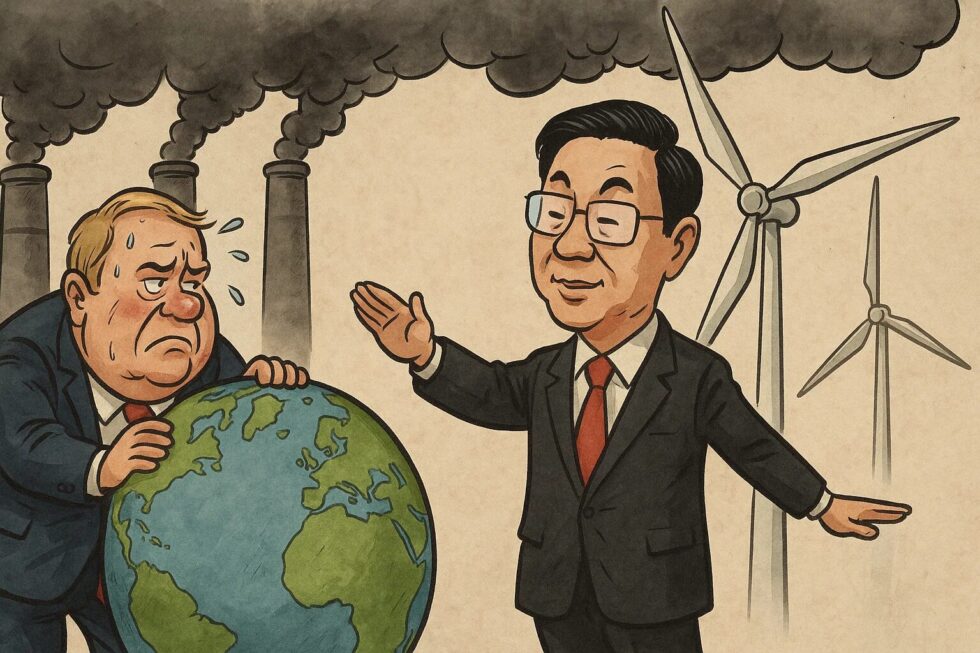
Developed countries are reportedly losing momentum in the fight against the climate crisis, even as China rapidly accelerates its production and deployment of clean energy technology, according to the president of the upcoming UN climate talks. André Corrêa do Lago, the Brazilian diplomat overseeing the Cop30 conference, stated that more nations should emulate China’s progress instead of complaining about the competition. Corrêa do Lago told reporters in Belém, the Amazonian city hosting the two-week conference that starts Monday, that "Somehow the reduction in enthusiasm of the global north is showing that the global south is moving." He noted that this shift has been ongoing for years but is now gaining greater exposure, reports The WP Times with reference to the Guardian.
Corrêa do Lago highlighted China, the world's largest emitter of greenhouse gases, as simultaneously being the biggest global producer and consumer of low-carbon energy solutions. He emphasized that China is generating solutions beneficial for everyone, not just itself. He pointed out that solar panels, thanks to China, are now cheaper and so competitive compared to fossil fuels that they are ubiquitous, which he called "good" for climate change mitigation.
Ministers and high-ranking officials representing 194 countries will convene at Cop30, seeking to solidify plans to limit global heating to, or as close as possible to, the 1.5°C target established in the Paris Agreement. Key goals include setting a roadmap for phasing out fossil fuels and ensuring vital financial assistance reaches vulnerable nations.
At the top of the agenda are national plans for cutting greenhouse gas emissions, which currently put the world on a path toward a devastating 2.5°C of heating. The Alliance of Small Island States (Aosis), through spokesperson and Palau’s UN ambassador Ilana Seid, stressed the need for a global pathway to deeper cuts. Seid told the Guardian that progress has been "insufficient" and a strong response is necessary, adding that the 1.5°C target "must be our north star." The Brazilian hosts are concentrating on "implementation"—putting existing commitments into action, such as tripling renewable energy capacity by 2030 and doubling energy efficiency. However, Aosis is pushing for faster emissions reduction policies, warning that the 1.5°C limit will be lost otherwise. Poor countries also demand concrete assurances regarding promised funding to help them adapt to the impacts of climate breakdown.
Meanwhile, a crucial climate commitment is already showing signs of failure as the conference begins. Data from the satellite analysis company Kayrros reveals that emissions from several major signatories of the Global Methane Pledge, forged at Cop26 in Glasgow in 2021, have actually increased. The pledge required a 30% cut in methane emissions by 2030, and approximately 159 countries signed on. Collectively, emissions from six of the biggest signatories—the US, Australia, Kuwait, Turkmenistan, Uzbekistan, and Iraq—are now 8.5% above 2020 levels. While Kuwait and Australia have made some progress, emissions from US oil and gas operations alone have risen by 18%. Methane is an extremely potent greenhouse gas, 80 times more powerful than carbon dioxide, and is responsible for roughly one-third of recent warming. Antoine Rostand, the president of Kayrros, stated that despite continuous promises, "methane emissions are rising," underscoring that the voluntary pledge is not sufficient. Durwood Zaelke, president of the Institute for Governance and Sustainable Development, called for a new, binding global agreement on methane to prevent the world from passing "fast-approaching tipping points."
Read about the life of Westminster and Pimlico district, London and the world. 24/7 news with fresh and useful updates on culture, business, technology and city life: First Update in 30 Years: UK Army Officially Adopts Ajax Combat Vehicle into Service.