
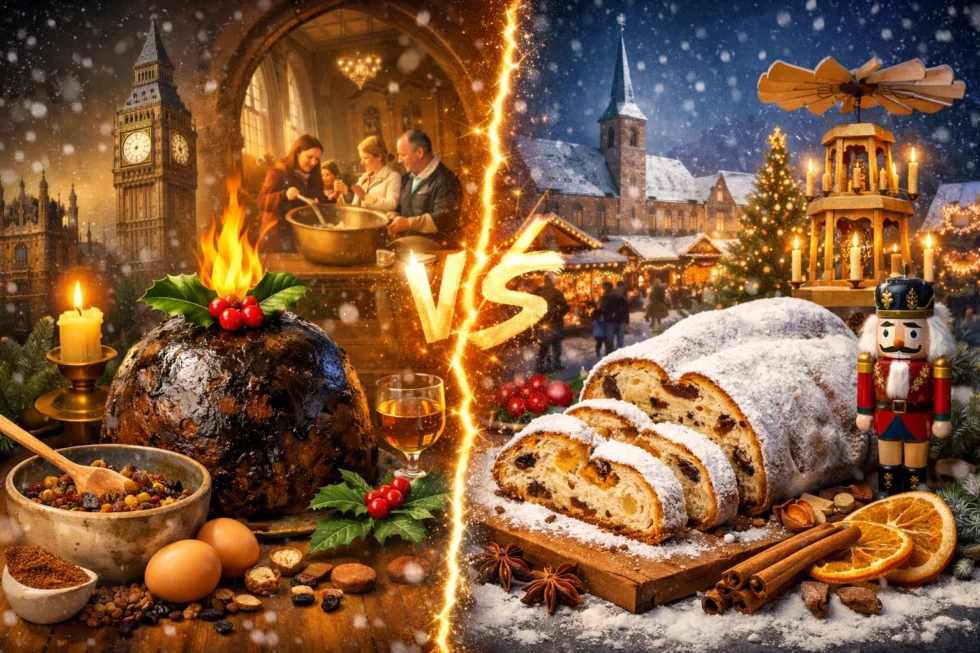
Christmas Pudding remains one of the most established elements of the traditional British Christmas dessert table, with documentary references dating back to the 17th century. Its earlier form evolved from medieval “plum pottage” — a mixture of meat, dried fruit, grains and spices — which gradually transformed into a sweet steamed pudding by the 18th and 19th centuries. The modern version is defined by long steaming, typically lasting between six and eight hours, which produces its dense structure and deep brown colour. Core ingredients in a traditional Christmas recipe include beef suet, fresh breadcrumbs, plain flour, eggs, dark brown sugar, black treacle, raisins, currants, sultanas and mixed spice. The high fruit content — often around 40–50% of the total mixture by weight — combined with alcohol such as brandy or stout contributes both to preservation and to the pudding’s characteristic intensity.
Unlike German Stollen, which is a yeast-fermented, oven-baked bread documented in Dresden records as early as the 15th century, Christmas Pudding relies on steaming rather than baking. Stollen typically contains flour, butter, yeast and candied fruit, producing a lighter, sliceable loaf dusted with icing sugar. By contrast, British Christmas Pudding is traditionally prepared weeks in advance, most commonly on Stir-up Sunday, the last Sunday before Advent — in 2025 falling on 23 November. During maturation, small quantities of brandy are periodically added to enhance flavour and moisture retention. On Christmas Day, the pudding is reheated by steaming for approximately two to three hours before serving. The custom of pouring warmed brandy over the pudding and igniting it briefly at the table has been recorded since at least the Victorian period. Folklore frequently references the use of thirteen ingredients, symbolically associated with Christ and the twelve apostles, though this is a cultural tradition rather than a fixed culinary requirement, reports.
Today, Christmas Pudding continues to represent continuity within London Christmas traditions and across the United Kingdom. Its extended preparation time, high dried-fruit ratio, alcohol preservation method and ceremonial presentation distinguish it clearly in comparisons such as Stollen vs Christmas Pudding. For readers researching a British Christmas dessert guide or an authentic London Christmas recipe, the defining characteristics remain precise: prolonged steaming, weeks of maturation, high fruit density and ritual serving practices rooted in centuries of seasonal custom.
The Historical and Culinary Differences: Pudding Versus Stollen
The British Christmas Pudding and the German Stollen, despite both being cherished holiday baked goods, embody distinct cultural and technical differences, making them culinary antipodes of the Christmas table. Historically, the Pudding evolved from savoury plum porridges, becoming the sweet, rich dessert we know today only after the Victorian era popularized the steamed version. Stollen, originating in Dresden, is fundamentally a bread; its primary ingredients are yeast, flour, and butter, and it is baked until golden, often featuring a marzipan core, whereas the Pudding is boiled or steamed for hours. The texture difference is pronounced: Stollen is soft, crumbly, and sugar-dusted, while the Pudding is heavy, moist, and sticky, preserving well due to its high fat and alcohol content. This distinction in preparation and consumption reflects broader differences in British and German festive eating customs.
Key differences between Christmas Pudding and Stollen:
- Preparation Method: Pudding is steamed or boiled for many hours; Stollen is baked in an oven.
- Leavening Agent: Pudding uses eggs and suet (fat) for structure; Stollen relies on yeast.
- Texture and Density: Pudding is dense, heavy, and moist; Stollen is light, airy, and crumbly.
- Serving: Pudding is often flamed with brandy; Stollen is dusted with powdered sugar and served cold.
- Maturity: Pudding is traditionally made weeks in advance to mature; Stollen is generally baked closer to Christmas.
Understanding the Authentic London Christmas Pudding Tradition
The authentic London Christmas Pudding tradition is defined not simply by ingredients, but by timing, technique and maturation. Preparation traditionally begins on Stir-up Sunday, the last Sunday before Advent, allowing a minimum of four to five weeks for flavour development before Christmas Day. This extended resting period distinguishes a traditional British Christmas dessert from most modern festive bakes, which are typically consumed shortly after preparation.
Historically, Christmas Pudding became firmly established in Britain during the 18th and 19th centuries, when steamed suet puddings replaced earlier boiled grain dishes. By the Victorian period, it had evolved into a standardised festive centrepiece across London households. Its defining characteristic is not sweetness alone, but density and preservation — achieved through a high proportion of dried fruit, animal fat (traditionally beef suet) and alcohol.
In a classic London-style recipe, dried fruit can account for up to half of the total mixture by weight. Raisins, currants and sultanas provide structure, while black treacle deepens colour and adds molasses notes. Suet is essential: unlike butter, its higher melting point creates a moist but stable crumb after prolonged steaming. Alcohol — most commonly brandy, dark rum or stout — performs a dual function: flavour enhancement and natural preservation.
The pudding is not baked. It is steamed continuously for six to eight hours, using indirect moist heat to develop its dark, compact interior. This method ensures even cooking while preventing the mixture from drying out, a key difference frequently noted in comparisons such as Stollen vs Christmas Pudding.
Technical Foundations of an Authentic Christmas Pudding
- Fruit Ratio: 40–50% dried fruit content
- Fat Structure: Beef suet for moisture retention and texture stability
- Sweetening Agents: Dark brown sugar and treacle for caramel depth
- Spice Profile: Cinnamon, nutmeg, cloves, ginger
- Cooking Method: 6–8 hours of steaming in a sealed basin
- Maturation Period: Minimum 4 weeks before serving
These measurable elements form the structural backbone of a traditional British Christmas recipe.
Ingredients and Preparation: Classic Steamed Christmas Pudding
Precision is essential when preparing an authentic Christmas Pudding. Dried fruits should be soaked overnight in brandy or stout to ensure proper hydration and flavour absorption. Skipping this step often results in a drier texture.
Breadcrumbs play a critical structural role. Unlike cake flour-based desserts, Christmas Pudding relies on crumbs to bind moisture and prevent heaviness. The mixture is then firmly packed into a greased pudding basin, sealed tightly with parchment and foil to prevent water ingress during steaming.
Standard 1.5-Litre Christmas Pudding Formula
Dried Fruits (450g total):
Raisins, currants, sultanas, mixed peel
Fat and Sweeteners:
100g shredded suet
100g dark brown sugar
2 tablespoons black treacle
Binders:
100g fresh breadcrumbs
50g plain flour
Liquid and Flavouring:
1 large egg
150ml brandy or stout
1 teaspoon mixed spice
Steam for 6–8 hours, maintaining a steady water level throughout.
The result is a dense, dark pudding with high moisture retention — structurally distinct from yeast-based festive breads.
Maturation: The Defining Stage of a Traditional British Christmas Dessert
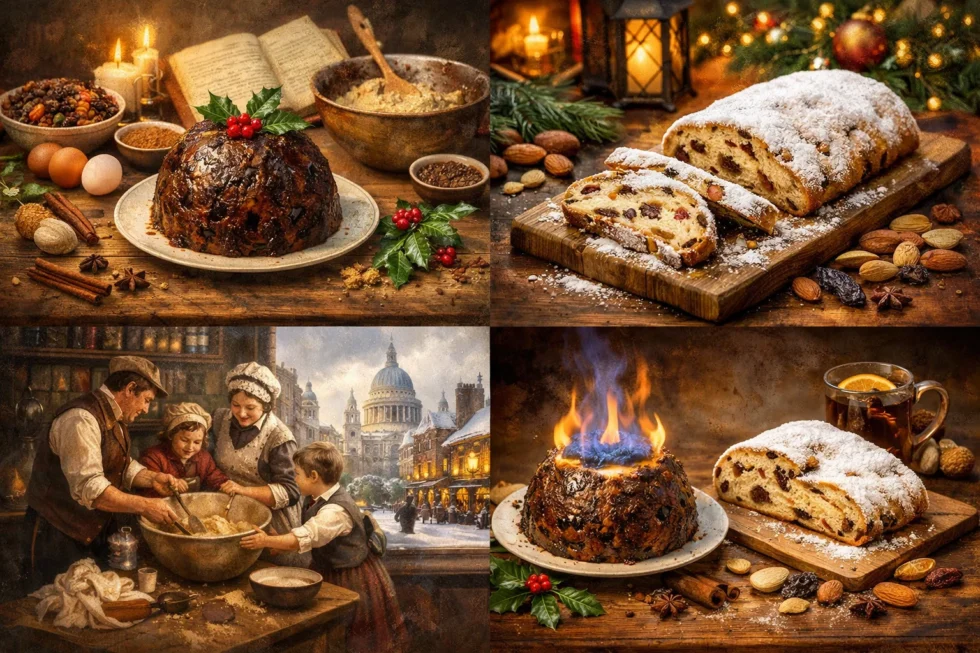
Maturation is the stage that distinguishes a traditional Christmas Pudding from an ordinary steamed fruit dessert. Unlike cakes that are consumed within days, a proper British Christmas Pudding is designed to improve over time. Once the initial six to eight hours of steaming are complete, the pudding must cool entirely in its basin before being resealed for storage. This cooling period is crucial, as sealing it while warm can create excess condensation and compromise texture.
The pudding is then stored in a cool, dry cupboard away from direct light. Refrigeration is generally unnecessary due to the high sugar content, dense fruit ratio and presence of alcohol, all of which contribute to natural preservation. During this resting period, flavours begin to integrate: spices soften, dried fruits absorb surrounding moisture, and treacle notes deepen.
At intervals of seven to ten days, a small measure — typically one tablespoon — of brandy or dark rum is added to the surface. This practice, commonly known as “feeding,” allows alcohol to gradually permeate the pudding, intensifying aroma while maintaining moisture balance. Over several weeks, the structure becomes more cohesive and the flavour profile noticeably richer.
On Christmas Day, the pudding is reheated by steaming for approximately two to three hours. This gentle reheating restores suppleness and ensures the centre reaches serving temperature evenly, preserving the dense yet moist consistency that defines an authentic traditional British Christmas dessert.
Presentation and Serving Ritual
The final step reinforces its ceremonial role within British festive traditions. A small quantity of brandy is gently warmed — never boiled — and poured over the pudding before being ignited briefly. The blue flame effect has been documented since the 19th century and remains a hallmark of a traditional London Christmas table.
Typical accompaniments include:
- Brandy butter
- Custard
- Double cream
- White rum sauce
Why It Differs Fundamentally from Stollen
In debates around Christmas Pudding vs Stollen, the distinction is not merely cultural — it is technical, structural and nutritional. Although both desserts contain dried fruit and spices, they are produced using entirely different culinary systems.
Christmas Pudding belongs to the category of steamed suet puddings, a method rooted in British cookery. It is not leavened with yeast and does not rely on aeration. Instead, its density comes from breadcrumbs, flour, eggs and suet, combined with a very high proportion of dried fruit — often 40–50% of the mixture by weight. The pudding is cooked using moist heat for six to eight hours, creating a compact, dark structure with long shelf stability.
Stollen, by contrast, is fundamentally a yeast-fermented enriched bread. It depends on proofing time, gluten development and oven baking. The crumb is lighter and sliceable. Butter is the primary fat, contributing to softness rather than density. Because it is bread-based, its texture changes more quickly after baking.
Another key distinction lies in maturation. A traditional Christmas Pudding is intentionally made weeks in advance — commonly four to six weeks before Christmas — and periodically “fed” with alcohol. This improves flavour integration and moisture retention. Stollen, although it may rest for several days to allow flavour settling, is typically consumed within one to two weeks of baking.
Structural and Technical Differences
- Cooking Method:
Christmas Pudding — prolonged steaming
Stollen — oven baking - Leavening System:
Pudding — eggs (no yeast fermentation)
Stollen — yeast fermentation - Fat Source:
Pudding — beef suet
Stollen — butter - Fruit Density:
Pudding — very high fruit concentration
Stollen — moderate fruit distribution within dough - Maturation Period:
Pudding — improves over several weeks
Stollen — short resting period, best fresh
These factors directly influence flavour depth, texture and shelf life.
Nutritional and Caloric Comparison
Because of its density and high fruit content, Christmas Pudding is typically more calorie-dense per portion than Stollen, though both are considered rich festive desserts.
Average Nutritional Values (per 100g, approximate)
| Component | Christmas Pudding | Stollen |
|---|---|---|
| Calories | 320–360 kcal | 300–340 kcal |
| Fat | 12–15g | 10–14g |
| Saturated Fat | 5–7g | 6–8g |
| Carbohydrates | 50–60g | 45–55g |
| Sugars | 35–45g | 20–30g |
| Protein | 4–6g | 6–8g |
| Alcohol Content | Present (small %) | Minimal or none |
Christmas Pudding tends to have:
- Higher sugar concentration due to fruit and treacle
- Higher moisture retention
- Slight alcohol content from brandy or rum
Stollen generally contains:
- More flour-based carbohydrates
- Higher butter-derived saturated fat
- Slightly higher protein due to bread structure
Shelf Life and Storage Differences
Christmas Pudding, due to its sugar density, alcohol content and steaming process, can be safely stored for several weeks — and in some cases up to several months if properly sealed. Stollen, being yeast-based, stales more rapidly and is best consumed within days to two weeks for optimal texture.
Beyond technique and nutrition, the distinction between Stollen vs Christmas Pudding reflects two separate festive traditions. Stollen is closely associated with German Christmas markets and gifting culture. Christmas Pudding, however, is deeply embedded in British Christmas Day ritual — prepared in advance, matured patiently and ceremonially reheated and flamed before serving.
It is this combination of extended preparation, high fruit density, alcohol maturation and steaming method that secures Christmas Pudding’s unique position within traditional British Christmas cuisine.
Read about the life of Westminster and Pimlico district, London and the world. 24/7 news with fresh and useful updates on culture, business, technology and city life: London Overground expansion: what a Great Northern takeover would actually change for commuters, property and fares by 2027