
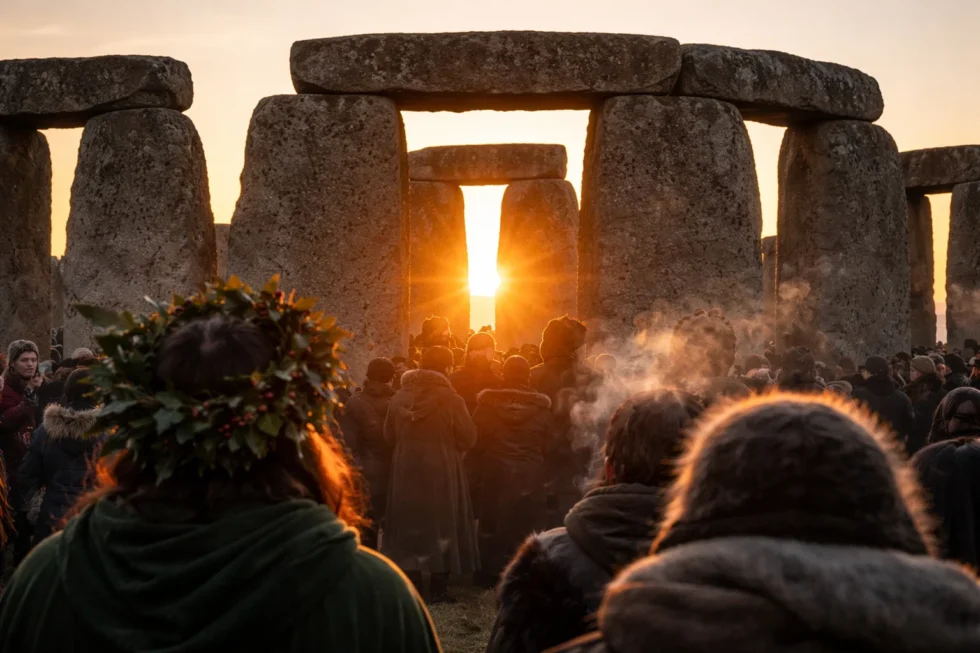
The winter solstice, observed in Britain each year around 21 December as the shortest day and longest night, has been intrinsically linked to Stonehenge since the monument’s earliest construction phases more than 5,000 years ago. Rooted in Neolithic Britain, the midwinter observance is widely understood to have marked survival through the darkest period of the year and the anticipated return of daylight. That tradition was reaffirmed yesterday when thousands gathered at the prehistoric stone circle near Salisbury to witness the solstice alignment. According to the BBC, around 8,500 people were granted controlled access to the site before dawn under special arrangements reports The WP Times.
Although the solstice can occur on either 21 or 22 December, depending on the astronomical year, it is always tied to this narrow mid-December window. In 2025, the precise moment of the solstice occurred on Sunday, 21 December, making yesterday the pivotal turning point after which daylight in Britain begins to increase again, minute by minute.
According to figures cited by the BBC, around 8,500 people were granted controlled access to the Stonehenge site near Salisbury in Wiltshire in the early hours of Sunday morning. Entry was timed to coincide with sunrise, allowing visitors to experience the solstice alignment from within the stone circle — a rare opportunity permitted only twice a year.
Why 21 December is the key date
The winter solstice is defined not by a calendar tradition but by astronomy. It occurs when the Earth’s axial tilt positions the Northern Hemisphere at its greatest angle away from the sun. This produces the least amount of daylight of the year, a phenomenon that has been observed and recorded for thousands of years.
Because the Earth’s orbit is not perfectly aligned with the Gregorian calendar, the solstice does not fall on a fixed weekday. However, it almost always occurs on 21 December, occasionally shifting to the 22nd. What remains constant is its meaning: from this point onward, days grow longer, marking a symbolic transition from darkness towards light.
Why Stonehenge is central to the solstice
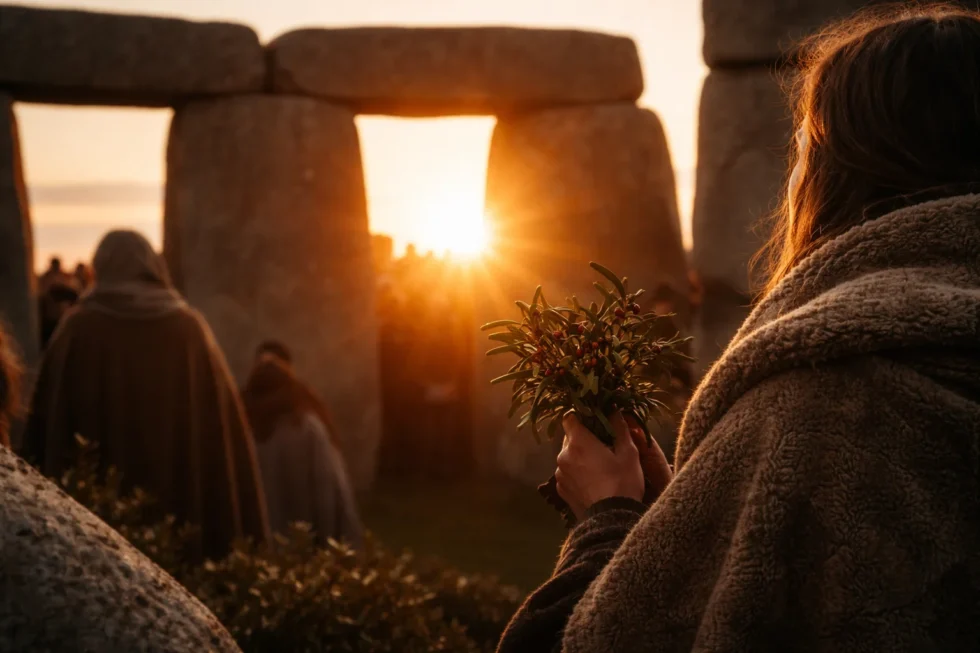
Stonehenge was built in multiple stages beginning around 3000 BC, more than 5,000 years ago, by Neolithic communities with no written language but a highly developed understanding of astronomy. Archaeologists believe the monument was deliberately aligned with the sun’s movements, particularly during the summer and winter solstices.
Unlike the summer solstice, which aligns with sunrise, the winter solstice aligns with sunset, leading many researchers to argue that midwinter was the more significant moment for Stonehenge’s builders. In an agricultural society, surviving the darkest point of the year carried profound social and symbolic importance.
Who organised yesterday’s gathering
The event was organised and overseen by English Heritage, which manages Stonehenge as part of a UNESCO World Heritage Site. English Heritage works in coordination with Wiltshire Police, local authorities, medical teams and conservation specialists to allow limited public access while protecting the monument.
Access to the inner stone circle is granted only on the winter and summer solstices. For the rest of the year, visitors remain on a perimeter path to prevent erosion and long-term damage to the stones and surrounding chalk landscape.
Who attends — and why they come
Yesterday’s crowd included druids and pagan groups who observe the solstice as a spiritual ritual, alongside tourists, photographers, historians and local residents. While motivations vary, many attendees describe the experience as cultural rather than religious — a moment to mark time through nature rather than technology.
English Heritage notes that solstice attendance has increased steadily over the past two decades, reflecting broader public interest in heritage, ritual and shared outdoor experiences.
Why the winter solstice still matters in Britain
In modern Britain, the solstice is not a public holiday and carries no official civic status. Yet it continues to resonate culturally because it represents something universal: the end of diminishing light and the beginning of its return. Cultural historians argue that such moments retain power precisely because they are tied to natural cycles rather than political or religious calendars.
As Britain moves forward from 21 December, daylight will increase by a few minutes each day. For those who gathered at Stonehenge yesterday, the experience was not simply about observing an ancient monument, but about participating — however briefly — in a ritual that has linked people to the rhythm of the natural world for millennia.
Read about the life of Westminster and Pimlico district, London and the world. 24/7 news with fresh and useful updates on culture, business, technology and city life: What is Boxing Day in Britain — how it is celebrated, why it exists, and how London does it differently