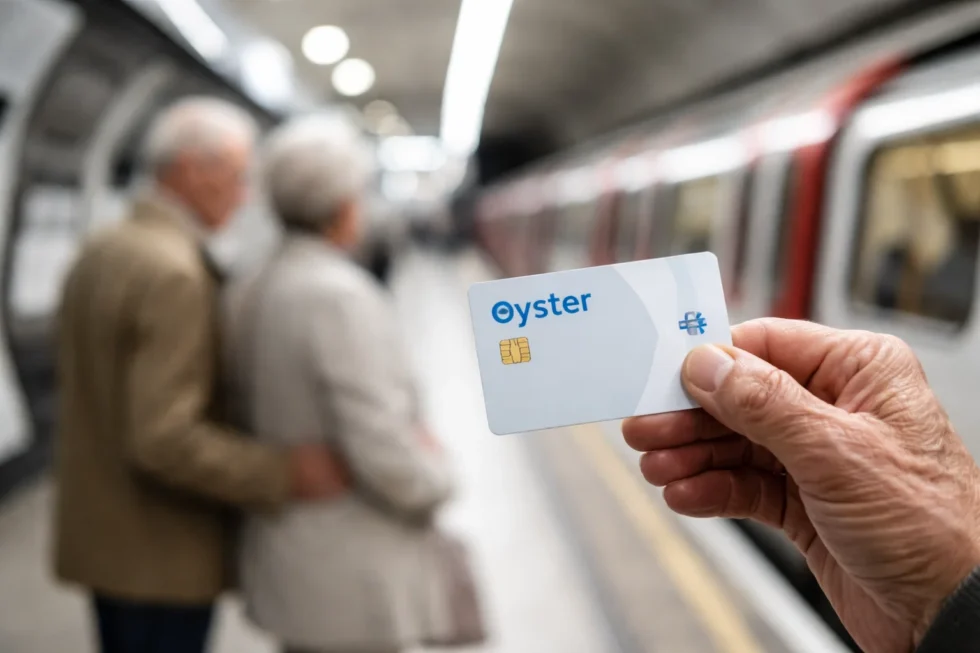
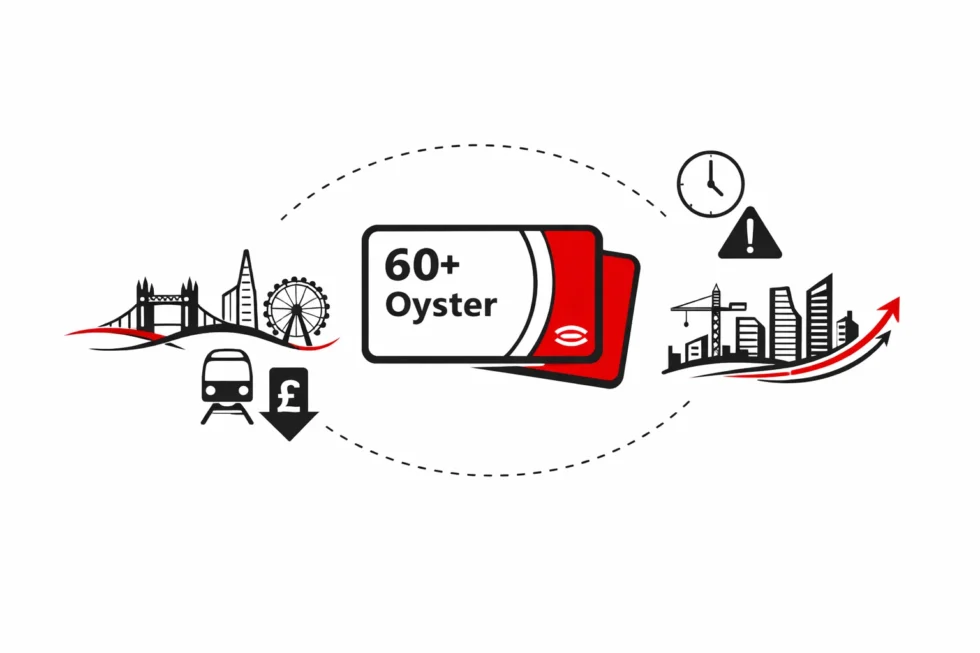
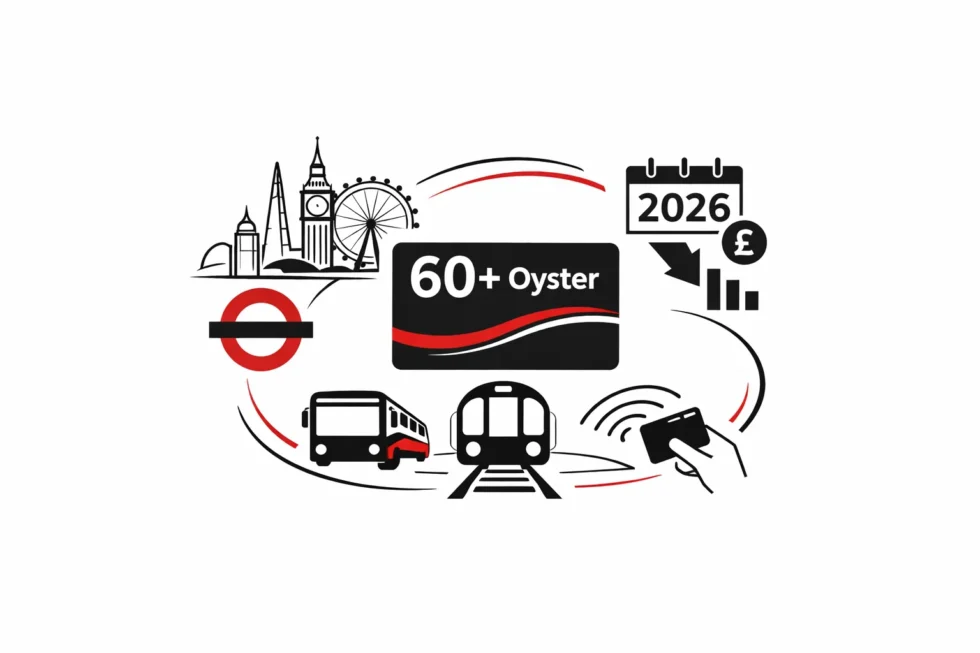
The 60+ Oyster is one of London’s most valuable public benefits, giving residents aged 60 and over free off-peak travel across the TfL network and saving many households more than £2,000 a year — but in 2026 its future has become a central issue in how the capital funds transport as passenger income weakens and the over-60 population grows, The WP Times reports.
The scheme, created to bridge the gap between work and the state-funded Freedom Pass, now sits at the intersection of two structural shifts identified by City Hall and the Department for Transport: a permanent drop in peak-hour commuting since the pandemic and a rapid rise in the number of older Londoners eligible for concessionary travel. TfL still relies on fares for the majority of its operating income, while concessionary journeys are not funded by central government, turning the 60+ Oyster from a social policy into a budgetary pressure point. As a result, officials and policymakers are increasingly treating the card as a test of whether London can maintain generous universal benefits without a new, more stable funding settlement for its transport system.
How the 60+ Oyster scheme works in London
The 60+ Oyster card is a concessionary travel pass issued by Transport for London (TfL) to residents of Greater London aged 60 and over. It was designed to bridge the financial gap between the end of full-time work and eligibility for the state-funded Freedom Pass, in a city with some of Europe’s highest transport costs.
Holders are entitled to free off-peak travel across most of London’s public transport network, including the London Underground, London Overground, DLR, the Elizabeth line, and all buses and trams. On buses and trams, travel is free at any time. On rail services, it applies outside weekday peak periods — before 06:30, between 09:00 and 16:00, and after 19:00 — reflecting TfL’s need to protect capacity and fare income during the busiest hours. Once a cardholder reaches state pension age, the 60+ Oyster is replaced by the Freedom Pass, which provides unrestricted free travel, including during peak hours and on some national rail routes.
What makes the scheme financially exposed in 2026 is how it is funded. Unlike the Freedom Pass, which is backed by legislation and supported by local authorities and central government, the 60+ Oyster is paid for entirely by TfL. Every journey made using the card therefore represents foregone fare revenue in a transport system that still depends on ticket sales for most of its operating income — a vulnerability that has become sharper as passenger numbers remain below pre-pandemic levels.
Why the 60+ Oyster was introduced
The 60+ Oyster was created to address a structural gap in the UK’s labour market and welfare system: the long period between leaving full-time work and qualifying for the state pension. In practice, many people reduce their hours or exit employment in their early 60s, often several years before they become eligible for pensioner benefits. In London, however, their fixed costs — rent, council tax and transport — remain among the highest in Europe. With a monthly travelcard costing between £150 and £300 depending on zones, public transport can become one of the largest household expenses precisely at the point when incomes begin to fall.
Without support, those costs act as a direct barrier to continued participation in work, caring and volunteering. Data from boroughs and transport authorities have consistently shown that transport affordability is a decisive factor in whether older residents remain economically and socially active, particularly in outer London, where daily life is heavily dependent on public transport.
The 60+ Oyster was designed to remove that barrier. By offering free off-peak travel, it allows people in their early 60s to keep working part-time, support family members and maintain social networks instead of being pushed into isolation by the cost of getting around. When the scheme was introduced, it appeared financially sustainable. TfL was expanding, ridership was rising and fare income was growing, allowing the cost of concessionary travel to be absorbed without placing significant strain on the transport system. That financial context has now fundamentally changed.
The scale of the financial exposure
By 2026, the financial environment in which the 60+ Oyster operates has shifted fundamentally. What was once a marginal cost within a growing transport system has become a material liability in one that is no longer expanding.
Concessionary travel for older and disabled passengers now costs Transport for London hundreds of millions of pounds a year. While TfL does not publish a separate line for the 60+ Oyster, its exposure is substantial: eligibility begins at 60, many users retain the card for six to eight years, and a large proportion rely on it for daily travel. In aggregate, that translates into millions of free journeys every month that would otherwise generate fare income.
London is structurally more exposed to this cost than almost any other major European city. Paris, Berlin and Madrid receive long-term operating subsidies from national or regional governments. TfL does not. Instead, it relies on fares for more than 70 per cent of its running costs — one of the highest ratios in global urban transport.
That makes every 60+ Oyster journey not just a social benefit but lost revenue. When passenger numbers were rising, those losses could be absorbed within a growing system. In a network where ridership has stalled and peak demand has collapsed, they cannot.
Since the pandemic, peak-hour commuting — the most profitable segment of TfL’s business — has fallen permanently. The result is that concessionary travel schemes now weigh far more heavily on the network’s finances than they did a decade ago, even though their social rationale has not changed.
Why 2026 is a turning point
This is why the 60+ Oyster has become one of the most sensitive fault lines in London’s transport policy. In 2026 it is no longer simply a social benefit; it has become a live test of whether the capital can continue to fund universal concessions without securing a new, more stable way of paying for its transport system. By 2026, Transport for London is operating in a financial environment fundamentally different from the one in which the 60+ Oyster was created.
TfL now relies on short-term funding settlements negotiated with the Treasury rather than a stable, multi-year subsidy framework. At the same time, its cost base continues to rise — driven by higher staff wages, elevated energy prices, the maintenance of an ageing network and debt repayments from earlier investment. That combination has left the organisation with shrinking financial flexibility just as its underlying costs harden.
London’s demographics are moving in the opposite direction. More than 1.6 million Londoners are already aged 60 or over, and tens of thousands reach that threshold each year. That steadily expands eligibility for the 60+ Oyster at precisely the moment when fare revenues remain structurally below pre-pandemic levels because peak-hour commuting has not returned. The result is a tightening fiscal squeeze: more passengers qualifying for free travel and fewer journeys generating full-fare income.
Legal vulnerability compared with the Freedom Pass
Feature
60+ Oyster
Freedom Pass
Age
60
State pension age
Funding
TfL
Boroughs and central government
Peak-hour travel
Restricted
Full
Statutory protection
None
Yes
The crucial difference is legal. The 60+ Oyster exists at the discretion of TfL and the Mayor of London. The Freedom Pass is protected by national legislation and cannot be removed without parliamentary change. That makes the 60+ Oyster far more exposed to budget pressure and political decisions.
Why 2026 is a turning point
By 2026, Transport for London is operating in a financial environment fundamentally different from the one in which the 60+ Oyster was created. What was once a growing, fare-rich system has become one that survives on negotiated lifelines from the Treasury.
TfL now depends on short-term funding settlements rather than a stable, multi-year subsidy framework. At the same time, its cost base continues to rise — driven by higher staff wages, elevated energy prices, the upkeep of an ageing network and debt repayments from earlier investment. The result is a transport authority with shrinking financial flexibility just as its fixed costs harden.
London’s demographic profile is shifting in the opposite direction. More than 1.6 million Londoners are already aged 60 or over, and tens of thousands cross that threshold every year. That steadily expands eligibility for the 60+ Oyster at precisely the moment when fare revenues remain structurally below pre-pandemic levels because peak-hour commuting has not returned.
The outcome is a tightening fiscal vice: more passengers qualifying for free travel and fewer journeys generating full-price income. This is why the 60+ Oyster has become one of the most sensitive fault lines in London’s transport policy. In 2026 it is no longer simply a social benefit; it is one of the few major concessions that can be altered quickly by City Hall without going through Parliament — turning it into a focal point for budget pressure and political risk.
Stay informed with The WP Times for independent coverage of London, Britain and global affairs as the 7 May 2026 UK elections approach. We report on how power is used across councils, city halls and Parliament so readers can understand what is changing in their communities.