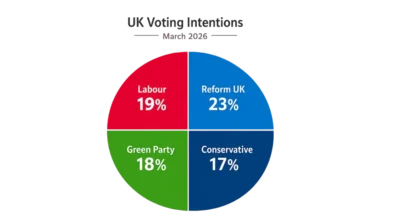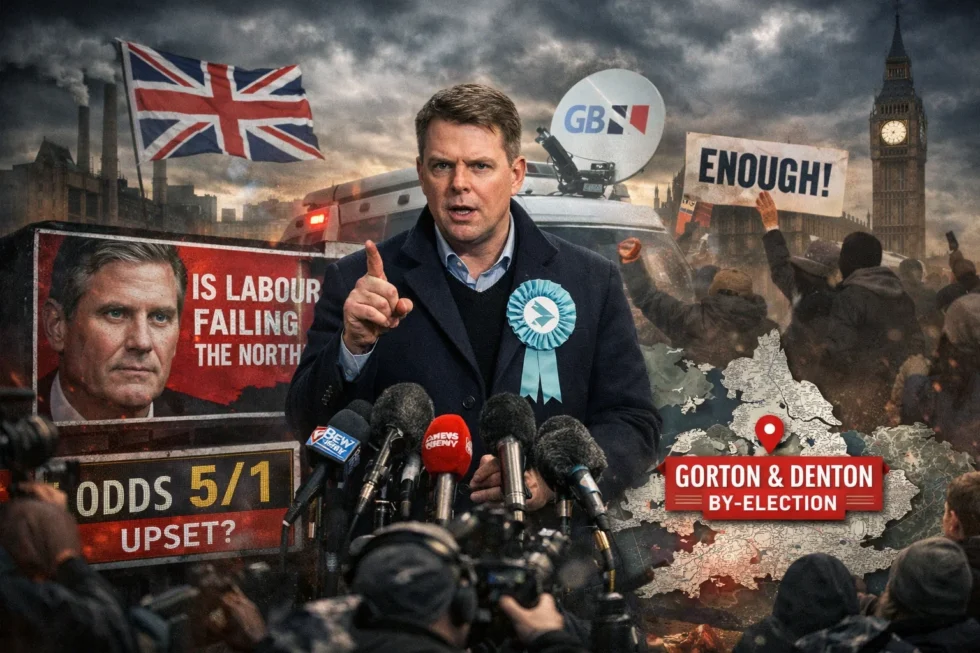
A decision announced in January 2026 has elevated what would normally be a low-profile local contest into a nationally scrutinised political stress test. Reform UK is not simply contesting a parliamentary seat; it is using the Gorton and Denton by-election as a strategic experiment to test whether cultural grievance, media amplification and protest voting can erode Labour’s long-standing dominance in northern urban constituencies, reports The WP Times .
Senior figures within the party have framed the vote as an explicit judgment on Keir Starmer, signalling that the outcome will be read far beyond Greater Manchester. In internal briefings and public statements, Reform UK officials have made clear that even a strong second-place finish would be treated as evidence of political momentum rather than electoral failure.
The choice of Matt Goodwin is central to that strategy. A former academic turned media commentator and broadcaster on GB News, Goodwin brings immediate national name recognition into a contest where turnout is expected to be low and voter engagement uneven. According to recent UK by-election data, turnout in comparable urban seats has typically ranged between 30% and 40%, magnifying the influence of motivated protest voters.
For Reform UK, this marks a clear departure from traditional by-election campaigning. Rather than prioritising locally embedded candidates, the party is increasingly favouring high-profile figures capable of dominating short campaign cycles and shaping national media narratives. Internal party assessments suggest that visibility and message penetration now outweigh constituency-level arithmetic.
As one senior Reform figure told the Financial Times, the objective is “momentum, not marginal arithmetic” — underscoring a strategy focused less on winning the seat outright and more on demonstrating relevance, reach and disruptive potential ahead of the next general election.
Who is Matt Goodwin
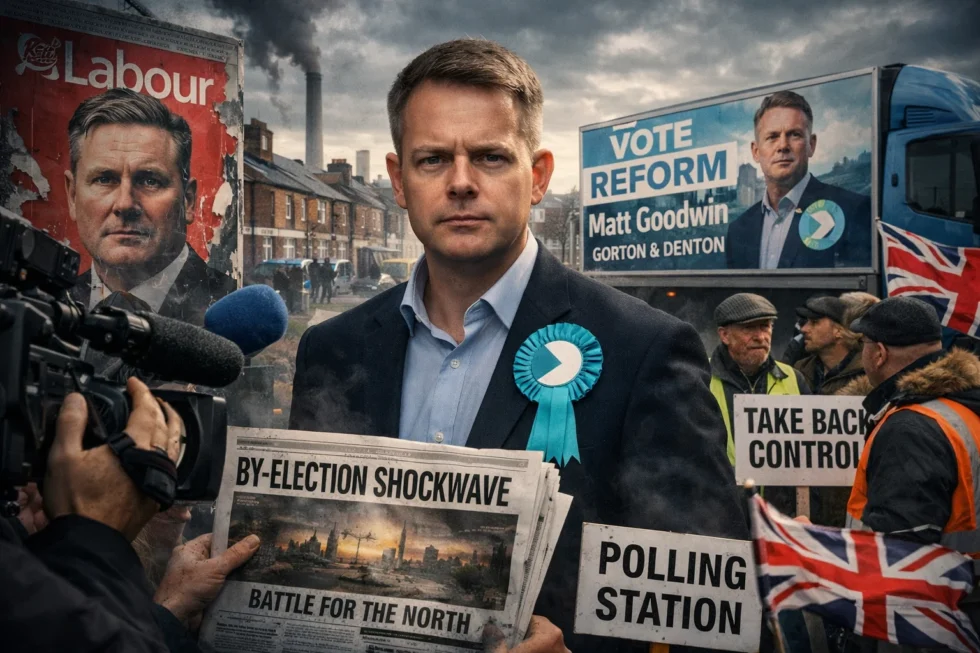
Matt Goodwin is a British political analyst, former academic and media commentator who has spent much of his career studying — and later actively engaging with — right-wing populism in the UK and Europe.
Academic background
Goodwin began his public career as a university academic specialising in British politics, populism and voter behaviour. He held senior academic positions and published research on UKIP, Brexit and political realignment, becoming a frequent source for mainstream media during the post-referendum period.
His work focused on:
- disaffected voters outside metropolitan centres
- cultural identity and national belonging
- declining trust in mainstream political institutions
For years, he positioned himself as an analyst rather than a partisan actor.
Shift from analysis to commentary
Over time, Goodwin moved away from academia into full-time media commentary. He became a regular columnist and television contributor, increasingly framing political developments through a lens critical of Labour, liberal institutions and what he describes as an elite political consensus.
This transition accelerated with his involvement at GB News, where he emerged as one of the channel’s most recognisable political voices, blending analysis with overtly normative arguments about immigration, culture and national identity.
From commentator to candidate
Goodwin’s decision to stand as a Reform UK candidate marks a decisive break from his earlier role as an observer. He is no longer interpreting political change from the outside, but actively attempting to convert the grievances he has long analysed into electoral support.
That move has drawn both criticism and interest:
- supporters argue it reflects intellectual honesty and conviction
- critics say it blurs the line between research, media influence and activism
Either way, his candidacy represents a rare case of a political analyst stepping directly into the electoral arena he once dissected.
Why his background matters
For Reform UK, Goodwin offers:
- instant national name recognition
- media fluency in short, high-conflict campaigns
- credibility with voters who distrust career politicians
For opponents, his background raises questions about:
- the politicisation of academic research
- the role of broadcast media in shaping electoral outcomes
- the normalisation of culture-war framing in by-election politics
In short, Matt Goodwin is not a local organiser or a conventional party figure. He is a candidate shaped by ideas, media and long-running arguments about what Britain is — and who it is for.
Why Gorton and Denton matters to Reform UK
The Gorton and Denton constituency, located in Greater Manchester, has long been treated as reliable Labour territory, shaped by its working-class history, dense urban character and ethnically diverse population. On electoral fundamentals alone, it would not normally be considered hospitable ground for Reform UK. However, party strategists argue that a combination of local and national factors has altered the political terrain enough to justify treating the seat as a strategic test case rather than a conventional target.
One of the most significant local flashpoints has been internal Labour tension surrounding candidate selection and the handling of senior northern figures, including Andy Burnham. While Burnham remains Mayor of Greater Manchester, the episode has fuelled resentment among sections of the local party and trade union base, reinforcing perceptions of top-down control from Labour headquarters.
Turnout dynamics also play a critical role. Recent parliamentary and local by-elections in comparable urban constituencies have seen participation fall well below general election levels, often into the 30–40% range, reducing the influence of traditional party machines and increasing the relative weight of motivated protest voters. Reform UK views low-turnout environments as disproportionately favourable to parties that can mobilise grievance-driven support.
More broadly, the party believes that parts of northern England are increasingly receptive to anti-establishment messaging, particularly where economic frustration intersects with concerns over crime, public services and cultural change. Rather than attracting large numbers of direct defections from Labour to Reform UK, strategists see a growing pool of disengaged or intermittent voters who no longer feel represented by mainstream parties.

Crucially, Reform UK is not measuring success in binary terms. Internal party assessments suggest that a strong vote share — even without winning the seat — would be presented as evidence that Labour’s northern coalition is softening at the edges. As one party strategist put it privately, the aim is “to show that Labour dominance here is conditional, not automatic.” In that sense, Gorton and Denton is less about immediate victory and more about validation.
Reform UK’s campaign message: national themes over local issues
Goodwin’s campaign messaging mirrors Reform UK’s national platform almost entirely, underscoring that this is not a locally tailored operation. Core campaign themes include:
- immigration control and border enforcement
- crime, antisocial behaviour and perceptions of disorder
- pressure on NHS access and public services
- opposition to net-zero policies framed as economically punitive
- rejection of what Reform describes as a “Westminster elite consensus”
At his launch event, Goodwin stated that the by-election should be treated as “a referendum on Keir Starmer and the direction of the country” (Reform UK press statement). Notably absent is detailed constituency-level policy, reinforcing the idea that the campaign is designed to resonate emotionally rather than administratively.
Controversy and identity politics
Goodwin’s candidacy has reignited scrutiny of past remarks in which he argued that British identity encompasses more than formal citizenship. Critics argue that such language risks alienating voters in a constituency with a large minority ethnic population.
Coverage by The Guardian has highlighted concerns that Reform UK is deliberately provoking cultural confrontation to drive turnout among sympathetic voters. When pressed during the campaign, Goodwin declined to restate or withdraw earlier comments, instead pivoting toward economic insecurity and public safety. Reform UK officials counter that the backlash itself illustrates unresolved cultural tensions ignored by mainstream parties.
How Labour and other parties are responding
Privately, Labour strategists concede that the Gorton and Denton contest is more volatile than previous by-elections in comparable seats. While the Labour Party remains the clear favourite on paper, internal assessments suggest the primary risks lie not in large-scale vote switching, but in voter behaviour at the margins.
Officials are particularly concerned about:
- turnout erosion among Labour-leaning voters
- protest abstention driven by dissatisfaction with national leadership
- fragmentation of the progressive vote
The presence of multiple challengers further complicates the arithmetic. Both the Green Party and the Liberal Democrats are expected to field candidates, increasing the likelihood that Reform UK could secure a strong second-place finish without coming close to winning the seat outright.
Wider political implications

Political analysts increasingly view the Gorton and Denton by-election as a test case for several structural shifts shaping British politics in 2026.
A strong performance would reinforce claims that Reform UK has overtaken the Conservative Party as the principal vehicle for protest voting on the right. For Labour, any underperformance would sharpen scrutiny of Keir Starmer’s leadership and the resilience of the party’s northern coalition. Success would also validate Reform UK’s emerging preference for high-profile, media-trained candidates over locally embedded organisers. As one senior pollster told YouGov, the campaign is “about proving relevance, not simply winning seats”.
Key facts: Gorton and Denton by-election
| Category | Detail |
|---|---|
| Constituency | Gorton and Denton |
| Region | Greater Manchester |
| Reform UK candidate | Matt Goodwin |
| Election type | Parliamentary by-election |
| Strategic narrative | Referendum on Labour leadership |
| National significance | Test of Reform UK’s growth model |
By selecting Matt Goodwin, Reform UK has signalled a clear departure from conventional by-election campaigning. Whether that approach translates into votes remains uncertain. What is already clear is that the Gorton and Denton by-election is being treated as a proxy test of voter volatility, leadership authority and the resilience of traditional political loyalties at a moment of growing fragmentation in British politics in early 2026.
Read about the life of Westminster and Pimlico district, London and the world. 24/7 news with fresh and useful updates on culture, business, technology and city life: How to vote in Westminster London local elections 2026: deadlines and voter ID rules – full guide UK
Source: during preparation, materials from The Guardian, BBC News, Financial Times, YouGov were used.