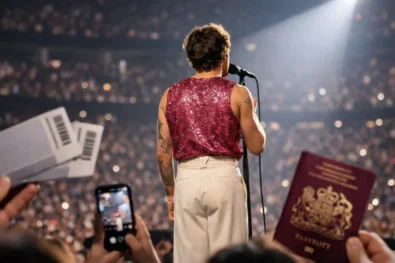
This week, Harry Styles announced a record-breaking 12-date residency at Wembley Stadium, a decision that has once again brought Britain’s live music economy under scrutiny. While framed as a milestone in modern touring, the move has reignited a long-standing debate over who stadium concerts are really for, amid growing concerns about affordability, access and the widening gap between large-scale spectacle and everyday audiences. This is reported by The WP Times the editorial team, citing recent reporting and commentary by BBC News and The Guardian.
The price of access
Official ticket listings reveal a pricing structure that many fans and industry observers describe as prohibitive rather than progressive. Seats in the upper tiers start at £44.10, while standard general standing tickets are priced at £144.65. Premium standing areas rise to £279.45, with top-priced seats reaching £466.24.
Access to presale tickets was limited to American Express cardholders and to fans who pre-ordered Styles’ forthcoming album, Kiss All the Time. Disco, Occasionally, scheduled for release on 6 March. While tiered pricing has long been a feature of stadium shows, criticism has focused on the growing gap between entry-level access and the core live experience.
For a fanbase that includes large numbers of teenagers and young adults, the structure is widely seen as favouring financial capacity over long-term loyalty. The backlash has been intensified by the broader cost of attending stadium concerts, as travel and accommodation expenses increasingly exceed the price of the ticket itself, particularly for fans travelling from outside London or from overseas.
A wider industry consequence
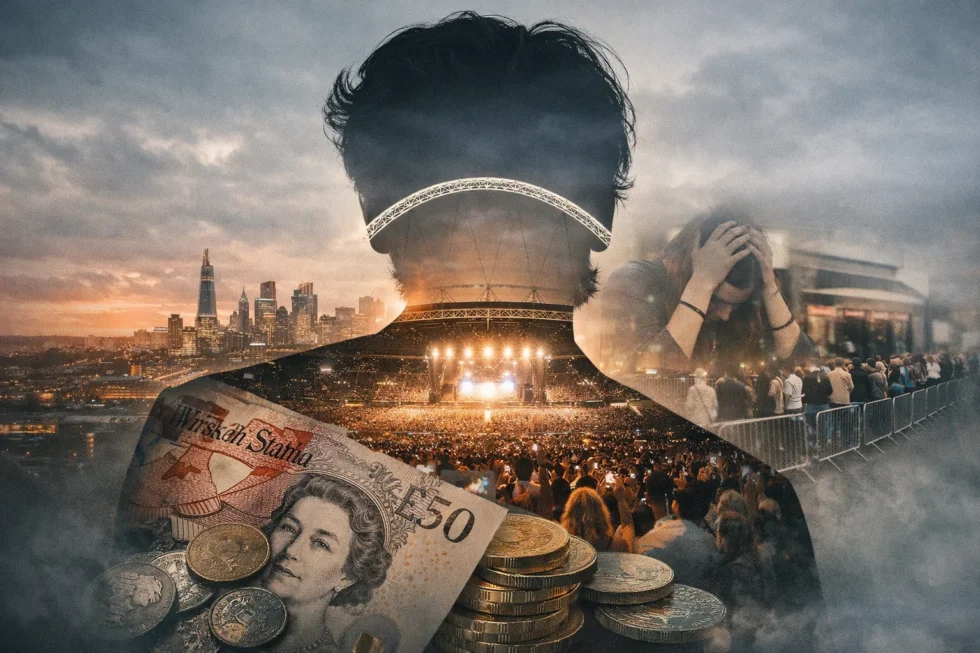
Styles is not an outlier, but part of a broader pattern across the live music sector. Adele, Taylor Swift and Oasis have all faced sustained scrutiny over ticket pricing in recent years, particularly where dynamic pricing has blurred the meaning of face value. While the UK government moved in November 2025 to ban ticket resale above face value, and the Competition and Markets Authority tightened oversight of platforms such as Ticketmaster, these measures have largely addressed secondary market abuse rather than the underlying issue of rising base prices.
The effects extend well beyond stadiums. Data from Music Venue Trust shows that one in six small UK venues closed in 2023, and that more than half of those remaining failed to turn a profit in 2025. Industry figures, including MVT chief executive Mark Davyd, have warned that when fans spend £150–£200 on a single stadium ticket, discretionary spending on grassroots shows inevitably falls, narrowing the pipeline for emerging artists and reducing opportunities for new talent to develop.
In this context, Wembley has become less a venue than a symbol — of an industry increasingly shaped by concentration, scale and financial extraction. Harry Styles did not create this system. But as one of the few artists with the power to set different terms, his choices now resonate far beyond the stadium gates, raising difficult questions about sustainability, access and the future balance of Britain’s live music economy.
Read about the life of Westminster and Pimlico district, London and the world. 24/7 news with fresh and useful updates on culture, business, technology and city life: Which erotic exhibitions will define 2026 — from London and Berlin to New York and Scandinavia