Vladimir premieres globally on 5 March 2026 on Netflix, with all eight episodes released simultaneously, marking it as one of the platform’s most deliberately positioned drama launches of the year. By opting for a full-series drop, Netflix places Vladimir squarely within its spring prestige window — a slot traditionally reserved for psychologically driven, awards-facing productions rather than fast-consumption genre titles.

The strategy reflects Netflix’s growing reliance on literary adaptations and adult-led narratives to anchor its cultural relevance beyond opening-week metrics. Rather than chasing immediate viewing spikes, Vladimir is positioned as a slow-burn release designed to unfold over time, encouraging sustained critical engagement and long-form discussion. The approach aligns with Netflix’s recent emphasis on character-led drama aimed at mature audiences, reports The WP Times..
What Vladimir is about — and why it resists easy categorisation
Set on a quiet American liberal arts campus, Vladimir follows an unnamed middle-aged professor whose outwardly ordered life begins to fracture. She is professionally accomplished, intellectually respected, married, and a mother — a collection of roles that suggest stability while masking a deep emotional stasis. The arrival of a younger colleague, Vladimir, triggers not an affair in the conventional sense, but a gradual internal shift. Curiosity hardens into fixation, and admiration into fantasy. Crucially, the series avoids the mechanics of scandal. There is no inciting incident designed to shock. Instead, tension accumulates through thought, self-justification and unspoken desire. That distinction is central to the show’s identity. Unlike workplace thrillers or erotic dramas that externalise conflict early, Vladimir treats obsession as a private, interior process long before it risks becoming visible to others.
Rachel Weisz and the anatomy of interior collapse
At 55, Rachel Weisz delivers one of her most inward-facing performances in recent years. Her character frequently breaks the fourth wall, addressing the camera directly to expose the fractures between language, thought and impulse.
This technique is not stylistic ornament. It allows the series to dramatise contradiction: what the character presents to the world versus what she privately rehearses. The result is a form of controlled intimacy that implicates the viewer, drawing them into her reasoning even as its instability becomes apparent. Weisz has described the role as exploring “the loss of relevance without the loss of intelligence” — a tension that gives the series much of its psychological gravity.
Leo Woodall’s Vladimir: presence without access
Leo Woodall, 29, plays Vladimir with notable restraint. Familiar to Netflix audiences from One Day and the latest Bridget Jones film, Woodall here avoids reassurance through charm. His performance is controlled, observational and deliberately opaque.
The series withholds Vladimir’s interior life almost entirely. Everything we learn about him is filtered through the professor’s perception, creating a sustained ambiguity: is he consciously seductive, passively responsive, or simply the focal point of her projection? That absence of authorial guidance intensifies the drama. The uncertainty is not a flaw to be resolved, but the engine of the series’ psychological tension.
From novel to screen: reframing obsession
Vladimir is adapted from Julia May Jonas’s acclaimed novel, with Jonas retaining unusually close creative control as creator, lead writer and executive producer. That continuity matters. Rather than softening or broadening the book’s interior perspective for television, the series preserves its most destabilising quality: a narrative anchored almost entirely within the consciousness of its protagonist.
The title Vladimir is a deliberate structural inversion. In literary and screen traditions, stories of obsession are typically named after the woman being desired, positioning her as object rather than author of longing. Here, the name belongs to the man, while narrative authority remains firmly with the woman who desires him. The shift is subtle but consequential: the series is less concerned with who Vladimir is than with what he comes to represent. Jonas has been explicit that the adaptation resists moral framing. Vladimir neither condemns nor redeems its central fixation. Instead, it examines obsession as a psychological instrument — a fantasy space in which agency, desirability and coherence can be temporarily reclaimed when a carefully constructed identity begins to fail. Desire, in this telling, is not a transgression but a symptom.
Tone, structure and what the trailer signals
The official trailer, released in February, signals the series’ priorities with unusual clarity. Plot is secondary; atmosphere is not. Short, discontinuous scenes are intercut with extended silences and abrupt shifts between imagined and real encounters, creating a sense of narrative slippage rather than forward motion. There is little effort to orient the viewer in time or motivation. That absence is deliberate. The series mirrors the protagonist’s internal disarray by denying the audience the comfort of clear narrative markers. What matters is not what happens, but how perception begins to distort.
Netflix has described Vladimir as “darkly funny”, though the humour is austere and inward-facing. It surfaces through self-awareness rather than dialogue, often exposing the gap between what the protagonist recognises intellectually and what she is unable to relinquish emotionally. Structurally, the series favours accumulation over catharsis: each episode tightens the psychological frame, while resolution is postponed, and possibly withheld.
Supporting cast and creative direction
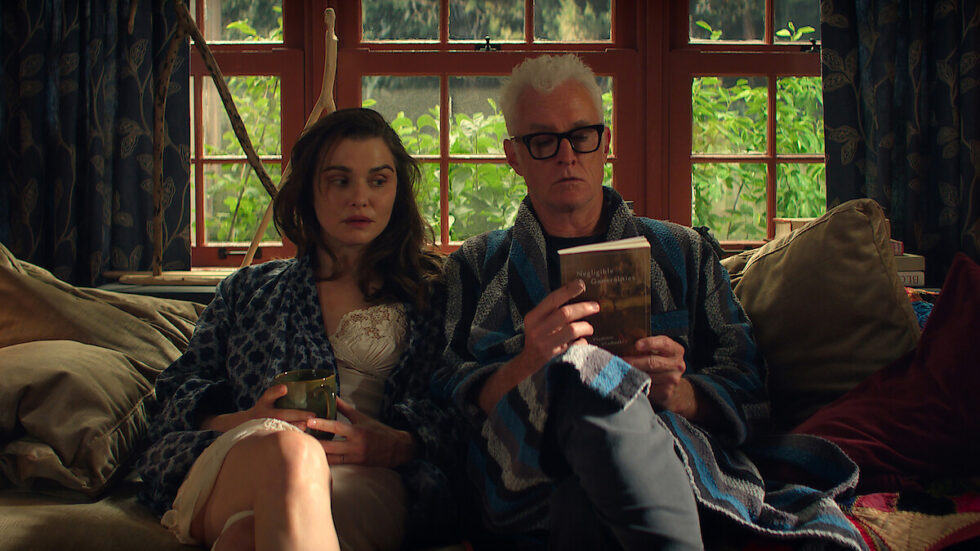
Alongside Rachel Weisz and Leo Woodall, the supporting cast includes John Slattery as the professor’s husband, a role defined by quiet emotional displacement rather than overt conflict. Jessica Henwick, Ellen Robertson, Kayli Carter and Miriam Silverman populate the academic and domestic spaces around the central figure, each reinforcing the social normality against which the protagonist’s interior rupture is measured.
Directorial duties are led by Shari Springer Berman and Robert Pulcini, whose work consistently prioritises psychological texture over narrative spectacle. Their approach in Vladimir is restrained and observational, allowing performance and rhythm to carry meaning. The series is produced by 20th Television, continuing Netflix’s strategy of pairing literary adaptations with filmmakers accustomed to character-driven, independent storytelling rather than conventional episodic escalation.
Why Vladimir matters in 2026 for Netflix and prestige television
Vladimir arrives at a moment when prestige television is shifting decisively away from spectacle and external shocks towards interior experience, psychological erosion and questions of identity. In an environment saturated with high-concept thrillers and algorithm-driven pacing, the series deliberately slows the frame, insisting on attention to thought rather than event.
It speaks directly to contemporary anxieties around ageing, relevance and power — particularly for women in intellectual, academic and cultural professions, where authority and accomplishment do not necessarily protect against gradual invisibility. Vladimir interrogates what happens when professional legitimacy remains intact, but emotional recognition begins to fail.
Crucially, the series refuses the binary moral logic that often governs stories of desire. It does not ask whether the central fixation is justified or transgressive. Instead, it poses a more unsettling question: what happens when fantasy becomes the only remaining space in which a person experiences agency, desirability and psychological coherence?That reframing places Vladimir firmly outside scandal-driven drama. What emerges instead is a sustained psychological study — one that rewards careful viewing, resists instant judgement, and invites extended discussion about power, ageing and interior freedom in contemporary life.
How to watch
- Platform: Netflix
- Global release: 5 March 2026
- Episodes: 8
- Release model: All episodes available on launch day
For viewers drawn to slow-burn, adult drama that prioritises psychological depth over narrative shock, Vladimir stands as one of Netflix’s most serious and considered releases of the year. Read about the life of Westminster and Pimlico district, London and the world. 24/7 news with fresh and useful updates on culture, business, technology and city life: Wuthering Heights Review: Margot Robbie, Jacob Elordi in Emerald Fennell Adaptation
Photo Netflix